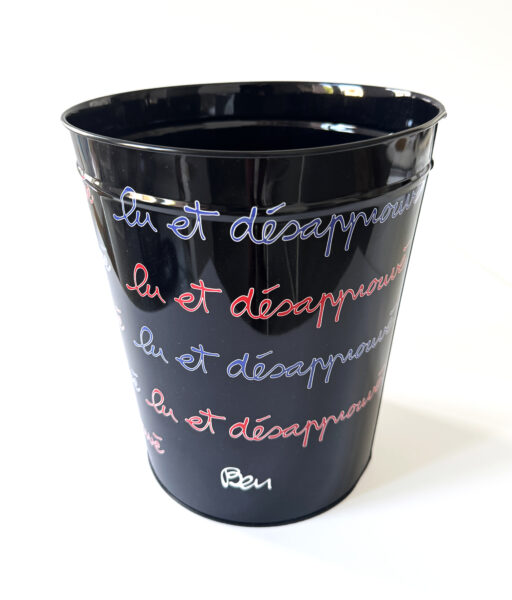
BEN VAUTIER, Lu et désapprouvé, 2019
26 x 22,5 x 22,5 cm
tin metal, text, waste paper basket
mint, unused with several tiny production dents at bottom very rare
published by Quo Vadis, France
€ 265,- plus € 24,- Track & Trace registered EU mail
inv.BVau 000-pr
The Situationist Times, nr. 6, 1967
27,4 x 21,5 cm
edition 2000 + 500 HC
litho prints from 33 artists
inlay as colophon pristine
published by Jacqueline de Jong, Paris, France
€ 395,- plus € 12,- Track & Trace registered EU mail
inv.TST 000-pr
The Situationist Times, no 6 is a compilation of 32 original lithographies printed in four colours. Participating Jan Voss, Jack Vanarsky, Topor, René Bertholo, Guido Blasi, Samuel Buri, Lourdes Castro, Maurice Henry, Martin Engelman, José Gamarra, Klaus Geissler, Theo Gerber, Reinhoud d’Haese, Hannelore, Peter Klasen, Jacqueline de Jong, Mariano Hernandez, Wifredo Lam, Yasse Tabuchi, Paul de Lussanet, Milvia Maglione, Christina Martinez, Roberto Matta, Lucio del Pezzo, Hannes Postma, Lea Lublin, Alejandro Marcos, Antonio Segui, Antonio Saura, Pierre Alechinsky, Asger Jorn, Arne Haugen-Soerensen and couver on the back is the 33rd lithograph at the back is of Ulf Trotzig.
History of prices:
Concept Books, Veldhoven, Netherlands June 2026 US$ 478.-
Antiquariat CoBrA, Oberrohrbach, Germany June 2026 US$ 735.-
p015, Rotterdam, Netherlands June 2026 US$ 358.- (poor)
WALTER VAN BEIRENDONCK, Wonder News, issue number 1, 1998
29,7 x 21 cm (unfolded 29,7 x 105 cm)
4x fold print, business card, 4 slides in sleeve, 2 A4 papers
8 parts
condition pristine extremely rare
published by Walter van Beirendonck, Antwerp, Belgium
€ 320,- plus € 12,- Track & Trace registered EU mail
inv.WvB 000-pr
The Situationist Times, nr. 4 (1963), nr. 5 (1964) and nr. 6 (1967)
many signatures in print, dated
edition successively 2000, 1600 and 2000 + 500 HC
condition: excellent, aged, nr. 6 (incl. inlay as colophon) is pristine
including numurous lithographs by Corneille, Karel Appel, Constant Jan Nieuwenhuys, a.o.
inv.Refl 000-pr
On 16 July 1948 the Experimentele Groep was founded by Karel Appel, Corneille, Theo Wolvecamp, Constant, Jan Nieuwehuys, Anton Rooskens and Eugene Brands. Later on this group became known as the Dutch hard core of the international Cobra movement. The artists closely co-operated with experimental groups a.o. from Paris, Copenhagen, Brussels.
Asger Jorn introduced Jacqueline de Jong to Gruppe Spur, the German branch of the radical left-wing movement Situationist International. After Guy Debord expelled her from the movement in 1962, she founded her own magazine: The Situationist Times. The publication followed the critical principles that formed the basis of the Situationist International.
In The Situationist Times nr 1 Constant wrote a manifest explaining the goals of the Experimentele Groep in The Netherlands.
TAMÁS St. TURBA, NETRAF, 2026
size needed
print for free use
published by the non-art-artist
ask for deatils
Tamás St. Turba, also known as Tamás St. Auby, Tamás Szentjóby, Staub, Stjóby, Stauby, Emmy/Emily Grant, St. Aubsky, T. Taub, St. Ruby, etc. began a non-art-art activity as soon as he ended his art activities in 1966. From that period on, he created an extensive oeuvre made up of actions, happenings, objects, concrete/visual/action-poems, images, compositions, sculptures, photos, videos, mail art and email art. Disseminating happenings and Fluxus ideas he deems himself a Neo-Socialist Realist.
The protests and art activities of Tamás St. Turba – aka Tamás St. Auby – in the late 50’s were heavily embedded in the shadow of the Sovjet umbrella. He became familiar with the ideas of Dada and the later Fluxus movement, and thus found his allies. ‘In the mid-’60s, the idea of Joseph Beuys, George Maciunas, and others about “everybody is an artist” proved to me that I’m not alone at the grassroots level. This conviction was in organic symbiosis with socialist/communist ideology, so I propagated Fluxus as Neo-Socialist-Realism, and established the International Parallel Union of Telecommunications (IPUT) in 1966, a Big Sister institution to counterbalance the power of the International Telecommunication Union, which controls the totality of the electromagnetic spectrum deeply into interstellar space as well.’ Interview with Jon Hendricks in MoMA Post notes on Art, 19 December 2018
In 1969, he organized the first Fluxus concert in Budapest. His work often challenged political and social norms, leading to his expulsion from Hungary in 1975. He settled in Switzerland and returned to Hungary in 1991.
In 2004, Tamás St. Auby showed several works in a group exhibition ‘Freedom Borders’ in Galerie van Gelder. During the installation he told me his view on the Hungarian society. Once back in his country after his exile, he discovered that although the political leaders from the communist era had been removed from their positions, the elite in the lower echelons (with their more than dubious or corrupt Stasi behavior in the past) had once again secured influential positions. To this day, he challenges unstoppable political and social norms in Hungary.
CLAUDE RUTAULT, invitation card, 1997
10,5 x 15 cm
offset, card
condition: splendid
published by Galerie Martine et Thibault de la Châtre, Paris, France
€ 80,- plus € 15,- Track & Trace registered EU mail
inv.CRu 1013-pr
HEIMO ZOBERNIG, Untitled, 1992
29,7 x 21 x 4 cm
dispersion paint, pressboard, hinges, + cotton gloves as published
edition 35
signed, dated, numbered
condition: mint very rare
published by Pinguin Editions/Caroline Nathusius, Cologne, Germany
€ 850,- plus € 32,- Track & trace registered EU mail
inv.HZob 1022-pr
DOMINIK STEIGER, Low Nose, 1979
7 x 11 x 1,7 cm,
cassette, tape, ink stamp ‘Buchdienst Fesch-Wien’
edition 40, here number 13/40
signed, dated, numbered
published by Buchdienst Fesch, Vienna, Austria
€ 85,- plus € 15,- Track & Trace registered EU mail
inv.DSte 1008-pr
In 1976, Dominik Steiger published quarterly magazine NERVENKRITIK under the name Buchdienst Fesch. Each issue (ca 20 pages) featured illustrations and text by fellow artists. The cover of the 250-copy print run displayed an enlarged so-called “Bone drawing” (Knöchelchen-Zeichnung] of Dominik Steiger. It functioned as a logo that is also depicted here on the cassette label of Low Nose.
Additional information
Below a couver of magazine Nervenkritik featuring one of his Bone drawings:
YINKA SHONIBARE, Flower Head, 2006
19,4 x 15 cm
print, ink stamped
hand numbered, edition 3000, here number 390/3000 extremely rare
published by Contemporary, London, United Kingdom
inv.YSh 490-pr
Subscribers of British art magazine Contemporary got this print for free.
MIKE KELLEY, Destroy All Monsters Magazine, 2011
together with CARY LOREN, NIAGARA and JIM SHAW
27 x 21 cm
artist’s book, SC, 270 pp.
signed
special edition 100, here numbered 2/100 includes a unique monotype-spray painted page, signed by 4 artists
black and white photograph (signed photo edition number 46/75) by Cary Loren, sealed bag with sand, original mylar envelope mint
published by Destroy All Monsters magazine, Detroit, USA
€ 980,- plus € 24, – Track & Trace registered EU mail
inv.MKel 000-pr
‘Formed in 1973, the Detroit band Destroy All Monsters was a wild and reckless synthesis of psychedelia, proto-punk, heavy metal, noise and performance art. The collective hailed from Ann Arbor, Michigan, and consisted of Cary Loren, Mike Kelley, Niagara and Jim Shaw (with later members including Ron Asheton of the Stooges and Michael Davis of the MC5). Later emerging as extremely distinctive individual artists, collectively the group forged new terrain in art, music, performance, theater and video. Destroy All Monsters released very little recorded music until Thurston Moore issued a three-CD compilation in 1994, but they published six issues of a now legendary and much sought-after zine, also titled Destroy All Monsters. This publication collects those six zines, released between 1976 and 1979, and also includes parts of a lost seventh issue that never saw publication. The Destroy All Monsters zines comprise a vibrant array of collage, writing, photography and other miscellanea by Kelley, Loren, Niagara and Shaw, and together provide insight into the collective’s kaleidoscopic vision of the dystopian values of their time.
“The new reprint volume lacks any introductory or explanatory text; true to Destroy All Monsters’ anarchic spirit, it plunges the reader straight into a frenzied dystopic world. Détourned comic strips, images pulled from pulp magazines, film stills, and tabloid news clippings clash with saccharine greeting cards, family Polaroids, and children’s coloring-book pages, while Op-art backgrounds, scrawled doodles, stickers, and rubber stamps compound the visual pandemonium. All of this is faithfully reproduced in the new facsimile, which is hand-bound and printed on paper of different weights, colors, and finishes—from coated stock to copy paper in elementary-school pastels. Each copy also includes a unique original spray painting by Loren, giving this lavish reproduction an authentically DIY accent.” Gwen Allen, Bookforum review
Ref. https://www.thebookbeat.com/bookshop/catalog/destroy-all-monsters-magazine/
In 1974, while attending the University of Michigan, he co-founded the proto-punk, experimental noise band Destroy All Monsters (DAM). The member of the band were: Mike Kelley on drums and vocals, Jim Shaw on vocals and squeeze toys, Niagara (Lynn Rovner) on vocals, and Cary Loren on guitar and vocals. Having met each other at the university, DAM convened in the basement of Kelley’s student accommodation, also known as ‘God’s Oasis Drive-In Church’, which soon became a communal space for the band to collaborate. Image below shows dirt in a tiny bag from ‘God’s Oasis Drive-In Church’, being part to this edition.