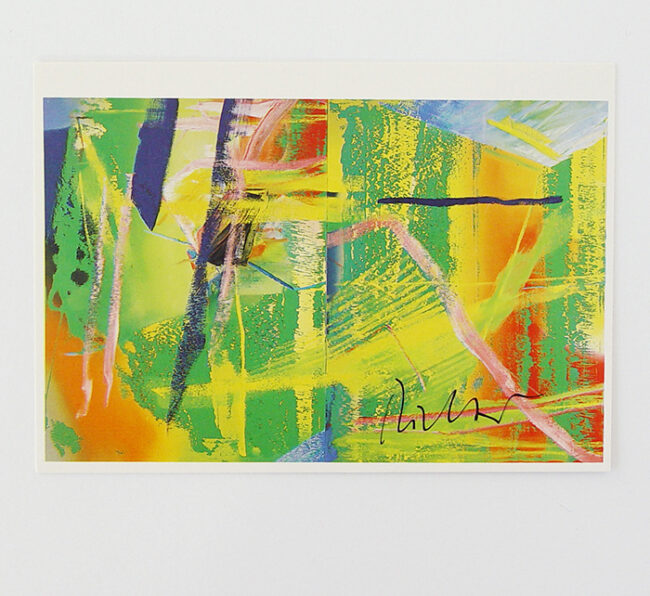
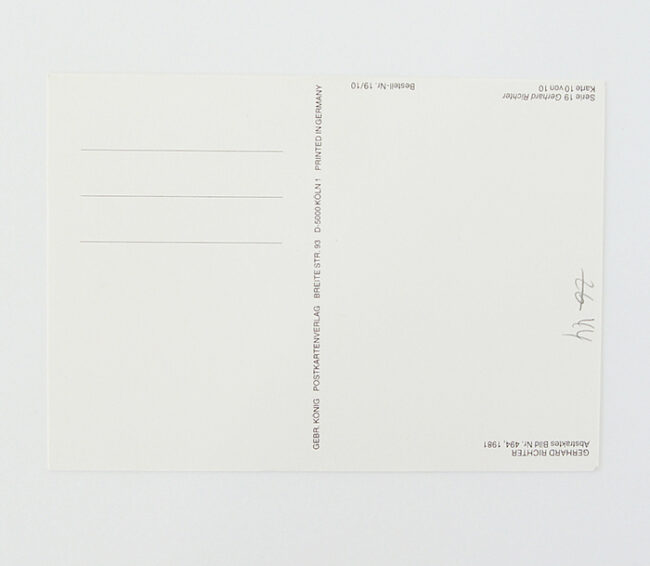
GERHARD RICHTER, Abstraktes Bild Nr. 494, 1981
10,5 x 14,8 cm
postcard, offset
signed
condition: splendid
published by Gebr. Koenig, Cologne, Germany
inv.GRic 0000-pr
Added information
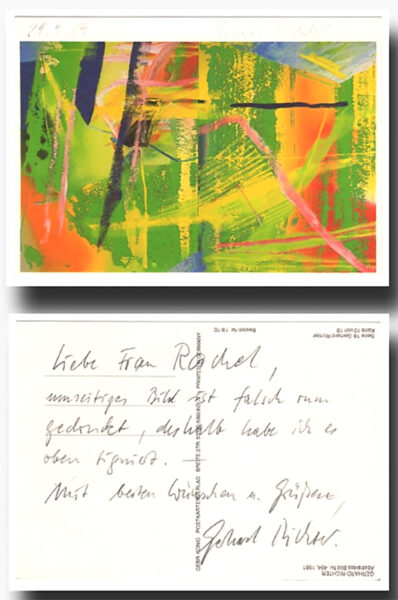
Gerhard Richter has signed this postcard more than once over the past decades. Around 2000, he wrote that the reproduction on the card has been printed upside down. The card reads: ‘Liebe Frau Rachel, umseitiges Bild ist falsch um gedruckt, deshalb habe Ich es oben signiert. Mit besten Wünschen u. Grüßen, Gerhard Richter.’
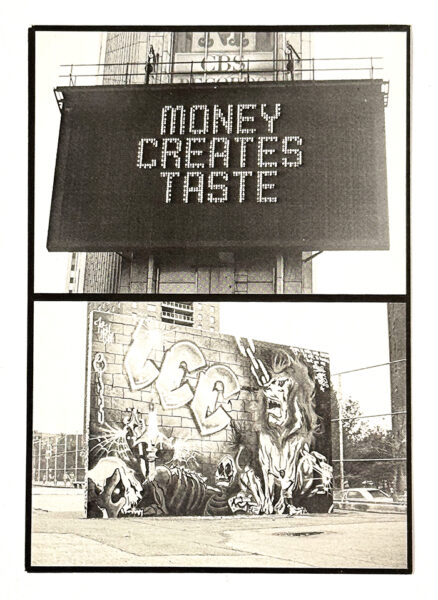
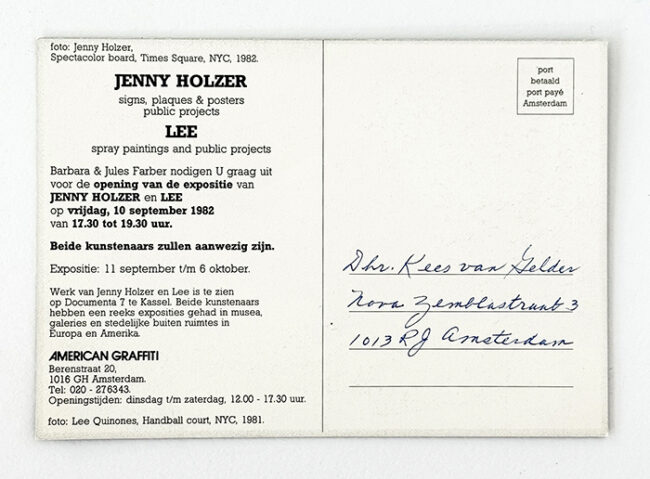
JENNY HOLZER – LEE QUINONES, 1982
15,1 x 10,6 cm
invitation card, offset rare
publshed by American Graffitti, Amsterdam
€ 195,- plus € 12,- Track & Trace registered EU mail
inv.JHol 1070-pr
Barbara Farber and her husband Jules Farber decided to start a gallery in 1979, after Barbara finished a period of successful designs of children’s clothing. Well-known artists from both US and Europe had shows in American Graffitti in Berenstraat, Amstedam.
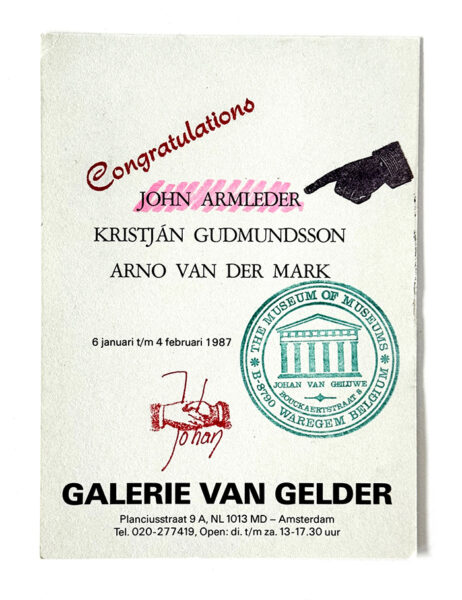
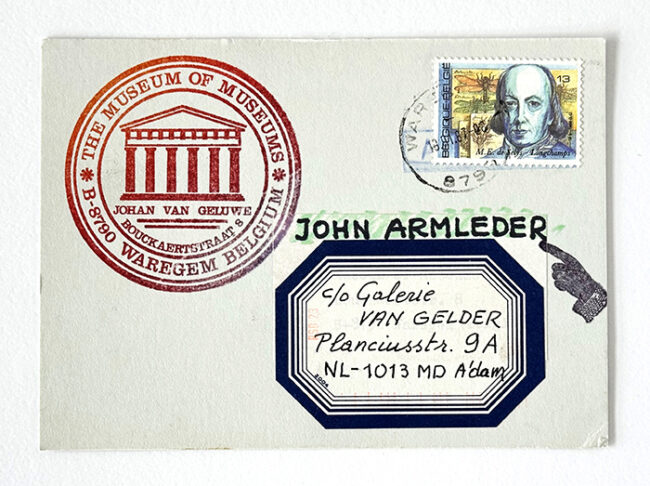
JOHAN VAN GELUWE: exhibition card, 1987
14,5 x 10,5 cm
6 ink stamps on card, felt pen ink, sticker
unique
€ 95,- plus € 15,- Track & Trace registered EU mail
inv.JvG 1068-pr
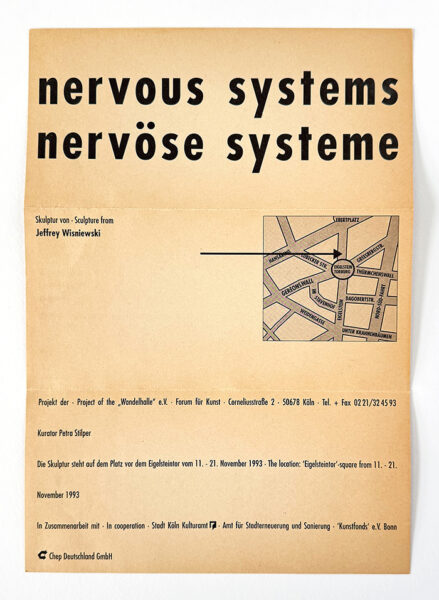
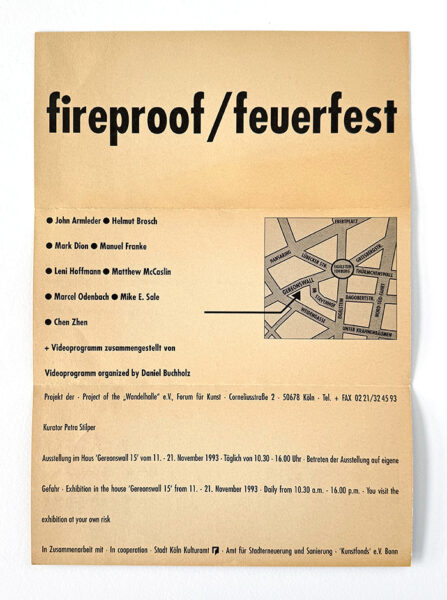
JOHN ARMLEDER, Fireproof-Feuerfest, 1993
announcement recto-verso
29,6 x 20,9 cm
offset on thin paper
condition excellent, although obviously aged extremely rare
published by Forum für Kunst, Cologne, Germany
€ 160,- plus € 15,- Track & Trace registered EU mail
inv.JMA 000-pr
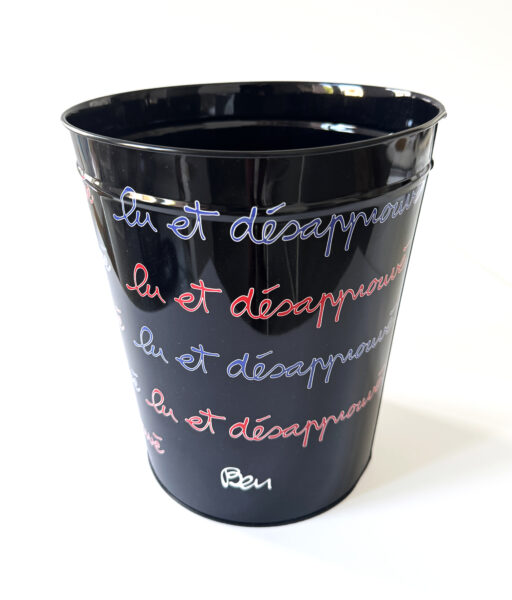
BEN VAUTIER, Lu et désapprouvé, 2019
26 x 22,5 x 22,5 cm
tin metal, text, waste paper basket
mint, unused with several tiny production dents at bottom very rare
published by Quo Vadis, France
€ 265,- plus € 24,- Track & Trace registered EU mail
inv.YKu 000-pr
The Situationist Times, nr. 6, 1967
27,4 x 21,5 cm
edition 2000 + 500 HC
litho prints from 33 artists
inlay as colophon pristine
published by Jacqueline de Jong, Paris, France
€ 395,- plus € 12,- Track & Trace registered EU mail
inv.TST 000-pr
The Situationist Times, no 6 is a compilation of 32 original lithographies printed in four colours. Participating Jan Voss, Jack Vanarsky, Topor, René Bertholo, Guido Blasi, Samuel Buri, Lourdes Castro, Maurice Henry, Martin Engelman, José Gamarra, Klaus Geissler, Theo Gerber, Reinhoud d’Haese, Hannelore, Peter Klasen, Jacqueline de Jong, Mariano Hernandez, Wifredo Lam, Yasse Tabuchi, Paul de Lussanet, Milvia Maglione, Christina Martinez, Roberto Matta, Lucio del Pezzo, Hannes Postma, Lea Lublin, Alejandro Marcos, Antonio Segui, Antonio Saura, Pierre Alechinsky, Asger Jorn, Arne Haugen-Soerensen and couver on the back is the 33rd lithograph at the back is of Ulf Trotzig.
History of prices:
Concept Books, Veldhoven, Netherlands June 2026 US$ 478.-
Antiquariat CoBrA, Oberrohrbach, Germany June 2026 US$ 735.-
p015, Rotterdam, Netherlands June 2026 US$ 358.- (poor)
WALTER VAN BEIRENDONCK, Wonder News, issue number 1, 1998
29,7 x 21 cm (unfolded 29,7 x 105 cm)
4x fold print, business card, 4 slides in sleeve, 2 A4 papers
8 parts
condition pristine extremely rare
published by Walter van Beirendonck, Antwerp, Belgium
€ 320,- plus € 12,- Track & Trace registered EU mail
inv.WvB 000-pr
The Situationist Times, nr. 4 (1963), nr. 5 (1964) and nr. 6 (1967)
many signatures in print, dated
edition successively 2000, 1600 and 2000 + 500 HC
condition: excellent, aged, nr. 6 (incl. inlay as colophon) is pristine
including numurous lithographs by Corneille, Karel Appel, Constant Jan Nieuwenhuys, a.o.
inv.Refl 000-pr
On 16 July 1948 the Experimentele Groep was founded by Karel Appel, Corneille, Theo Wolvecamp, Constant, Jan Nieuwehuys, Anton Rooskens and Eugene Brands. Later on this group became known as the Dutch hard core of the international Cobra movement. The artists closely co-operated with experimental groups a.o. from Paris, Copenhagen, Brussels.
Asger Jorn introduced Jacqueline de Jong to Gruppe Spur, the German branch of the radical left-wing movement Situationist International. After Guy Debord expelled her from the movement in 1962, she founded her own magazine: The Situationist Times. The publication followed the critical principles that formed the basis of the Situationist International.
In The Situationist Times nr 1 Constant wrote a manifest explaining the goals of the Experimentele Groep in The Netherlands.
TAMÁS St. TURBA, NETRAF, 2026
size needed
print for free use
published by the non-art-artist
ask for deatils
Tamás St. Turba, also known as Tamás St. Auby, Tamás Szentjóby, Staub, Stjóby, Stauby, Emmy/Emily Grant, St. Aubsky, T. Taub, St. Ruby, etc. began a non-art-art activity as soon as he ended his art activities in 1966. From that period on, he created an extensive oeuvre made up of actions, happenings, objects, concrete/visual/action-poems, images, compositions, sculptures, photos, videos, mail art and email art. Disseminating happenings and Fluxus ideas he deems himself a Neo-Socialist Realist.
The protests and art activities of Tamás St. Turba – aka Tamás St. Auby – in the late 50’s were heavily embedded in the shadow of the Sovjet umbrella. He became familiar with the ideas of Dada and the later Fluxus movement, and thus found his allies. ‘In the mid-’60s, the idea of Joseph Beuys, George Maciunas, and others about “everybody is an artist” proved to me that I’m not alone at the grassroots level. This conviction was in organic symbiosis with socialist/communist ideology, so I propagated Fluxus as Neo-Socialist-Realism, and established the International Parallel Union of Telecommunications (IPUT) in 1966, a Big Sister institution to counterbalance the power of the International Telecommunication Union, which controls the totality of the electromagnetic spectrum deeply into interstellar space as well.’ Interview with Jon Hendricks in MoMA Post notes on Art, 19 December 2018
In 1969, he organized the first Fluxus concert in Budapest. His work often challenged political and social norms, leading to his expulsion from Hungary in 1975. He settled in Switzerland and returned to Hungary in 1991.
In 2004, Tamás St. Auby showed several works in a group exhibition ‘Freedom Borders’ in Galerie van Gelder. During the installation he told me his view on the Hungarian society. Once back in his country after his exile, he discovered that although the political leaders from the communist era had been removed from their positions, the elite in the lower echelons (with their more than dubious or corrupt Stasi behavior in the past) had once again secured influential positions. To this day, he challenges unstoppable political and social norms in Hungary.
CLAUDE RUTAULT, invitation card, 1997
10,5 x 15 cm
offset, card
condition: splendid
published by Galerie Martine et Thibault de la Châtre, Paris, France
€ 80,- plus € 15,- Track & Trace registered EU mail
inv.CRu 1013-pr