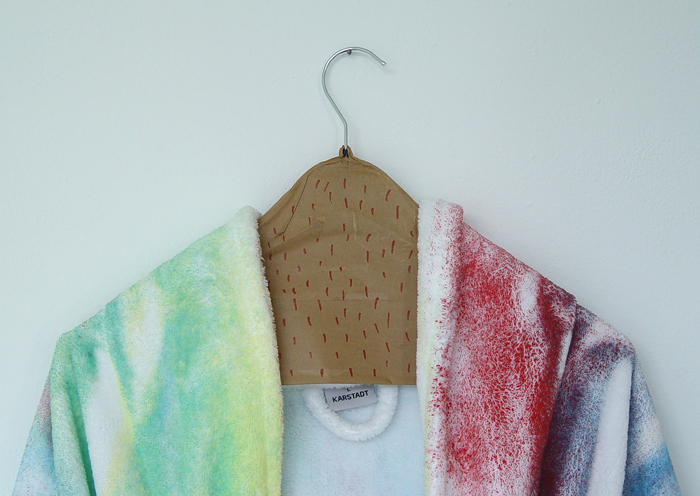
BART VAN DER LECK, Metz & Co Amsterdam – Den Haag, 1952
31 x 13,2 cm
flex print on paper bag, chord
design for and published by Metz & Co, Amsterdam / The Hague
condition: good
€ 225,- plus € 15,- Track & Trace EU registered mail
inv.BvdL 000-pr
Metz & Co was a firm specialized in furniture, textiles, and arts and crafts. Since 1900 Metz & Co. had been under the far-sighted management of J. de Leeuw, who imported the internationally renown Liberty fabrics from London. In the 1920s he introduced stylish, deluxe furniture from Paris and Vienna while gradually taking on more Dutch industrial artists. De Leeuw’s introduction to Rietveld and the painter Bart van der Leck around 1930 brought renewed vigour to the store. Van der Leck designed the firm’s logo as well as an assortment of bags and boxes in his inimitable style of fragmented letterforms with primary colours, all properly reflecting Metz & Co.’s combination of exclusivity and the avant-garde. The bag’s restraint and air of sophisticated modernity is no less contemporary today.
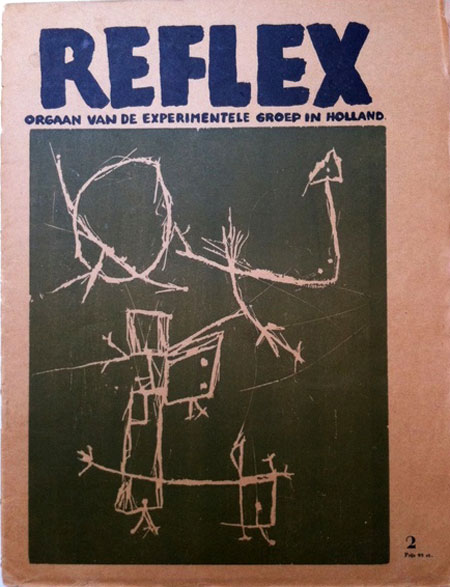
Reflex, nr 2, 1948
including 4 lithographs by Corneille, Karel Appel, Constant and Jan Nieuwenhuys
signed, dated in plate
€ 620,- plus € 18,- Track & Trace registered EU mail
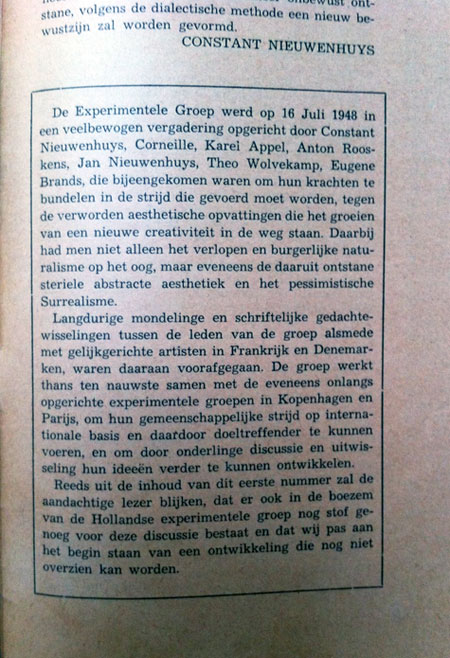
On 16 July 1948 the Experimentele Groep was founded by Karel Appel, Corneille, Theo Wolvecamp, Constant, Jan Nieuwehuys, Anton Rooskens and Eugene Brands. Later on this group became known as the Dutch hard core of the international CoBrA movement; COpenhagenBRusselsAmsterdam. The artists closely co-operated with experimental groups a.o. from Paris, Copenhagen, Brussels.
History of prices of Reflexnrs 1 and 2 as one lot:
UnOriginal Sins, Midlothian, UK November 2023 GBP 1,450.-
Modern Dutch Art-online, Netherlands 15 June 2022 € 699,- (pair in discoloured condition)
Catawiki-user4cbe1b2, Netherlands 23 September 2019 € 342,- hammer price (pair in poor condition)
Reflex, nr 1, 1948
including 4 lithographs by Corneille, Karel Appel, Constant and Jan Nieuwenhuys
signed and dated in print
condition: very fine, although aged
€ 420,- plus € 15,- Track & Trace registered EU mail
inv.Refl 000-pr
On 16 July 1948 the Experimentele Groep was founded by Karel Appel, Corneille, Theo Wolvecamp, Constant, Jan Nieuwehuys, Anton Rooskens and Eugene Brands. Later on this group became known as the Dutch hard core of the international CoBrA movement; COpenhagenBRusselsAmsterdam. The artists closely co-operated with experimental groups a.o. from Paris, Copenhagen, Brussels.They published a magazine called Reflex, a name that referred to the fact that they looked at their works as an immediate reaction to reality, not steered by the ratio; an expression of reality equal to how they experienced the years after the Second World War.
In The Situationist Times, nr 1, Constant wrote a manifest explaining the goals of the Experimentele Groep in Holland.
History of prices of Reflexnrs 1 and 2 as one lot:
UnOriginalsins, Midlothian, UK November 2023 GBP 1,450.-
Modern Dutch Art-online, Netherlands 15 June 2022 € 699,-
Catawiki-user4cbe1b2, Netherlands 23 September 2019 € 342,- hammer price
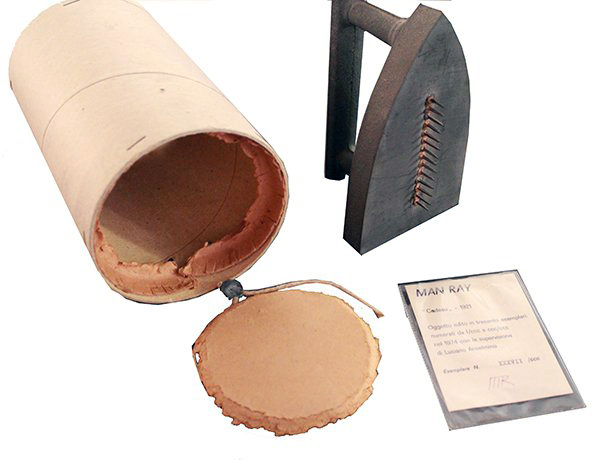
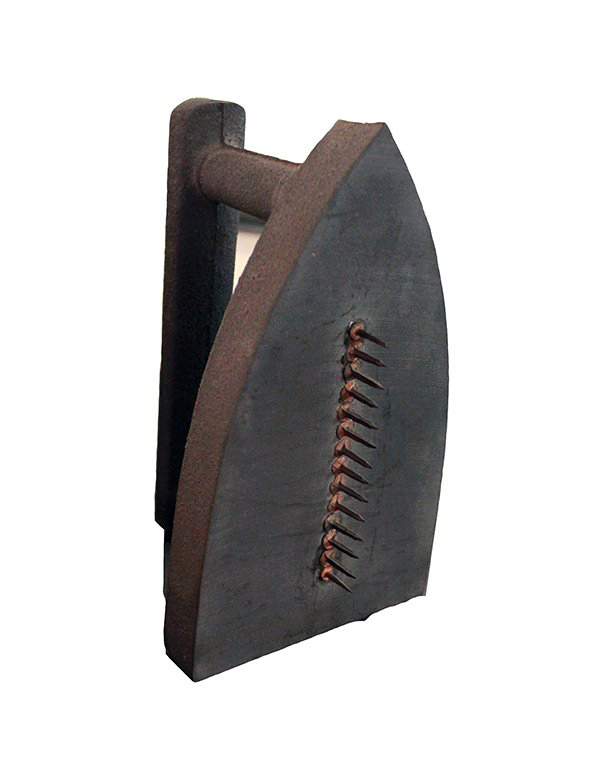
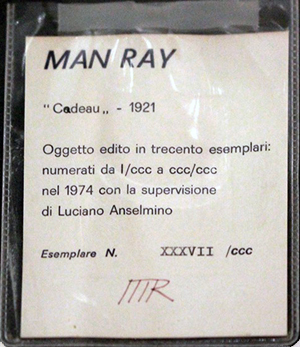
MAN RAY, Cadeau, 1921
16,5 x 10,2 x 9,5 cm
Cast iron, copper spikes, cilinder shaped cardboard box, certificate
signed with initials in ink, numbered
edition 300
The work ‘Cadeau’ was published in 1921 under the supervision of founder Luciano Anselmino, Turin. Here with original box. Again it was executed in 1974 by the same founder and publisher Luciano Anselmino in an edition of 5000, accompanied by a signed and numbered plastic card and a numbered certificate by Arturo Schwarz with information about the object.
“Man Ray never destroys, he always modifies and enriches. In this case, he provides the flat iron with a new role, a role that we dimly guess, and the probably accounts for the object’s strange fascination.”
Arturo Schwarz (dealer and author)
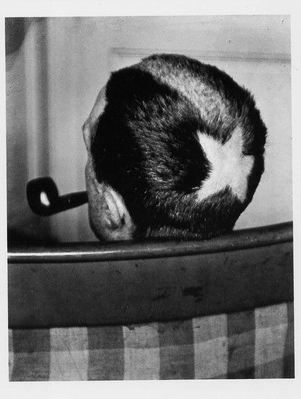
MAN RAY, Tonsure (Marcel Duchamp), 1984
15 x 10 cm / 4″ x 6″
postcard, cream coloured
edition unknown
published by Fotofolio, New York, USA, 1984
€ 145,- + € 8,- Track & Trace registered EU mail
inv.MRay 146-pr
Throughout his career Marcel Duchamp recasted accepted modes for assembling and describing identity. In 1917, having recently arrived in the United States, Duchamp found special significance in a mechanically produced photo-postcard that depicted him simultaneously from five different vantage points, thanks to a hinged mirror: ‘Five-Way Portrait of Marcel Duchamp’.
In 1921 Duchamp famously pictured himself as Rrose Sélavy (Eros c’est la vie: a pun translating to “Eros is life,” when pronounced aloud in French). He would associate himself with this female persona throughout the remainder of his career. At the same time, he posed for well-known photographs in which he sported an unconventional tonsure emblazoned with a star. This photo was taken in 1921. Soon thereafter, he used mugshots to cast himself as a criminal of many aliases wanted for running an illegal gambling operation.
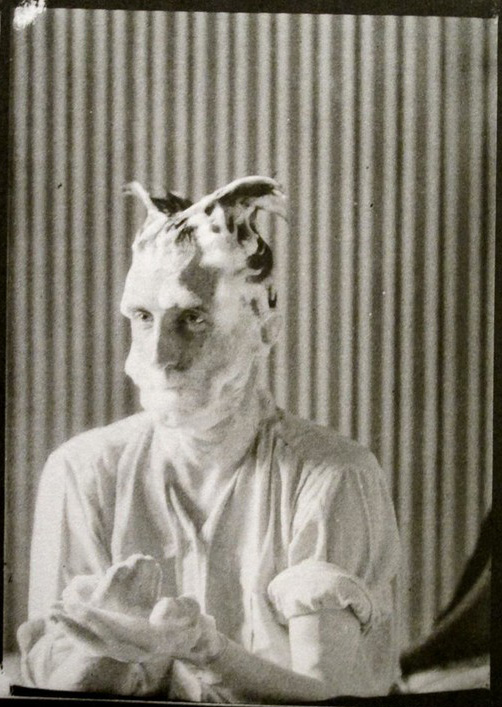
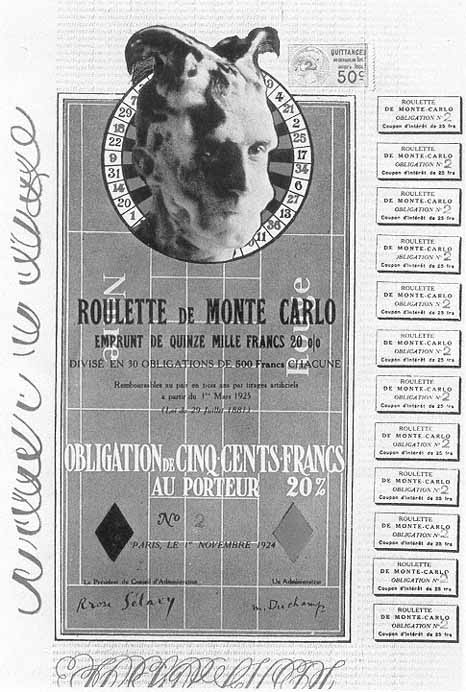
Another example of a staged portrait of Marcel Duchamp photographed by Man Ray and used for a Monte Carlo bond:
Marcel Duchamp, Monte Carlo Bond ‘Obligation de Cinq Cents Francs’, 1924
collage of colour lithograph with photograph by Man Ray of Marcel Duchamp’s soap-covered head