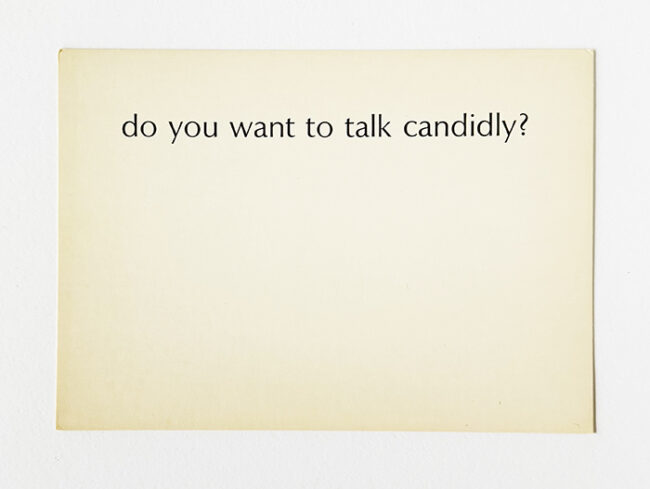
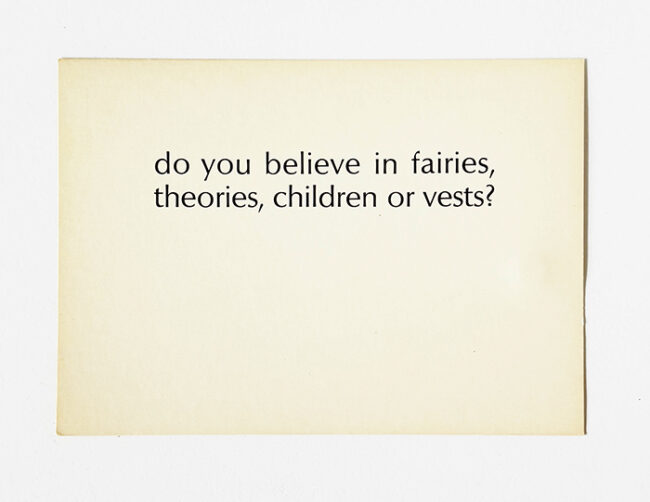
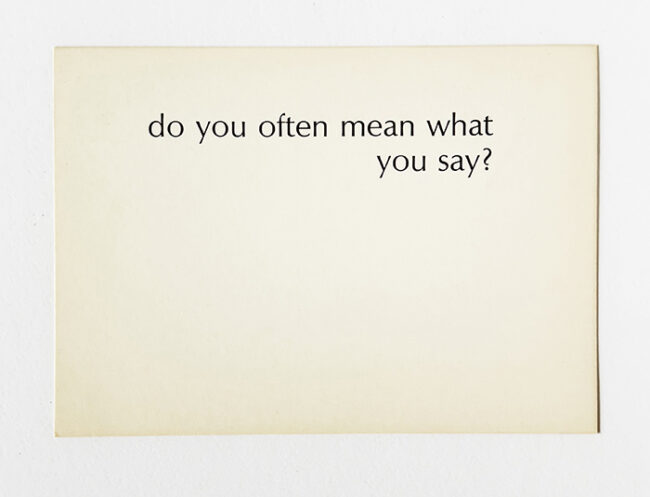
The Situationist Times, nr. 6, 1967 [magazine, Jacqueline de Jong]

The Situationist Times, nr. 6, 1967
27,4 x 21,5 cm
edition 2000 + 500 HC
litho prints from 33 artists
inlay as colophon
pristine
published by Jacqueline de Jong, Paris, France
€ 395,- plus € 12,- Track & Trace registered EU mail
inv.TST 000-pr

The Situationist Times, no 6 is a compilation of 32 original lithographies printed in four colours. Participating Jan Voss, Jack Vanarsky, Topor, René Bertholo, Guido Blasi, Samuel Buri, Lourdes Castro, Maurice Henry, Martin Engelman, José Gamarra, Klaus Geissler, Theo Gerber, Reinhoud d’Haese, Hannelore, Peter Klasen, Jacqueline de Jong, Mariano Hernandez, Wifredo Lam, Yasse Tabuchi, Paul de Lussanet, Milvia Maglione, Christina Martinez, Roberto Matta, Lucio del Pezzo, Hannes Postma, Lea Lublin, Alejandro Marcos, Antonio Segui, Antonio Saura, Pierre Alechinsky, Asger Jorn, Arne Haugen-Soerensen and couver on the back is the 33rd lithograph at the back is of Ulf Trotzig.

History of prices:
Concept Books, Veldhoven, Netherlands June 2026 US$ 478.-
Antiquariat CoBrA, Oberrohrbach, Germany June 2026 US$ 735.-
p015, Rotterdam, Netherlands June 2026 US$ 358.- (poor)

WALTER VAN BEIRENDONCK, Wonder News, issue number 1, 1998 [magazine, fashion]

WALTER VAN BEIRENDONCK, Wonder News, issue number 1, 1998
29,7 x 21 cm (unfolded 29,7 x 105 cm)
4x fold print, business card, 4 slides in sleeve, 2 A4 papers
8 parts
condition pristine
extremely rare
published by Walter van Beirendonck, Antwerp, Belgium
€ 320,- plus € 12,- Track & Trace registered EU mail
inv.WvB 000-pr

The Situationist Times, nr. 4 (1963), nr. 5 (1964) and nr. 6 (1967)

The Situationist Times, nr. 4 (1963), nr. 5 (1964) and nr. 6 (1967)
many signatures in print, dated
edition successively 2000, 1600 and 2000 + 500 HC
condition: excellent, aged, nr. 6 (incl. inlay as colophon) is pristine
including numurous lithographs by Corneille, Karel Appel, Constant Jan Nieuwenhuys, a.o.
inv.Refl 000-pr

On 16 July 1948 the Experimentele Groep was founded by Karel Appel, Corneille, Theo Wolvecamp, Constant, Jan Nieuwehuys, Anton Rooskens and Eugene Brands. Later on this group became known as the Dutch hard core of the international Cobra movement. The artists closely co-operated with experimental groups a.o. from Paris, Copenhagen, Brussels.


Asger Jorn introduced Jacqueline de Jong to Gruppe Spur, the German branch of the radical left-wing movement Situationist International. After Guy Debord expelled her from the movement in 1962, she founded her own magazine: The Situationist Times. The publication followed the critical principles that formed the basis of the Situationist International.

In The Situationist Times nr 1 Constant wrote a manifest explaining the goals of the Experimentele Groep in The Netherlands.

The Situationist Times, Nr 6:

Colophon inlay:

RICHARD HAMBLETON, invitation, 1984 [exhibition announcement]

RICHARD HAMBLETON, invitation, 1984
29,7 x 21 cm
twice folded as mailed
condition: splendid – mint
rare
published by Galerie Barbara Farber, Amsterdam
€ 260,- plus € 12,- Track & Trace registered EU mail
inv.RHa 1024-pr

One of Richard Hambleton lesser-known series of “Shadow men” is the so-called “Blood works” and “Mass Murder series”, where he used his own blood as a medium to push the impact of an image to its limits. A fallen figure on the street (or stair case) was outlined as if that was drawn by the police after a shot incident. A splash of blood as part of such a street painting gave it an eery atmosphere in the city of New York.
Galerie Barbara Farber was the only gallery in Amsterdam in the 80’s that showed American street artists like Richard Hambleton.

KEITH HARING, invitation card, 1986 [invitation card 25-2-1986, exhibition SMA]

KEITH HARING, invitation card, 1986, dated 25-2-1986
10,5 x 14,5 cm
text on card, Dutch language + added newspaper article
very rare
published by Stedelijk Museum Amsterdam
€ 150,- plus € 12,- Track & Trace registered EU mail
inv.KHa 000-pr

_________________________________________________________

‘Due to the opening of the KEITH HARING exhibition
on March 15, the upper floor of the Stedelijk Museum
will be closed until 15:00.

At 11:30 AM, Keith Haring will give a LECTURE in the auditorium.

From 3:00 PM to 5:00 PM, the exhibition will be opened.

You are cordially invited.’
_________________________________________________________

In 1986, Haring had his first solo museum exhibition at the Stedelijk Museum Amsterdam. During this period, he also actively manifested himself outside the museum in the city. He took to the streets with young graffiti artists and painted the wall of the then-museum depot on the grounds of the Central Market Halls on Jan van Galenstraat, Amsterdam.


Central Foodmarket, Jan van Galenstraat, Amsterdam

Added:

TAMÁS St. TURBA, NETRAF, 2026 [poster]

TAMÁS St. TURBA, NETRAF, 2026
size needed
print for free use
published by the non-art-artist
ask for deatils

Tamás St. Turba, also known as Tamás St. Auby, Tamás Szentjóby, Staub, Stjóby, Stauby, Emmy/Emily Grant, St. Aubsky, T. Taub, St. Ruby, etc. began a non-art-art activity as soon as he ended his art activities in 1966. From that period on, he created an extensive oeuvre made up of actions, happenings, objects, concrete/visual/action-poems, images, compositions, sculptures, photos, videos, mail art and email art. Disseminating happenings and Fluxus ideas he deems himself a Neo-Socialist Realist.

The protests and art activities of Tamás St. Turba – aka Tamás St. Auby – in the late 50’s were heavily embedded in the shadow of the Sovjet umbrella. He became familiar with the ideas of Dada and the later Fluxus movement, and thus found his allies.
‘In the mid-’60s, the idea of Joseph Beuys, George Maciunas, and others about “everybody is an artist” proved to me that I’m not alone at the grassroots level. This conviction was in organic symbiosis with socialist/communist ideology, so I propagated Fluxus as Neo-Socialist-Realism, and established the International Parallel Union of Telecommunications (IPUT) in 1966, a Big Sister institution to counterbalance the power of the International Telecommunication Union, which controls the totality of the electromagnetic spectrum deeply into interstellar space as well.’ Interview with Jon Hendricks in MoMA Post notes on Art, 19 December 2018

In 1969, he organized the first Fluxus concert in Budapest. His work often challenged political and social norms, leading to his expulsion from Hungary in 1975. He settled in Switzerland and returned to Hungary in 1991.

In 2004, Tamás St. Auby showed several works in a group exhibition ‘Freedom Borders’ in Galerie van Gelder. During the installation he told me his view on the Hungarian society. Once back in his country after his exile, he discovered that although the political leaders from the communist era had been removed from their positions, the elite in the lower echelons (with their more than dubious or corrupt Stasi behavior in the past) had once again secured influential positions. To this day, he challenges unstoppable political and social norms in Hungary.

BEN PATTERSON, Sneak Preview – one of five “surprises”, 2014 [signed, special edition]

BEN PATTERSON, Sneak Preview – Special edition, one of five “surprises”, 2014
5,3 x 31,6 x 22,3 cm
3 photo prints, 2 DVD’s, catalogue, list of content, confetti streamers and various items, cardboard box
signed, dated
with dedication
special edition 5
rare
published by Down With Art! Verlag, Berlin, Germany
(in stead of € 500) € 250,- plus € 15,- Track & Trace registered EU mail
inv.BPa 000-pr

Publisher (ed. Petra Stegmann) Down With Art! Verlag asked to financially support the production of a catalogue to be named ‘Sneak Preview’. For this, a cardboard box with surprises was sent to a very limited amount of supporters. This is one of the five boxes made for the occasion.

WJM KOK, Monochrome 360°, 2020-present [posters on ‘Peperbussen’]

Photo: Stadscuratorium, Amsterdam

WJM KOK, Monochrome 360°, 2020
590 x 340 cm
coloured paper on Peperbus
open series
rental price per column ca € 700,- dd. 2020
ask for details

In 2020, Wjm Kok made a series of approximately 60 large-scale advertising columns part of his work. These columns, known as ‘Peperbussen’ and normally used for poster campaigns are distributed throughout the city of Amsterdam. They periodically remain vacant between advertising cycles. During these intervals, Kok transforms them into monochrome works, i.e. blue in this instance to become part of his oeuvre.
What began as an independent artistic initiative is now recognized as part of Amsterdam’s ‘art in public space’ and has been incorporated into the city’s archives of Stadscuratorium.

‘Amsterdam has a long tradition of art in public space. A large number of well-known and lesser-known artworks tell the story of the city and its inhabitants. Art in public space manifests itself in many different ways, in various forms, and with different functions. For instance, the collection of the Amsterdam Metropolitan Area is rich in a broad spectrum of artworks: from monuments, sculptures, social projects, and interventions in environmental design, to graffiti, murals, and wall reliefs.’
City Curatorium, Amsterdam

Ref.
https://stadscuratorium.nl/collectie/

KARIM HASHEM, Wibautotisme, n.d. [poster, ca 1980]

KARIM HASHEM, Wibautotisme, n.d. [ca 1980]
39,1 x 61,3 cm
poster, thin paper
edition unknown
inv.MapD 000-pr

As a graphic designer, Karim Hemshed created newspapers, posters, and flyers—everything in the fight against the ‘Amsterdamse stadsvernieling’ and in support of squatter movements. For instance, he drew a circle with an arrow through it using a thick felt-tip pen, which subsequently became a squatter symbol starting in 1979.

Added information