DAVID HORVITZ, The Distance of the Day, 2013
ca 12,5 x 18 cm, 2 parts
set of leporello postcards, beach sand from Maladives and Los Angeles in cellophane envelopes
edition 25, here numbers 12/25
signed, dated, numbered
mint
€ 250,- plus € 18,- Track & Trace registered EU mail
inv.DHor 000-pr
‘In early February I asked my mom to go and watch the sunset and make a video. She did this from the Palos Verdes Peninsula, where I used to watch the sunset when I lived in California. She made the video with her iPhone taped to a metal barrier that protects people from falling over the cliffs.
In synchronicity with her, I too was looking at the sun and making a video. From my perspective the sun was rising. I had calculated where the the sun would be seen as rising at the exact same moment it was seen as setting in Los Angeles. In early February this was the Maldives, a location which may not exist in the near future due to the rising of the seas.
As my mom watched the sun set into the Pacific Ocean, I was watching it rise over the Laccadive Sea. Synoptic is a useful term here. It comes from the Greek syn, meaning “together”, and optic, meaning “seen”. Though separated by thousands of miles, we were watching the sun together.
The title, The Distance of a Day, is a reference to the idea of the journey. Originally, journey meant the distance one traveled in a day. Here, the spatial distance that separated my mother and myself was not defined by the distance one could travel in a day, but by the day itself. By the delimitations of a day – where the sun rises and where the sun sets.
Phones were chosen to make (and display) the video because they are devices that orient us spatially and temporally. They are like contemporary pocket-watches and compasses that we carry with us. They coordinate and synchronize us. They broadcast moments instantaneously across distances. Or, what seems to be instantaneously. There is always some delay.
The same two phones that were used to shoot the videos, that were once on opposite sides of the world, are now used to display the videos. They are now only inches away.
Right now somewhere the sun is simultaneously setting and rising. Someone or something is probably bearing witness to this.’
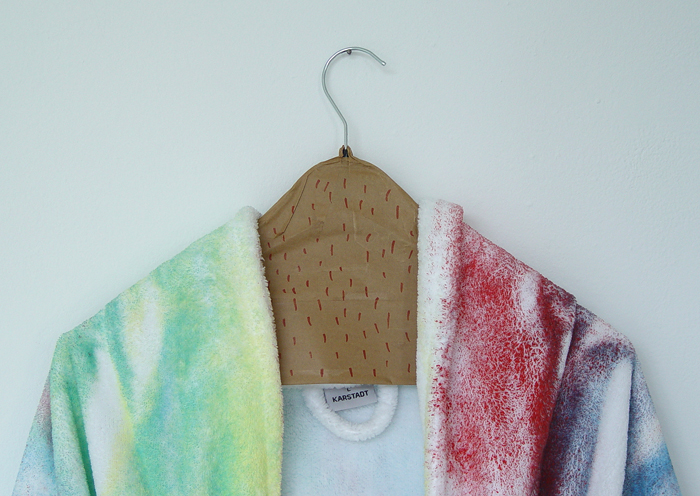
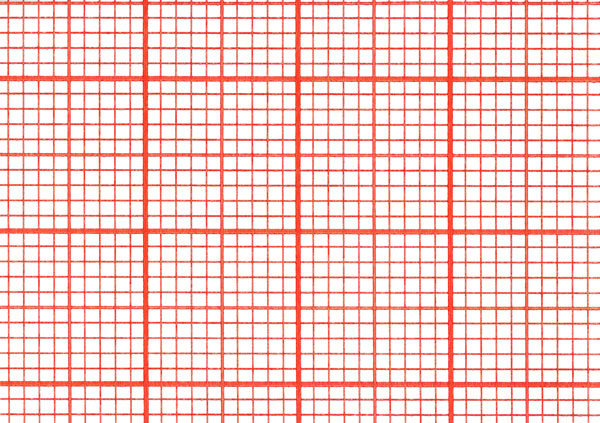
PHILIPPE DECRAUZAT, Untitled [wallpaper], 2013
0,53 x 10 meters / 20.86 inches x 11 yardsprinted wallpaper
limited edition 264
published by Wallpaper by Artists, Lyon, France
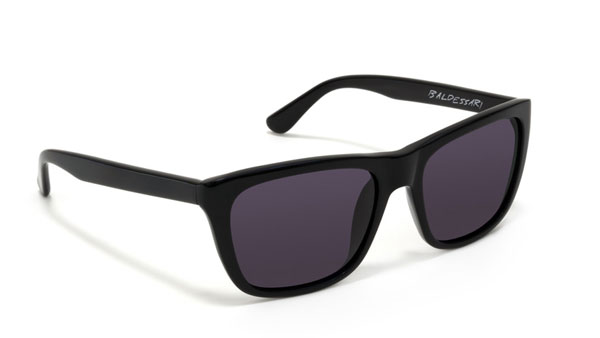
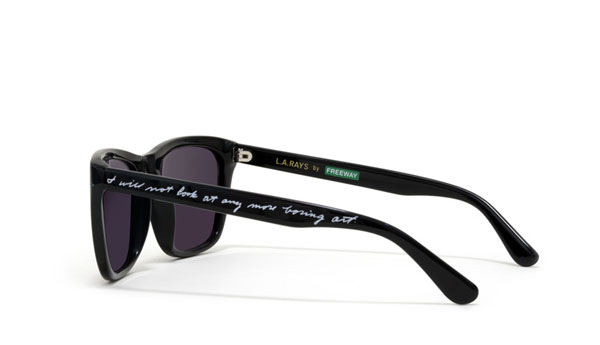
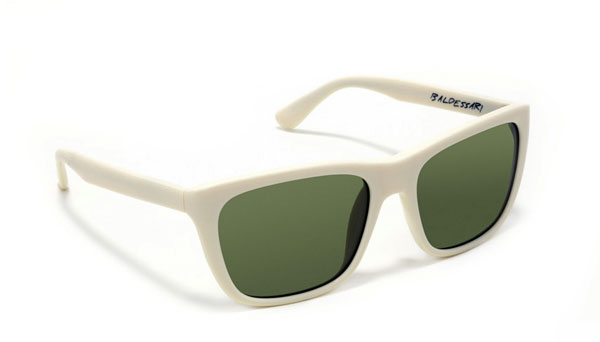
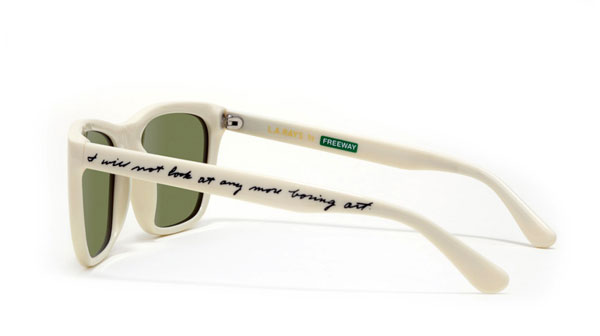
JOHN BALDESSARI, I will not look at any more boring art, 2013
signed in print on leg
black version with white text and dark lenses
edition 100
published by Freeway, Los Angeles, USA
JOHN BALDESSARI, I will not look at any more boring art, 2013
signed in print on leg
white version with white text and green lenses
edition 100
published by Freeway, Los Angeles, USA
History of price:
Freeway, Los Angeles, USA April 2014 US$200.00 – sold out
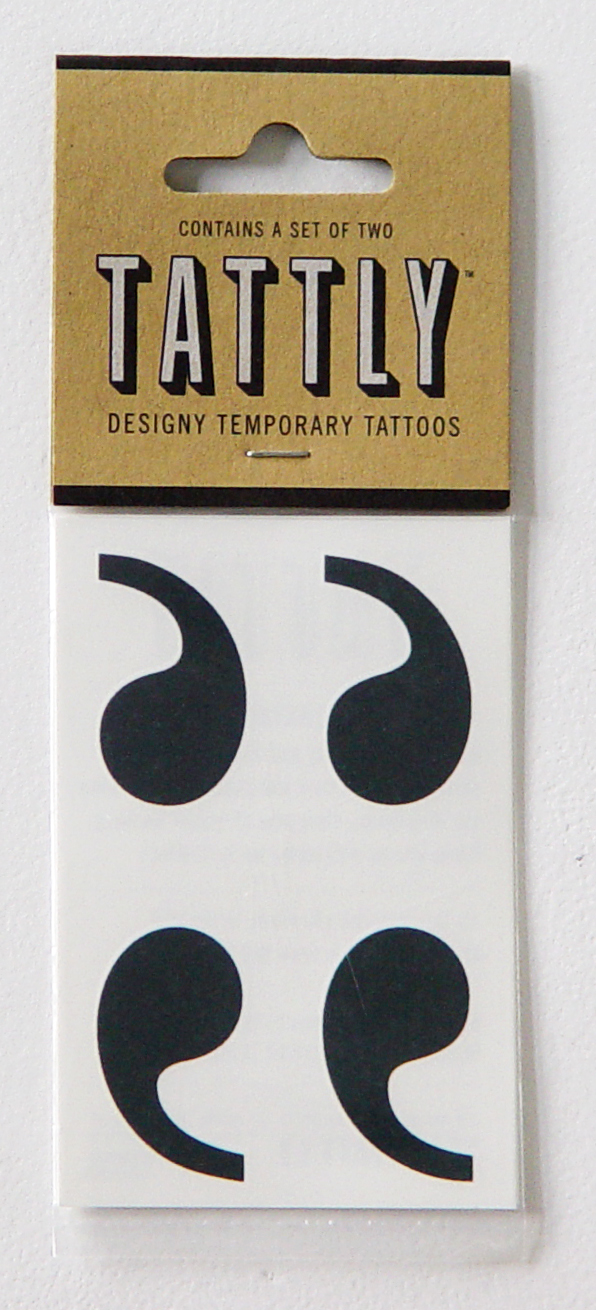
RICHARD ARTSCHWAGER, Quotation marks, 2012 [tattoos]
7,7 x 5 cm
4 quotation marks in plastic envelope, transfer prints, printed paper, staple
edition unknown
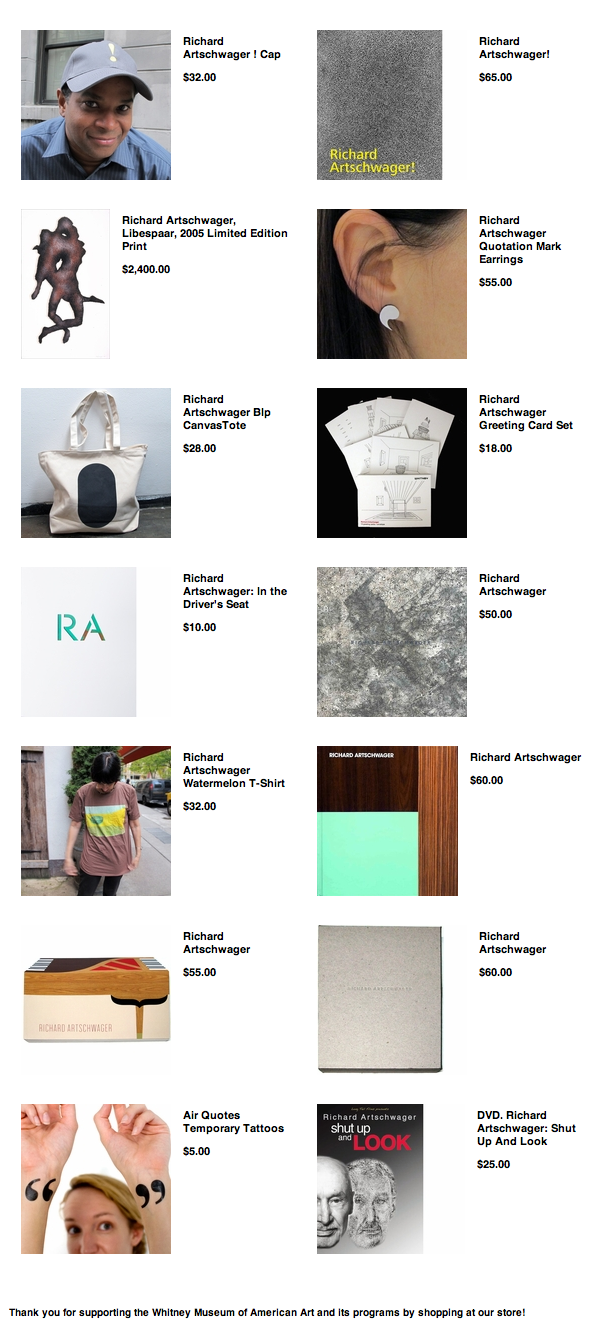
For sale in 2013 at the Whitney Museum, New York, USA
The space between two quotation marks either on human skin or e.g. on a gallery wall emphasize these spaces in between. This tattoo work with quotation marks is apparently not made to unravel what is ‘quoted’ in a given space. Whitney Museum, New York – March 2013
In March 2013 on its website the Whitney Museum categorizes this multiple as an edition that is ‘Reminiscent of Richard Artschwager’s artwork, where he utilizes punctuation outside of its normal realm, rendering its meaning questionable’ and was sold as “Air Quotes Temporary Tattoos”. There is no printed name of Richard Artschwager as a kind of authorization comparable to the “Richard Artschwager Quotation Earrings” The Whitney had simultaneously for sale.
CUT magazine about art, issue # 9, 2013
29,7 x 21 cm
digital print, tipped in program of 2nd set of performances, 16 pp.
edition 80, incl. 6 signed by Sigurdur Gudmundsson
‘CUT magazine about art appears irregularly however often’ and is published by Galerie van Gelder. This issue opens with a part of the diary of Sigurdur Gudmundsson together with color reproductions of new sculptures he made in China. Further more a visual report of gallery performances by Roderick Hietbrink, Kate Levant, Ekko Lokkwa and Kroôt Juurak invited by Aditya Mandayam.
ELVIRE BONDELLE, Maison, voiture, chien, 2013
22,5 x 13,9 cm, 48 pp.
artist’s book, SC, offset print, black and white
signed, numbered
edition 25
published by Book Machine / One Star Press, Paris, France
This artist’s book is read from back to the front, i.e. from both sides.
MARC BAUER, Untiled, 2013
paper bag
signed, numbered
edition 100
published by Migros Museum, Zurich, Switzerland € 100,- January 2013
Marc Bauer lives and works in Amsterdam and Berlin. His drawings, installations and videos suggest a mix of childhood memories and fantasies that repeatedly transgress taboos. His works unsettle a traditional understanding of morality. The lines in his drawings are so out of focus, in fact, that here and there they barely give shape and definition, blending and dissolving often into a mist of gray. With all their blurring and smudging, his drawings seem to emulate painting. In this, technically, Marc Bauer plots a new twist in the classical story of drawing versus painting. Here butterflies are symbolizing freedom or innocence, yet this depicted beauty of nature is paradoxically put in order and apparently framed.
PETRIT HALILAJ, Poisened by men in need of some love, 2013
color photo, semi-transparant envelope
series of 1 (+ 1AP) of 80 different color photographic
signed
published by Wiels, Brussels, Belgium € 200,- December 2013
color photo in semi-transparant envelope (verso):
Singular photos in edition of 1 (+1AP) unique series of 80 photographs that are reproductions of images found in the archive of the former Museum of Natural History in Kosovo.
GARY HUME, Misery, 2012
49,8 x 32 cm
silver paper, acrylic paint, collage on hand made paper
series of 25 unique collages
numbered, signed
published by Monopol – Magazin für Kunst und Leben, Berlin
not available
Gary Hume once said: ‘The surface is all you get of me’, and one can see in this collage what he means given that his applied material is not only smooth and polished, but above all very present. He is known for paintings between figuration and abstraction on aluminum panels, which often feature colour combinations made with industrial paints.
Gary Hume was one of the very first of the Young British Artists to be embraced by the art establishment – the first to win the Jerwood Prize in 1997, the first to represent Britain at the Venice Biennale in 1999, the first to be elected to the Royal Academy in 2001.
History of price:
Monopol/Magazin für Kunst und Leben, Berlin € 3.900,- December 2012