JOSEPH BEUYS
from “Rheinische Bienenzeitung” – Biene in der Kunst, 1975
offset print, folded as issued, Edition Verlag Constatin Post, Cologne, Germany
23,5 x 33 cm / 9 1/4 x 13 inches
edition 34 + several AP’s (here AP)
published by Edition Constatin Post, Cologne, Germany
mint, rare
Ref. Schellmann 152, p. 166
€ 690,- plus € 18,- Track & Trace EU registered mail
inv. JBeuys308
Coll. Harvard Art Museums/Busch-Reisinger Museum, The Willy and Charlotte Reber Collection, Louise Haskell Daly Fund, Cambridge, MA, USA
GERHARD RICHTER, Eis, 2016
19,5 x 11,5 cm
artist’s book, offset, 144 pp., ca 320 grams
46 by hand tipped-in black and white images
limited edition 350
published by Salon Verlag, Cologne, Germany mint
inv. GRich 309
€ 260,- plus € 12,- Track & Trace registered EU mail
This book is a facsimile of Gerhard Richter’s original design for ‘Eis’, an artist’s book first published by Galeria Pieroni in 1981. The brown yellowish glue stains shining through the pages of that dummy are reproduced here, as an extra factual layer. The 46 pictures – glued in the middle of the book – are reproductions of photos Richter took in Greenland.
The most interesting contribution Gerhard Richter has managed to deliver in the comtemporary visual arts is the uninterpreted image, i.e. an image without interpretation, morality or emotion. A picture made with the objectifying camera leads to a matter of pictorial fact. Since we are used to read images within a fraction of a second Richter manipulates his images by blurring them, and so creating a cooler distance from the viewer looking at an image. Due to this added misty curtain it is more difficult to detect what is going on. Also it blocks a first fast reading. What Emmanuel Kant analysed for the theory of knowledge is what Gerhard Richter analysed for the pictorial phenomenology, i.e. knowledge a priori (knowledge one is born with) or a posteriori (knowledge achieved by experience) is comparable to Richter’s observation that a photo is empty (no thoughts, no ideology, no theme, no order) or loaded (with ethics, aesthetics, etc.).
Since Gerhard Richter is convinced that the objectivity of the (snapshot) photo has to be helped by providing it with manipulations of distance, he states that painting a photo is the best way to bring its emptiness of no position to perfection.
Reading ‘Eis’ against the background of the above one may say that Richter’s idea to make this artist’s book with no beginning and no ending is expressing his will to neutralise a fixed direction of reading (in fact, there are no texts to read). Black and white images are glued in and some are shown upside down towards each other, depending from where you start reading the book. After some confusion one may accept its awkwardness of how to read on and a kind of reader’s ‘floating’ is created. This awareness of being in a cloud is the detached situation Richter is looking for. In German one would say: “Richter’s richtige Richtung” leading to a void in which there is no urge anymore to judge. The reader finds himself in a pictoriality of no beginning and no ending.
The tipped-in images in the middle seen from the book edge:
History of prices:
Stefan Schuelke Fine Books, Cologne, Germant January 2025 € 280,-
eBay-carolinanitsch, New York, USA US$ 1,500.- September 2023
Studio Bibliografico Marini, Valenzano, Italy € 439,- September 2023
Galerie Buchholz, Cologne, Germany € 680,- September 2023
eBay-carolinanitsch, New York, USA US$ 900.- December 2022
Galerie Buchholz, Cologne, Germany US$ 351.- December 2022
eBay Kleinanzeigen-Christian, Nordrhein-Westfalen, Sankt-Augustin, Germany € 550,-
July 2022
Studio Bibliografica Marini, Rome, Italy € 350,- July 2022
eBay-carolinanitsch, New York, USA US$ 900.- December 2021
Antiquariat Querido-Frank Hermann, Düsseldorf, Germany US$ 255.- December 2021
Buchhandlung Walther König, Cologne, Germany € 240,- July 2021
Antiquariat Querido-Frank Hermann, Düsseldorf, Germany € 220,- April 2020
GILBERT & GEORGE, The thoughts of Gilbert & George, 2016
LP
signed, numbered
edition 2000
mint
published by the MoMA, New York, USA
€ 85,- plus € 18,- Track & Trace registered EU mail
inv.G&G 000
This edition on vinyl LP is a unique record work of art by Gilbert & George on which they revisit their first mature work, The Singing Sculpture from 1969, when they presented themselves as a Living Sculpture singing with a recording of Flanagan and Allen’s Depression-era song “Underneath the Arches.”
OLIVIER MOSSET, Buick Riviera, 2014
3 x 12 x 4,7 cm
window chocolate box (11,5 x 17 x 5 cm)
chocolate, cardboard box, celluloid
signed, dated
edition 50
published by Centre Culturel Suisse, Paris, France
€ 385,- plus € 12,- Track & Trace registred mail
inv.OM 322
OLIVIER MOSSET / George Maciunas, n.d. [heap of confetti ca 1969]
35 grams confetti as “Production Art”
handmade by George Maciunas for “Flux Dots By Mosset Total Art Nice”, in plastic box with label
In 2008 Olivier Mosset prepared a solo exhibition in Galerie van Gelder in Amsterdam. Next to several huge monochrome paintings he brought a white envelope. As part of the legacy of George Maciunas the heirs didn’t know what to do with the left-overs of the multiple box Flux Dots By Mosset Total Art Nice. So they gave it to me, he said while handing over the envelope: “I don’t know what to do with it, so I thought I just give it to you. You can do with it what you like.”
Usually George Maciunas only produced a Fluxus box when someone was interested in buying one. So this envelope with confetti originally comes from his stock.
In short this envelope with confetti is neither art nor just a bunch of confetti. These pieces of handmade “Flux dots” (a name Olivier Mosset would never use since he never considered himself to be associated with the Fluxus movement) were once meant to be part of a plastic box series called “Flux Dots By Mosset Total Art Nice”. In the end both artists have touched these particles; for sentimental and also historic reasons this piece could best be named On hold Art.
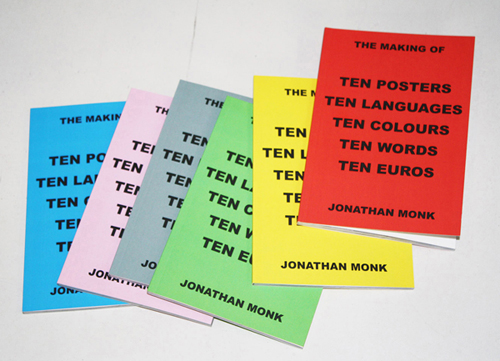
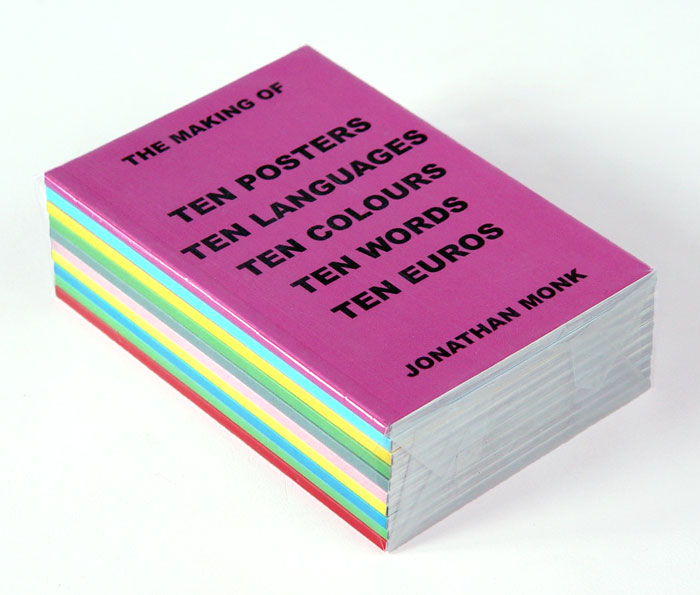
JONATHAN MONK, The making of ten posters, ten languages, ten colours, ten words, ten euros, 2011
book, 50 pp.
17 x 11,5 x 0,5 cm
50 pages of color photographs documenting the creation of an edition of Jonathan Monk posters
published by Yvon Lambert, Paris, France
pristine
set of 5: € 290,- plus € 20,- registered mail Track & Trace
inv.JMon 000-pr
Also available
As issued, stack of all the ten books in different colours, in original cellophane wrapping
pristine
set of 10: € 920,- plus € 20,- registered mail Track & Trace
inv.JMon 304-pr
Jonathan Monk: “… Once something has been done, it can be done again in a different colour.”
From studio interview by U. G. Lambert, 26 April 2012.
ROBERT FILLIOU, dice Eins, Un, One, not dated [1984]
3 x 3 x 3 cm
over-sized dice, wood, industrially coloured
pencil signed with initials ‘rtf.’ on sticker as issued
limited edition, signed: 100
pristine
€ 325,- plus € 12,- Track & Trace registered EU mail
inv.RFil 682-GvG
The pencil is shown for scale. The initials on the sticker stuck on the dice as issued are written in lowercase by Robert Filliou. Provenance A. Hundertmark, Cologne, Germany
THIERRY DE CORDIER, Les Fragments d’Héraclite selon Thierry De Cordier, 2015
22 x 13,9 cm
artist’s book, 170 pp., guilt edged, French text
numbered
edition 300, here nr 103/300
pristine, sealed as published
published by Salon Verlag, Cologne, Germany
inv. ThDeCor 303
THIERRY DE CORDIER, Les Fragments de Héraclite selon Thierry de Cordier, 2015
Belgian artist Thierry De Cordier (1954) was once gifted a small book with the hand written title ‘Heracleitos’ on the cover. The booklet, barely eight pages, contained Dutch translations of texts by Heraclitus, a pre-Socratic Greek philosopher whose original writings are lost and who is only known through the quotations of later authors. At the time, De Cordier read these ‘Fragments of Heraclitus’ superficially without giving them much thought. He put away the book, probably a Dutch translation of Heraclitus by Laurens Vancrevel with artwork by Rik Lina, and forgot about it until it surfaced when he moved house. Reading Heraclitus again after all those years De Cordier found himself captivated by the quotations, sometimes no more than a couple of words, of the philosopher of change (‘no man steps in the same river twice’) and unification of opposites (‘the path up and down are one and the same’). De Cordier started to retranslate the Dutch texts in his native French trying to find a way to combine philosophical and poetic language. It took him more than a full winter to complete the work. De Cordier’s translations were published in 2015 without any comments, footnotes or illustrations in Salon Verlag’s ‘Ex Libris’ series, in which artists are invited to reprint their favourite books.
JOHN M ARMLEDER, Untitled, 1998 [spirograph drawing]
34,8 x 49,8 cm (frame: 53,1 x 38,2 cm)
colour pencil, lead pencil
unique series of 25 unique spirograph drawings + 10 AP
published by Edition Franz Mäder, Basel, Switzerland
€ 8.400,- plus € 32,- Track & Trace registered mail
This is a drawing with the appearance of a print.
Before John Armleder made this drawing he first provided the paper with a blind imprint of an etching plate. He then used a spirograph to make each time a unique drawing in this series of twenty five sometimes very different drawings. Every time, at a certain point he left the utensil uncontrolled run over the paper creating a most surprising juggler’s lightness of the lines.
He once stated that for him when he has to think about how to make something, it is in the end every time no more than a performance. Here in this drawing, it is without any doubt. In spite of its uniqueness each drawing has been numbered as if it concerns a traditional etching; hence it’s etching-like fragile thin line appearance and its blind plate imprint. This is certainly one of the most light hearted and musical drawings John Armleder probably ever made.
De Kunstkraai, 1988 [tabloid]
42 x 29 cm
offset, tabloid, 8 pp.
edition unknown
very good condition, due to aging slightly yellowed
De Kunstkraai was published in May 1988 during the Dutch artfair Amsterdam KunstRai and meant as a magazine with gossip and slander on the Dutch art scene.
Commentaar op bespreking van journalist Renée Steenbergen op de eerste solotentoonstelling van JOHN M ARMLEDER in Nederland: