BRUCE NAUMAN
Footsteps, 1968
6,6 x 27,5 x 6,6 cm / 7.25 w x 11.75 h inches
offset, tape
edition 2000, of which 1500 have been in fact printed, including one hundred signed, portfolio #5
published by The Letter Edged in Black Press Incorporated, London, 1968
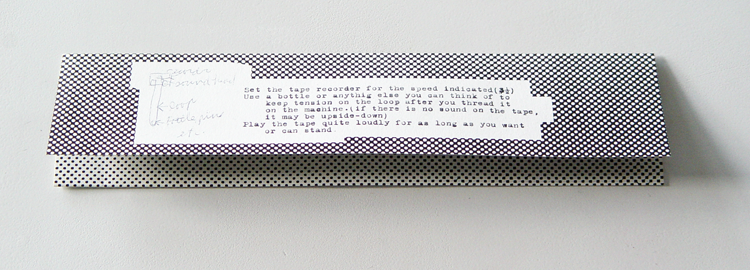
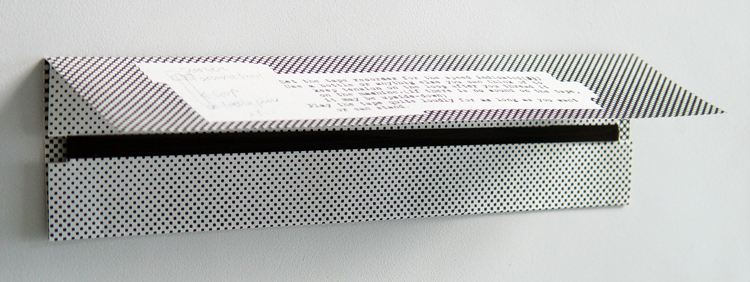
A loose piece of magnetic tape featuring sounds of walking wrapped around a triptych folded card with the following instructions: Set the tape recorder for the speed indicated (3½)
Use a bottle or anything else you can think of to keep tension on the loop after you thread it on the machine (if there is no sound on the tape, it may be upside down)
Play the tape quite loudly for as long as you want or can stand
William Copley, American surrealist painter and art dealer, invited artists in 1968 to contribute to his periodical entitled S.M.S., which stood for “Shit Must Stop.” Copley was inspired by the Fluxus movement.
Decades later the factual printed edition of 1500 got water damaged which left most of the items of portfolio #5 to a total of ca 800 copies.
The Letter Edged In Black Press Inc.
American William Copley founded the publishing house The Letter Edged in Black Press Inc. that produced 6 SMS (abbreviation for “Shit Must Stop”) portfolios released in 1968. In addition to providing a place for artists to work, Copley published a series of artists’ multiples sold by subscription. The artists represented ranged from the very well known to less known artists, including Christian Henning, Ben Patterson, Dick Higgins, Christo, Walter de Maria, Julian Levy, La Monte Young, Marian Zazeela, James Lee Byars, Marcel Duchamp, Bruce Conner, Meret Oppenheim, Ray Johnson, Nicolas Calas, José Cortes, H.C. Westermann, Hannah Weiner, Allan Kaprow, Joseph Kosuth, Roland Penrose, Man Ray, Terry Riley, Dick Higgins, Enrico Baj, Roy Lichtenstein, Arman, John Cage, On Kawara, Robert Watts, Hollis Frampton, Yoko Ono, Mel Ramos, Lawrence Weiner, Angus MacLise, Bruce Nauman, Walter Marchetti, Dian Wakoski, Richard Artschwager, John Giorno, Diter Rot, Claes Oldenburg, and many other with an open mind, covering many areas of art. Among the 73 individual works, 6 involved sound, while the majority were visual or written works. Meticulously reproduced, each item was a distinctive artistic work giving each issue a widely varying character.
BEN PATTERSON, Solo, 1965
each 28 x 21 cm and 21 x 21 cm
6 parts
offset on various kinds of paper, board
texts in German and English
signed, numbered
edition ca 500
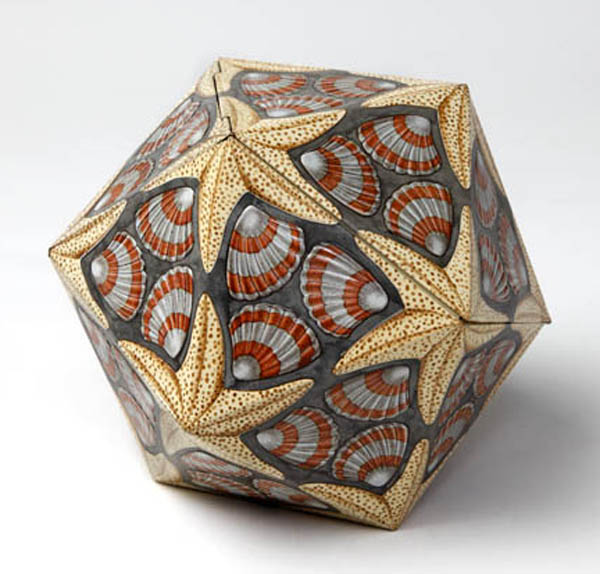
M.C. ESCHER, Icosaëder [Icosahedron], 1963
12,5 x 12,5 x 12,5 cm
printed tin box with embossed relief
edition 7100
published by Verblifa / Vereenigde Blikfabrieken, Krommenie; on behalf of its 75th anniversary
not available
Originally M.C. Escher was not interested in a commission to make a tin box. Nevertheless a delegation of Verblifa convinced the artist eventually by showing a box called Koh-I-Noor once designed in 1955 for the Verkade chocolate factory, i.e. a Icosahedron, a geometrical shape with twenty sides. He got fascinated by this object and invented a way for having the box industrially produced by Verblifa.
The tin was produced in an edition of 6.800 and an additional 300 tins were produced to replace any defects.
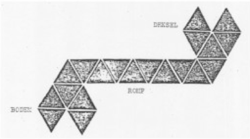
Drawing of the invention for the production of the box by M.C. Escher displaying lid, hull and bottom.
Employees during the production of the icosahedron shaped tin boxes in Krommenie 1963.
History of prices.
Venduehuis, The Hague, Netherlands € 2.800,- 29 April 2021 (hammer price)
Auction house Christie’s, Amsterdam € 395,- / US$ 456.- / Dfl. 865,- December 1998
Auction house Vendue Huis, Den Haag € 800,- / US$ 1,060.- August 2013
New Art Editions US$ 1,425.- / € 1.075,- September 2014
KEN FRIEDMAN, This is really it! This is really it! This is?, ca 1962-1968
27,9 x 21,6 cm / 19,7 x 15,3 cm
prints on paper, folded as issued, petrified rubber band
3 parts from unknown source
inv.KFrie 1012
This is an unknown publication, probably connected to one of the “Fourre-Tout” publications produced by Ben Vautier in the sixties. An edition of 101 copies composed of two parts, i.e. a bocal and an envelope with artist’s contributions. For sale at Ben Vautier’s Fluxus shop ‘La Çedille qui rit’ in Nice, France. The theme of this issue “Fourre-Tout” (tr. mishmash) was apparently about “Realism”, although this is not explicitly outspoken in the accompanying text by ben Vautier.
BART VAN DER LECK, Metz & Co Amsterdam – Den Haag, 1952
31 x 13,2 cm
flex print on paper bag, chord
design for and published by Metz & Co, Amsterdam / The Hague
condition: good
€ 225,- plus € 15,- Track & Trace EU registered mail
inv.BvdL 000-pr
Metz & Co was a firm specialized in furniture, textiles, and arts and crafts. Since 1900 Metz & Co. had been under the far-sighted management of J. de Leeuw, who imported the internationally renown Liberty fabrics from London. In the 1920s he introduced stylish, deluxe furniture from Paris and Vienna while gradually taking on more Dutch industrial artists. De Leeuw’s introduction to Rietveld and the painter Bart van der Leck around 1930 brought renewed vigour to the store. Van der Leck designed the firm’s logo as well as an assortment of bags and boxes in his inimitable style of fragmented letterforms with primary colours, all properly reflecting Metz & Co.’s combination of exclusivity and the avant-garde. The bag’s restraint and air of sophisticated modernity is no less contemporary today.
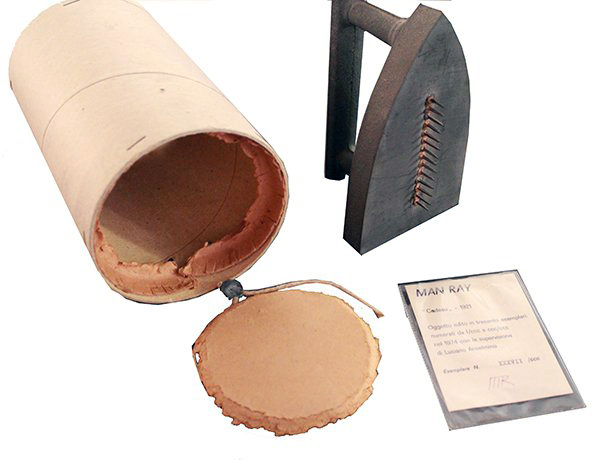
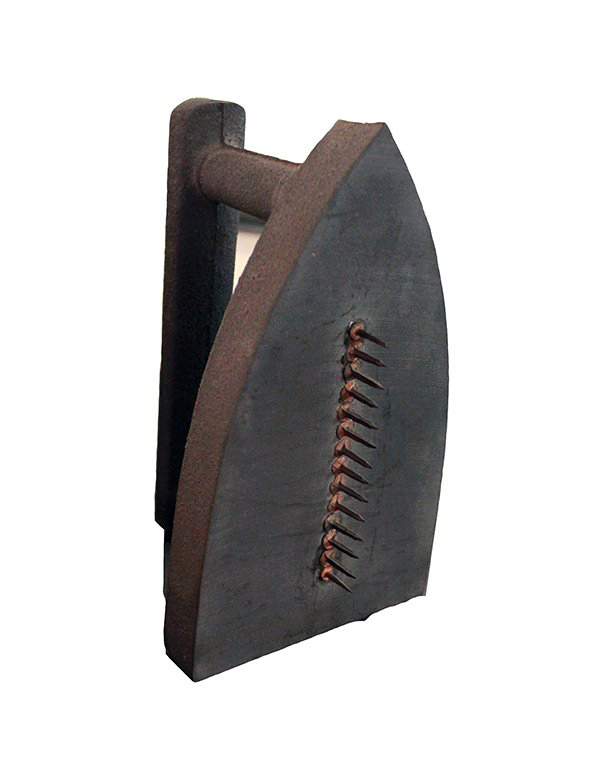
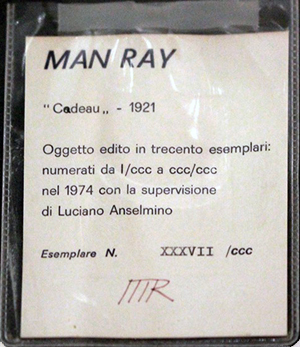
MAN RAY, Cadeau, 1921
16,5 x 10,2 x 9,5 cm
Cast iron, copper spikes, cilinder shaped cardboard box, certificate
signed with initials in ink, numbered
edition 300
The work ‘Cadeau’ was published in 1921 under the supervision of founder Luciano Anselmino, Turin. Here with original box. Again it was executed in 1974 by the same founder and publisher Luciano Anselmino in an edition of 5000, accompanied by a signed and numbered plastic card and a numbered certificate by Arturo Schwarz with information about the object.
“Man Ray never destroys, he always modifies and enriches. In this case, he provides the flat iron with a new role, a role that we dimly guess, and the probably accounts for the object’s strange fascination.”
Arturo Schwarz (dealer and author)