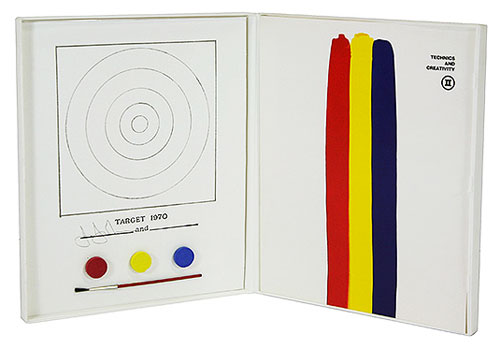
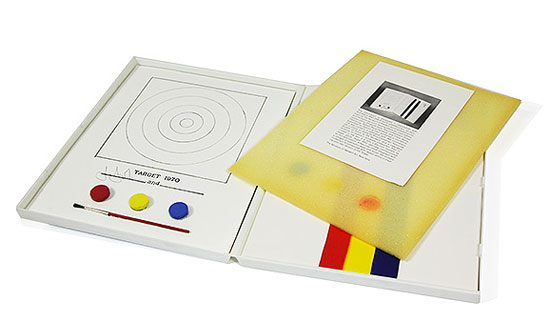
JASPER JOHNS, Target, 1970
27 x 22 cm / 10 1/2 x 8 1/2 inches
watercolour pads and brush, plastic clam-shell box containing prints
signature in print
published by Gemini G.E.L., New York City / Museum of Modern Art. 1971
not available
This publication was produced in conjunction with an exhibition at MoMa in New York called “Technics and Creativity: Gemini G.E.L.” The box contains a catalogue with 364 illustrations of which 20 in colour, a catalogue raisonné of Gemini’s production and a multiple ‘Target 1970’ of Jasper Johns.
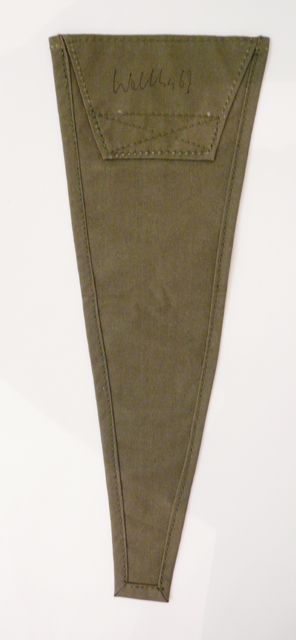
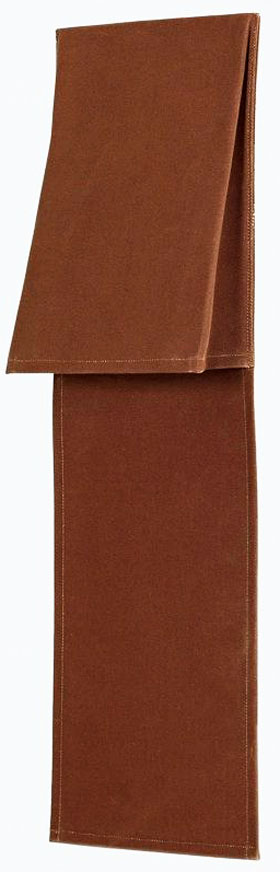
FRANZ ERHARD WALTHER, Find a purpose for the pocket, 1969
ca 37 x 13,5 cm
canvas shaped pocket
unlimited edition stamp signed, dated
condition: good, slightly discoloured
published by Vice-Versand, Remscheid, Germany
€ 1.450,- + € 18,- Track & Trace registered mail
inv. FEWal 27
Here the older and smaller version with stamped signature and date is shown. Franz Erhard Walther began making objects (…the work as a tool…) of fabric that invite the viewer to become active. Here a loop sewn onto the verso enables one to wear this triangle shaped pocket on a belt.
There are two versions: one with stamped signature and dated ’69 and one without. Apparently at some point not all editions were stamp signed and dated.
This work may be found with various titles like ‘Find a reason for this pocket’ or ‘Find a purpose for the bag’. In 1969 Wolfgang Feelisch advertised the multiple as “Find a purpose for the pocket”.
‘Multiple: Segeltuch in Dunkelgrün, genäht zu einer trapezförmigen Tasche mit Lasche, unlimitierte Edition; ca. 37 x 14 cm. Edition des Vice-Versandes. Schneider V 43; dort fälschlicherweise als “stempelsigniert” angegeben.’
From website dd 26 march 2024 of Artax Kunsthandel, Düsseldorf, Germany
History of prices:
Alternateprojects.com, US$ 1,800.- 19 August 2021 (stamp signed)
Alternateprojects.com, US$ 1,800.- 16 April 2020 (stamp signed)
Van Ham Kunstauktionen, Cologne, Germany € 400,- (hammer price) 24 October 2019 (stamp signed)
Karl & Faber, Munich, Germany € 500,- (excl. VAT) 6 December 2018 (stamp signed)
Grisebach, Berlin, Germany € 400,- (hammer price) 29 November 2014 (stamp signed)
OLIVIER MOSSET, Flux Dots by Mosset Total Art Nice, n.d. [1969]
10 x 12 x 1,6 cm
confetti – produced by George Maciunas – in red or black plastic box with label
very small edition: estimation ca 13 – 15
published by George Maciunas / Total Art, Nice, France
Private collection, Amsterdam extremely rare
p.o.r.
inv.OM 000-pr
In 1990 Olivier Mosset had his first solo show in Galerie van Gelder. A few days before the opening I presented him a red box ‘Flux Dots by Mosset’. “Well… looks good!” Olivier commented, “I have heard about it, but this is the first time I see this. I remember that Maciunas once phoned me. He asked whether I was the man of the circle paintings and I said yes, why…?” “Listen he said, you are a Fluxus artist, with all these circles on canvases, you really are!” “No, I answered, I don’t consider myself a Fluxus artist.” Maciunas: “Certainly you are and I have an idea. What about making a Fluxus box with punched dots, you know, like confetti?”
Related information
In 2008 Olivier Mosset had another solo exhibition in Galerie van Gelder. He arrived with huge white monochrome paintings of 8 meters long flown in from his studio in Tucson, Arizona. Still having his rain coat on he gave me a small thick envelope. “I got this from the heirs of Maciunas”, he said. “I don’t know what to do with it, so I thought I hand it over to you. You may do with it whatever you like.” I looked into the half opened cream colored envelope and saw a heap of hundreds of red confetti, unmistakably the ones Maciunas punched for his Flux Dots box edition.
Ref. Kees van Gelder talking to Olivier Mosset in Galerie van Gelder on 20 March 2008.
Ben Vautier opened a gallery shop BDDT / Ben Doute de Tout in Nice in 1958, which later became well-known as the Around 1960. He started to know the artists of Nouveau Réalisme: Yves Klein, Daniel Spoerri and others. In the autumn 1962, he travelled to London for visiting the Festival of Misfits, where he encountered many Fluxus artists, with whom he subsequently collaborated in various ways. A year later, Vautier organised the Fluxus Festival of Total Art in Nice.
OLIVIER MOSSET, Flux dots [1969]
10 x 12 x 1,6 cm / 3.5 x 4.75 x 0.75 inches
edition ca 13 – 15, here box 13 (in black)
published by George Maciunas, New York, USA
OLIVIER MOSSET: Flux Dots [1969] – black box version
Collection University of Iowa Special Collections, Iowa City, USA
OLIVIER MOSSET: Flux Dots [1969] – black box version/verso
Ref. the Fluxus Digital Collection of the University of Iowa were donated by artist Ken Friedman.
FRANZ ERHARD WALTHER, ‘Sockel: Hand und Arm unten’, 1969
59,3 x 19 x 2 cm / 23 3/8 x 7 ½ x 0 6/8 inches
hand sewn fabric
edition 20
signed, dated, numbered on technical drawing as work certificate (A4 size)
not available
The pedestal or ‘Sockel’ to be actively used by the viewer is a central concept in Franz Erhard Walther’s work. During the 1960s Franz Erhard Walther produced a series of 58 sculptural objects that were collectively titled ‘1. Werksatz’ (trans. “First Set of Works”). The earliest of these, ‘Stirnstück’ (trans. “Forehead Piece”), 1963, involved using the front of the head to slide a strip of maroon velvet down a wall. The works in the 1. Werksatz series explicitly tackle the relationship body versus sculpture, also dragging in the problem of the pedestal. Here ‘Sockel, Arm und Hand unten’ (1969) is next to being a title basically an instruction for using the piece as a pedestal. Not only meant physically as Piero Manzoni anticipated his ideas with his ‘Magic Bases’ (1962), namely conceived as a means of turning anyone who climbed onto them into a statue, but also as “a condition that produce a mental image”. The pedestal is a metaphor for everything that supports the human individual and upon which our own images come into being.
JÖRG IMMENDORFF
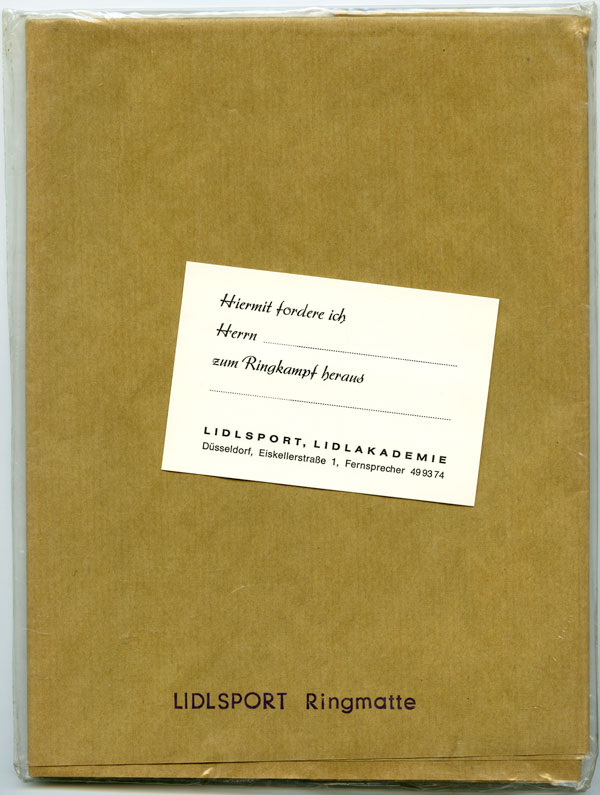
Lidlsport Ringmatte, 1969
ca 19 x 26 cm / unfolded 75 x 100 cm
hand stamped on kraft paper, with text on loose label, in original plastic bag
unlimited and unsigned edition
published by Vice-Versand / Wolfgang Feelisch, Remscheid, Germany
condition: mint – uncommon in this pristine condition
€ 225,- plus € 18,- Track & Trace registered EU mail
inv.JImm 000-pr
Jörg Immendorff’s LIDLSPORT–Ringmatte is a folded sheet of paper, that is meant to be laid out in public and wrestled upon. The loose label is essential. It explains the concept, at least indirectly that a fight on the mat of paper can take place.
In 1968 together with Chris Reinecke Jörg Immendorff founded the „LIDL-Aktionen“. His first „LIDL“-Kunstaktion with a black-red-golden log around his leg put the cat among the pigeons. On the log one could read the title of their new Kunstaktion “Lidl”, being a nonsense word taken from baby language. He walked up and down in front of the Bundestag in Bonn which brought the police eventually to intervene. His provocative attitude of neo-dada events later on triggered the German gouverment to expell him from the Akademie Düsseldorf, based on “Verunglimpfung der Bundesrepublik Deutschland”. Jörg Immendorff founded an office against the commercializing of the Olympiade 1972 and took the initiative to the Aktion “Selbsthilfe Wohnen”. He is also known for a painting called „Hört auf zu malen!“ quickly smeared on the canvas and crossed again with his paint brush. In short artistic concepts were connected to playful events addressing politicians and the society in general.
History of prices:
AaG Auktionshaus am Grünewald GmbH, Berlin, Germany 6 December 2025 € 120 (without label, hammer price)
Zwiggelaar Auktions, Amsterdam 22 July 2021 € 190 (hammer price)
Grisebach Auction, Berlin, Germany 29 November 2014 € 125 (incl. premium)
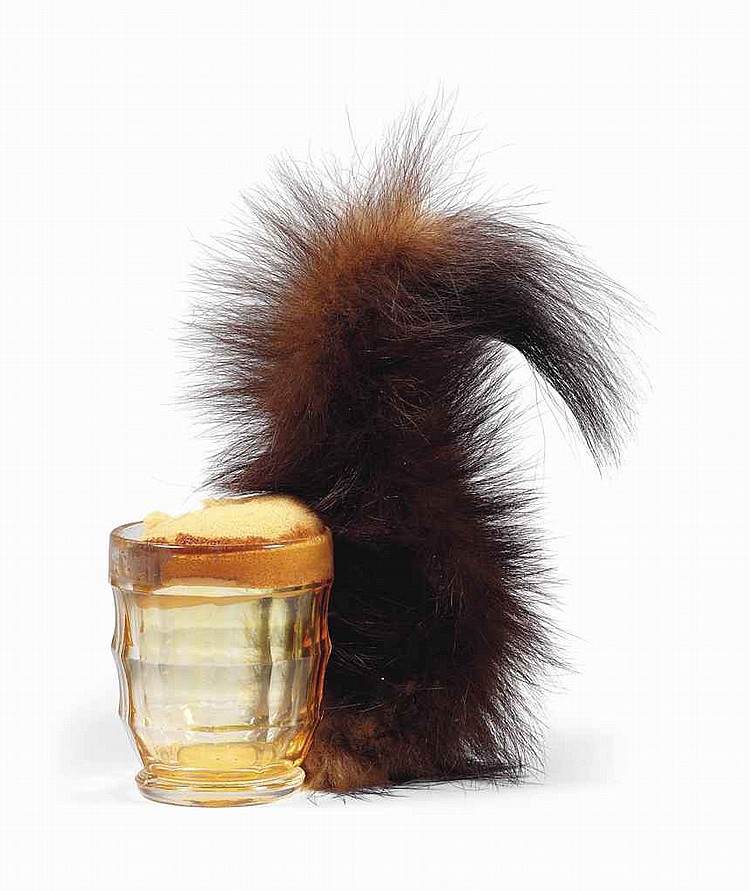
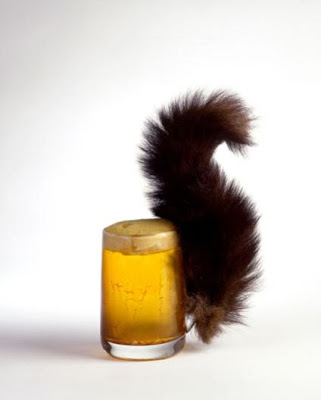
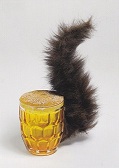
MERET OPPENHEIM, L’écureuil / squirrel, 1969
23 x 21 x 10 cm
beer glass, foam plastic, fur
edition 100
published by La Medusa Grafica
not available
Added information:
The condition of each individual multiple may differ, especially the foam and content of the beer glass is most of the time deteriorated, dried out or petrified.
History of prices:
Galerie Levy, Hamburg, Germany DM 3.000,- February 1985
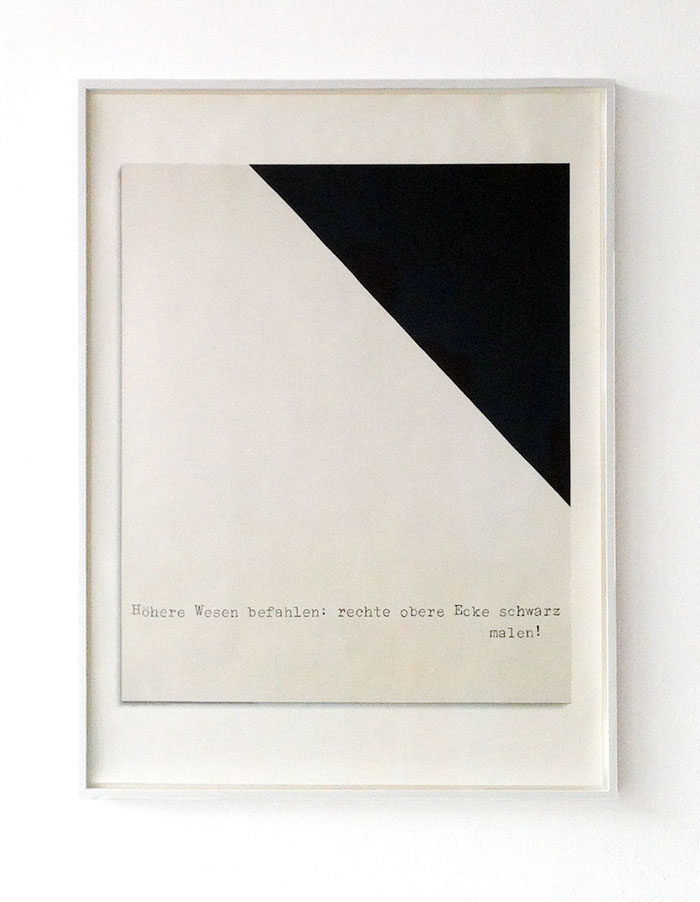
SIGMAR POLKE, Höhere Wesen befahlen: rechte obere Ecke schwarz malen!, 1969
96 x 72 cm (93 x 68,5)
offset print on very thin paper, framed behind anti UV-light glass
edition unknown
published by Edition René Block, Berlin, Germany
pristine condition extremely rare
Margin scheme, part of Private collection, Amsterdam
€ 12.000,- plus costs of transport
inv.SPol 000-pr
Sigmar Polke favoured a plan to have a cheap version in print of his painting Höhere Wesen befahlen: rechte obere Ecke schwarz malen! that is part of the collection of Van Abbemuseum in Eindhoven, Netherlands. Both painting and print caused irritation of the public.
This is printed matter on remarkable thin paper with a printed shadow and therefore may be considered as a work on its own. The painting has been photographically reproduced with several additions to its original. In the lower part of the reproduced painting a hue-like horizontal shadow (i.e. in the text part) causes a kind of snapshot-like liveliness. With the shadow lines on the left and bottom around the work depth is created; as if the light comes from the top right corner. Hence more than just a mere reproduction.
It is remarkable that until today TAIL never detected this edition on internet, sites of antiquarians or even auctions. This is definitely a priceless work.
ERIC ANDERSEN, Tape Piece, [1968]
three printed cards each 3 x 10,6 cm + piece from audio cassette tap in cellophane bag as published
this object is part of Ben Vautier’s magazine Fourre-Tout No. 3
edition 100 + 1 glass bottle with original manuscripts
published by Ben Vautier, Nice, France
Ref. Ben Vautier: Fourre-Tout No. 3, 1968
inv. BVau 220
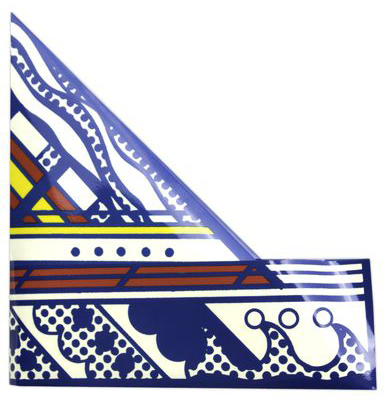
ROY LICHTENSTEIN, Folded Hat, 1968
7.25 x 14 inches
offset on plastic foil
published by The Letter Edged in Black Press Inc. / William Copley, New York 1968
not available separately
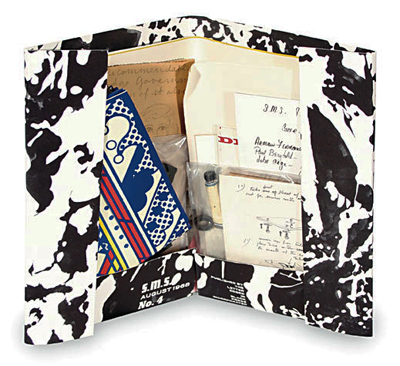
This SMS edition is part of issue #4 and an offset print on plastic, sandwiched in plastic and hand-folded to form a tri-cornered hat.
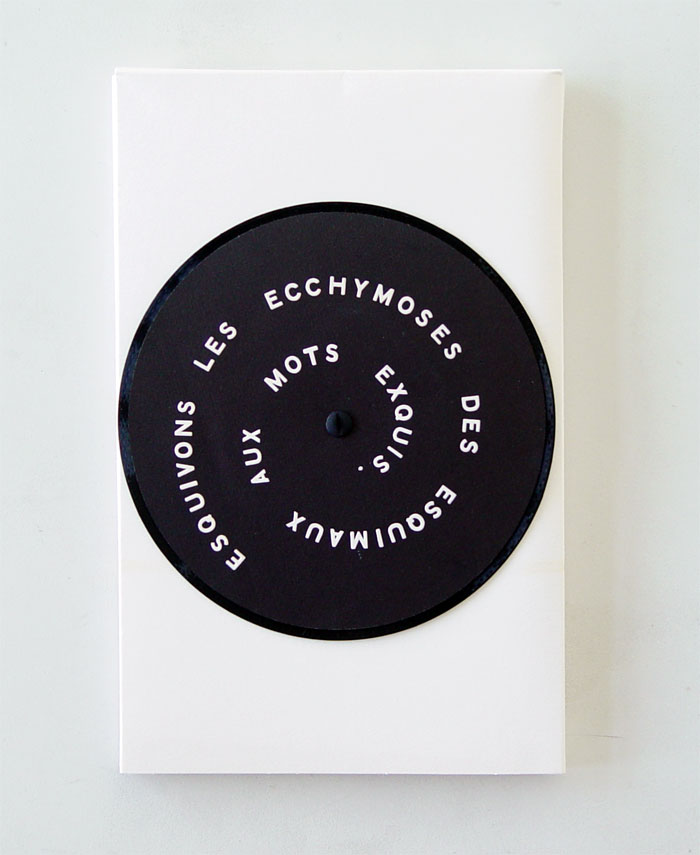
MARCEL DUCHAMP, Contrepetrie, 1968 [vinyl record on empty portfolio]
ca 28 x 18 x 2 cm / ca 11 x 7 x 0.8 inches
relief letters Esquivons les ecchymoses des esquimaux aux mots exquis
vinyl record 7’0”, glued on relief print, stiff paper portfolio
edition ca 2000
published by The Letter Edged in Black Press Inc. / S.M.S. – William Copley, New York 1968
condition: pristine, although with a very light brownish horizontal line on cover rare in this condition
€ 1.450,- plus € 18,- Track & Trace registered mail
inv.MDuc 000-pr
Sound record: 7′ recording of contrepetrie
This is one of the very last works that French artist Marcel Duchamp (1887–1968) created during his lifetime. It is a recording of his voice reciting French word games, known as contrepètries, which play with the sounds of words. The phonograph record presents an absurd alliterative sentence written in a spiral, that could translate to “We dodge the bruises of the Eskimos in exquisite words.”
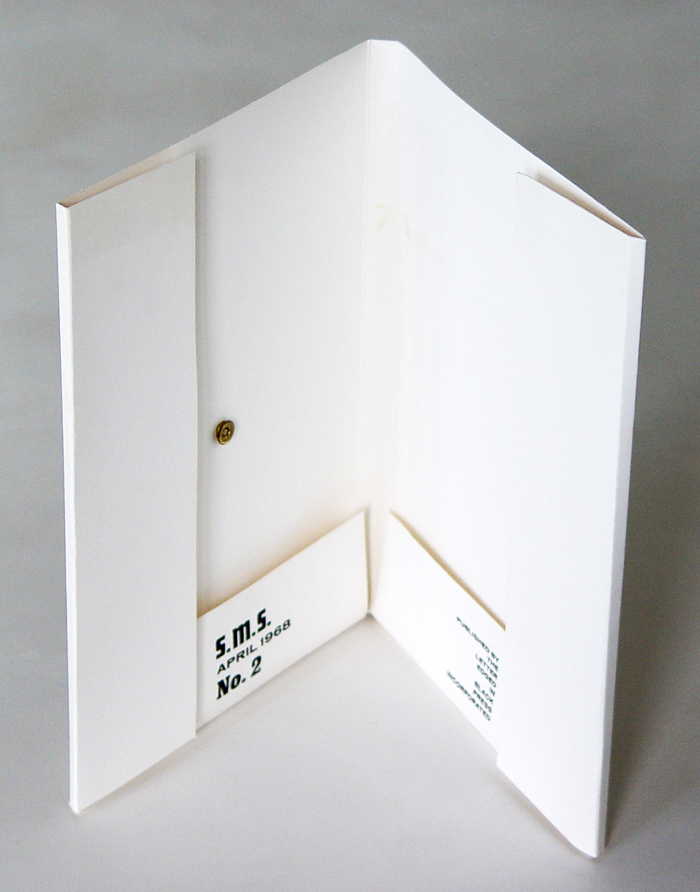
S.M.S., short for “Shit Must Stop,” endeavoured to do just that. Founded in New York City by artist, collector and dealer William Copley. S.M.S. was an art collection in a folio, filled with contributions of the artists invited by Copley. Regardless of stature, each was paid US$ 100,- for their contribution.
‘In 1967, in response to William Copley’s request to contribute to S.M.S., Duchamp gave him a sound recording (present location, unknown) he had made at an amusement booth around 1950. For the label of the record, they conceived of using a facsimile of one of the Disks Inscribed With Puns, 1926 (cat. no. 415-23), that Duchamp used in his film Anemic Cinema, 1926-26 (cat. no. 424).’ Arturo Schwarz
The SMS portfolios were a collaboration between William Copley & Dmitri Petrov which they published through their Letter Edged in Black Press Inc., working with some of the most important artists of the twentieth century. Exemplifying the community ethos of the ’60s, Copley sought to produce a new form of art journal that would bypass traditional institutions to distribute the artist’s work directly to its audience instead. Copley accepted contributions in almost any medium, carefully reproducing each artwork in his Upper West Side studio. All contributors, from the world-renowned to the obscure, received the same sum of $100 for their work. Presented without comment, each portfolio was mailed directly to subscribers every two months. Only six portfolios were produced, in an edition of 2000. Each portfolio contained from eleven to thirteen artist objects.
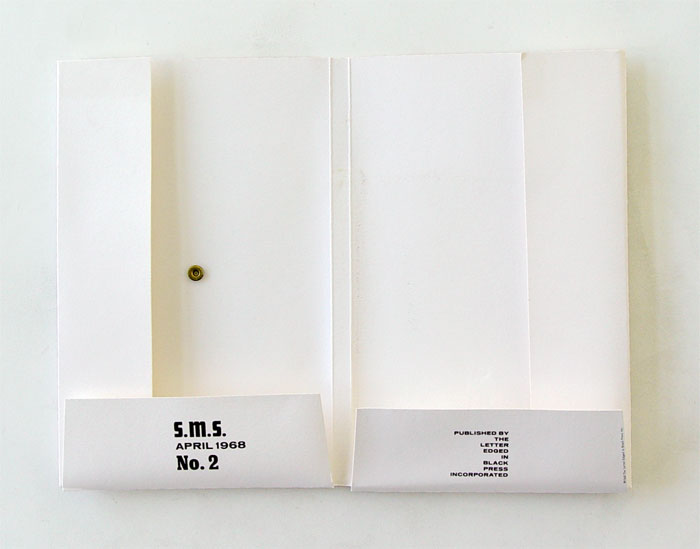
This SMS #2 edition is a seven-minute recording by Duchamp of “contrepetrie,” a word play involving transposing words, letters, and syllables and their sounds to make puns and effect new meanings. Record is part of S.M.S. magazine No.2 – April 1968.
History of prices:
1stDibs, New York, USA € 5.346,- September 2023 (make offer)
eBay-feltown2015, Madrid, Spain € 1.400,- September 2023
Akim Monet Fine Arts, Dallas/Los Angeles, USA US$ 1,000.- September 2022
Gerrish Fine Art, England GBP 1,250.- March 2020
Akim Monet Fine Arts, Los Angeles, USA, April 2020, US$ 2,000.-
Stubbs Fine Art, UK, March 2020, GBP 950.-
Wright Auction, Chicago, USA, 18 January 2018, US$ 500.- incl. premium
_________________________________________________
Extra information:
Original content of the empty portfolio S.M.S. issue # 2 as shown above:
The magazine came in the shape of a white folder which contained art multiples – here not for sale – by the following artists:
1. Nicolas Calas 2. Bruce Connor 3. Marcia Herscovitz 4. Alain Jacquet 5. Ray Johnson 6. Lee Lozano 7. Meret Oppenheim 8. Bernard Pfreim 9. George Reavey 10. Clovis Trouille 11. Marcel Duchamp (the record).
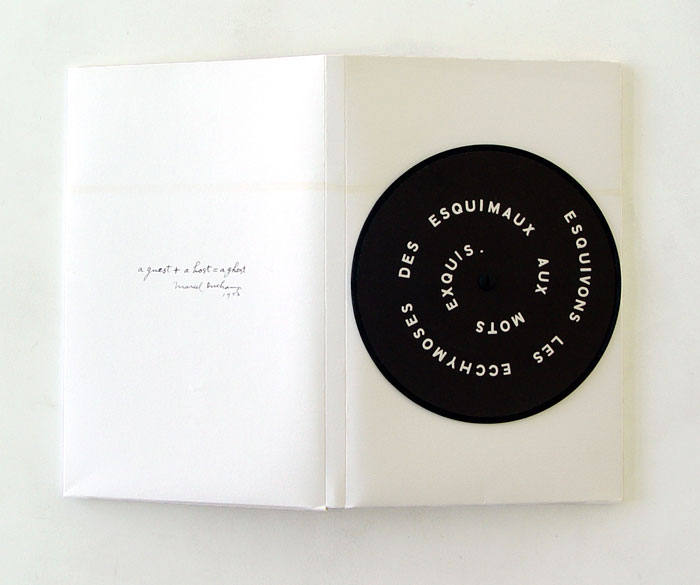
Magazine cover reads “A guest + a host = a ghost, Marcel Duchamp 1953”.
Record is fixed with nut and bolt to the magazine.
Part of a folio of artist multiples, Marcel Duchamp’s piece works on at least two levels. One side of this disc features a short word game printed on black paper which covers the area of any grooves. The text “esquivons les ecchymoses esquimeaux aux mots exquis” (trans. ‘Let us dodge the bruises of the Eskimoes in exquisite words’). It is based on an element in Duchamp’s anagrammatically named filmplays on the similarity of the sound of words with quite different meaning and is one of the many circular texts seen rotating on similar discs in Duchamp’s film “Anemic Cinema”. The whole series of text is read by Duchamp on the opposite side of the disc in a 7 minute recording. While almost all are in French, Duchamp does include a single example in English: “my niece is cold because my knees are cold” which helps convey the sense of word play inherent in these pieces, and in fact in much of Duchamp’s work. The reading and circular representation of one of the texts display the circular aspects of these pieces which draw their sly humor from internal references within each stanza. While published in 1968, the recording sounds much older due to its thin quality, and may in fact have necessarily drawn from an archival source as Duchamp passed away that year. Adding to this, the record is haunted by a large amount of surface noise as the playing side was mounted directly to the folder cover enclosing SMS No. 2 leaving the surface exposed to more abuse. The combination of the fidelity and surface noise leaves the record sounding like an older 78 shellac disc even after extensively cleaning. Nonetheless, it is still an important document given the scant number of recordings of Duchamp’s calm speaking voice.
The work ‘Contrepetrie’ is mounted on a portfolio in which SMS # 2 was issued, being a part of the contribution to the magazine. Signed and dated in print verso on portfolio.