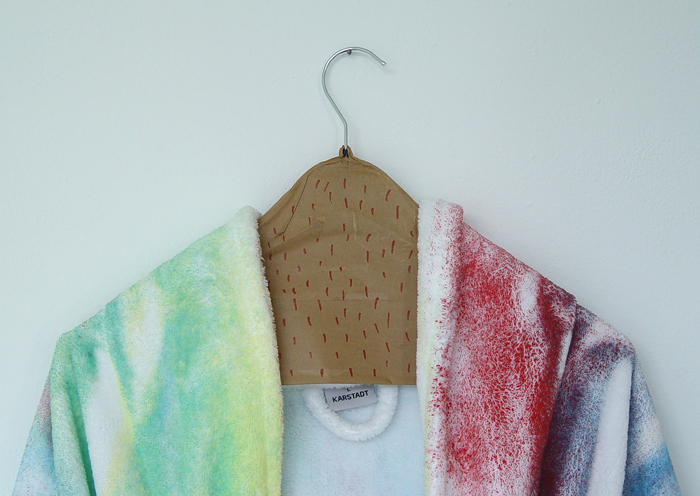
JAN KÄMMERLING, Greetings!, 2015
ca 20 x 18 x 1,5 cm
paint, cut postcard
series of 3 unique postcards
published by the artist
For a group exhibition in Galerie van Gelder, Amsterdam in 2015 named ‘Postcards are to be looked at’ Jan Kämmerling made a series of three unique wall sculpture made by postcards.
JAY TAN, Mums Magnets, 2015
10 x 5,9 cm
photo prints, magnetic flexible sheets
signed, numbered, dated
series of 4 different magnets; each edition 9
published by Galerie van Gelder Editions, Amsterdam, Netherlands
each € 100,- / set of 4 € 300,-
On Saturday 5 September 2015 four fridge magnets – nrs 6/9, 7/9, 8/9 and 9/9 – were stolen during the opening of Jaap Kroneman. These are officially registered at the police as taken away by someone of the inner (Arnhem) art circle.
One of the magnets:
Although Jay Tan makes installation-based exhibitions, often the works involved are dealt with in an individual way, including furniture, video, texts, printed matter, photos, food, clothing, presents from friends. She has recently begun to include performance. Occupied by the desire to understand relations between everyday materials and contextual knowledge, she questions both the eye and the mind by putting e.g. a drinking glass with cute small colourful candles all alone on a long clean kitchen sink. KvG
MORITZ EBINGER, Golden Poem / Golden Garden, 2014
30,5 x 30,5 cm
LP, 24 carat gold on metal
two versions: “Golden Poem” and “Golden Garden”, each edition 6
verso signed, numbered, dated
published by the artist
This guilded LP comes with regular vinyl; signed on cover
€ 350,-
Moritz Ebinger is known for connecting anything with everything, a bit like André Breton’s method of the écriture automatique. He has made many wall installations with curly crawling creatures that disappear in words and the other way around. He loves to get people involved in his art, activities and actions. The golden record ‘Mi fen ‘na Gowtu’ (Surinam for ‘Let’s go to the gold’ and notice that every round of the record player’s needle deteriorates the grooves!) shows his remarkable generosity towards not only the accumulation of his images already produced but also to people around him. KvG
This golden record contains conversations of a Swiss banker, the owner of a goldmine, a quick silver smugler, a herb-doctor, a Buddha monk and musicians/artists who were commissioned by Moritz Ebinger to participate in this project by integrating Gold in their contributions. Participating artists, among others: The Suprematist Guitar Ensemble, Dick el Demasiado, Bo Kisser, Boompje Trie, Sixton Creeps, FLG Banda Bachata, Klaske Oenema & Harm Wierda, Barney de Krijger and Bigeneric aka Marco Repetto (Marco is the artistic genius of ‘Ich möchte ein Eisbär sein im kalten Polar’ for Grauzone).
JOAN JONAS, untitled, 2015
140 x 140 cm / 54.6 x 54.6 inches,
hand-printed shawl (5% Cashmere, 35% Silk, 30% Wool), tag, print on wooden box
edition 160 + 10 AP, here nr 32/160
signed, numbered on certificate of authenticity
also print signed in fabric mint
published by Yoox Group, Bologna, Italy
€ 460,- plus € 24,- Track & Trace registered EU mail
Known as an “artist’s artist,” Joan Jonas has influenced artists with her integration of live performance and video – from the late 1960’s on.
The Nam June Paik Art Center in Korea has named Joan Jonas as the winner of the Nam June Paik Prize 2024.
History of price:
Fondazione Ratti, Como, Italy January 2026 € 500,-
Artspace, new York, USA April 2023 € 583,-
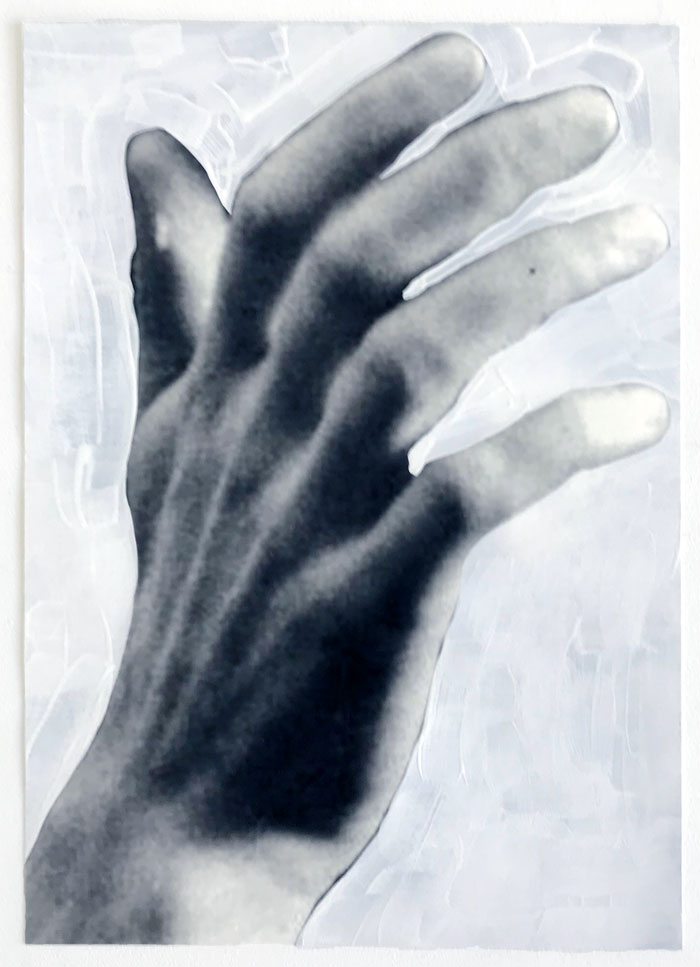
JONATHAN MONK, Hand Painted by Hand, 2015
26,7 x 19 cm
gouache on digital photographic fiber based matt paper
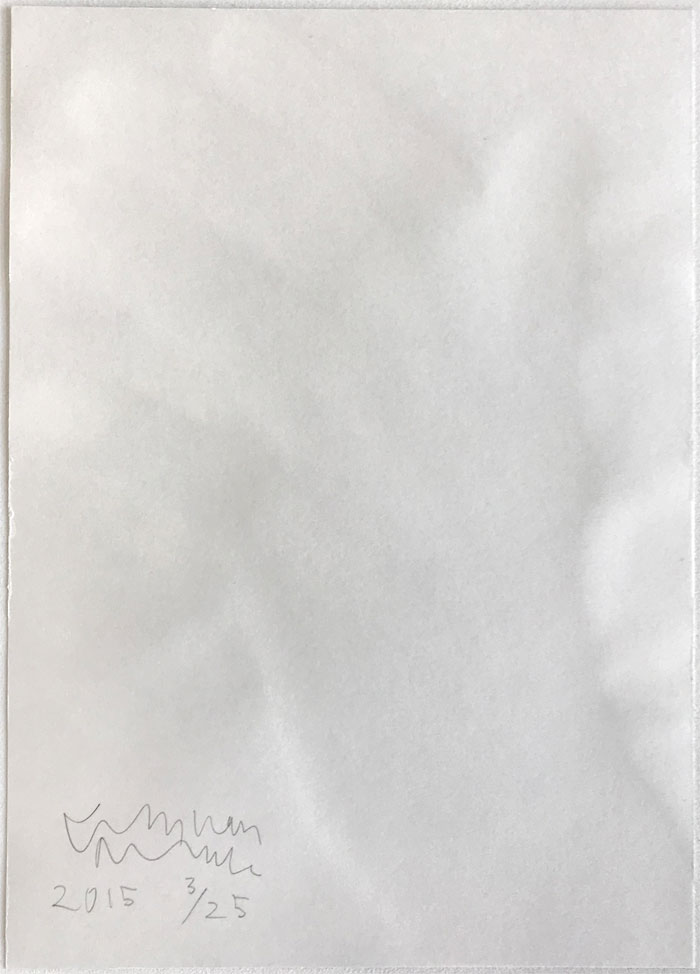
unique hand painted series of 25, here number 3/25
pristine condition, with waves in paper as issued
published by Camden Arts Centre, London, UK
inv.JMon 1097
available at publisher
This edition shows the hand from Bas Jan Ader’s work I’m Too Sad to Tell You, with the background painted by hand by Jonathan Monk. The latter is known for emphasizing the simplicity inherently present in a working plan like painting a background of a hand by his hand. Any subject is allowed as long as the obvious can be banally pushed further: “… Once something has been done, it can be done again in a different colour.” By means of doubling and repeating the result has most of the time the effect of a Fluxus-like humor.
Together with artists like Yann Sérandour, Claude Closky, Nicolas Chardon, Martin Creed a.o. Jonathan Monk belongs to a generation that is – apparently being impressed by historical mile stones – making use of references to works of famous colleagues in the past.
RICHARD PRINCE, lecture, 2015
4.7 inch vinyl audio CD
with plastic sleeve as issued
edition unknown
inv.RPri 186_187-pr
Recording of a lecture by Richard Prince on what he is interested in and above all on what he is not……., surprisingly with cliche statements on The Doors, Jim Morrison, Punck, Heavy Metal, Pop art, Paul Gaugain, e.a. KvG
DORA GARCÍA, The Sinthome Score, 2015, alias Venice Sinthome Score Edition
26,5 x 37 x 11,5 cm
printed matter, photo print + original drawing, signed, numbered
score book (31 x 23 cm) used as performance prop, numbered and also signed
edition 16
published by ProjectSD, Barcelona, Spain
7 parts
– one of the scores (performance prop) used by the performers during the exhibition in the Venice Biennual 2015, signed with initials, numbered
– original drawing made by Dora García in A4 size, which refers to the cosmogonies created for the work, signed
– photograph, 30 x 24 cm, C-print of a moment of the performance in Venice, signed with initials, dated, numbered
– catalogue ‘I See Words’ (sealed)
– folio with certificate of authenticity, signed, dated in print
– folio with sticker
– cardboard archive box with sticker
The work of the French psychoanalyst Jacques Lacan appears in García’s recent work. The score of the performance is based on an “unofficial” English translation of Jacques Lacan’s seminar 23 “Le Sinthome” (1975-1976), a series of ten lectures that drew from the writings of James Joyce to elaborate on language, the unconscious, and a reconsideration of the Borromean knot.
Lacan and his relationship to James Joyce is the subject of the Dora García’s work The Sinthome Score. The term “sinthome” (symptom) originates from a text of the same name by Lacan, Le Séminaire livre XXIII, Le Sinthome (1975-1976) where Lacan uses Joyce’s writings to expand his model of the three rings composing a Borromean knot, i.e. Symbolic, Imaginary and Real. Joyce’s subversion of language becomes a way of knotting them together, as well as avoiding their collapse into madness: it is the synthome (symptom; synthomeis spelled in old French), in homage to the Irish writer’s penchant for etymology, portmanteaus and polyglotism.
The Sinthome Score (performance publication, photograph of performance): two people perform as a duo, where one of them reads from a book (cover looks like a music score publication) called “The Sinthome Score” and the second one executes a series of movements that change each time the reader begins a new chapter, following instructions in the book.
Garcia’s work is accompanied by ten sets of movements, one drawn for each of the ten lectures. Two performers determine the rhythm, cadence, and speed of the performance. Garcia’s score and choreographic notation welcome new participants, accidental stutters of the body, or slips of the tongue. It is left to the visitor to decide if, how, and when to enter the conversation. The performance was shown at the Venice Biennale 2015, running continuously during the opening hours.
The publication is one of the scores used at the Venice Biennual 2015.
DAVID HORVITZ, Studio Rent Editions, 2015 (December)
each 12,6 x 17,6 cm, 2 parts
colour photo prints, verso hand stamped
gravel imprints and two scuffings due to postal handling
signed, numbered, dated
edition 10
published by the artist
inv.DHor 000-pr