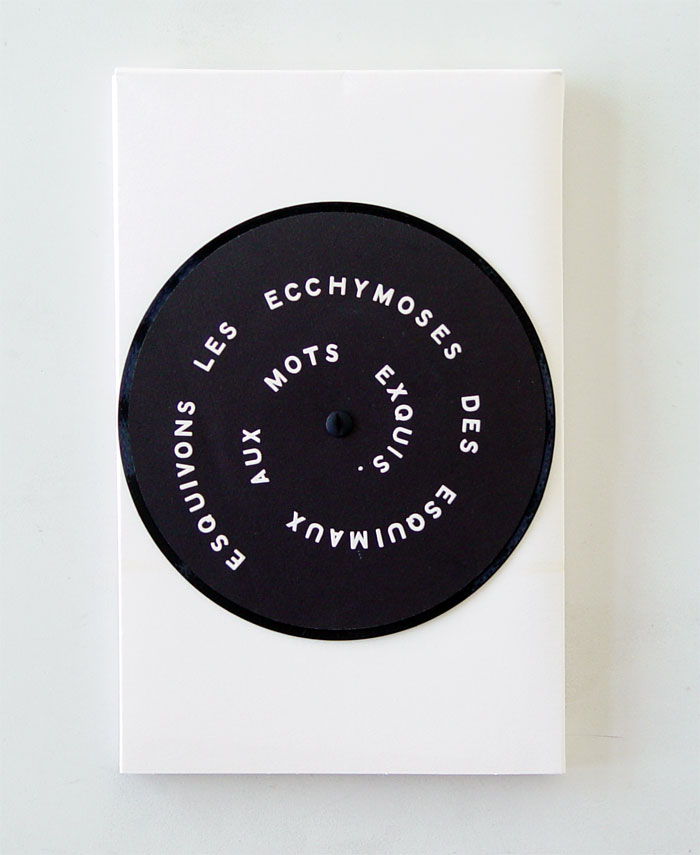
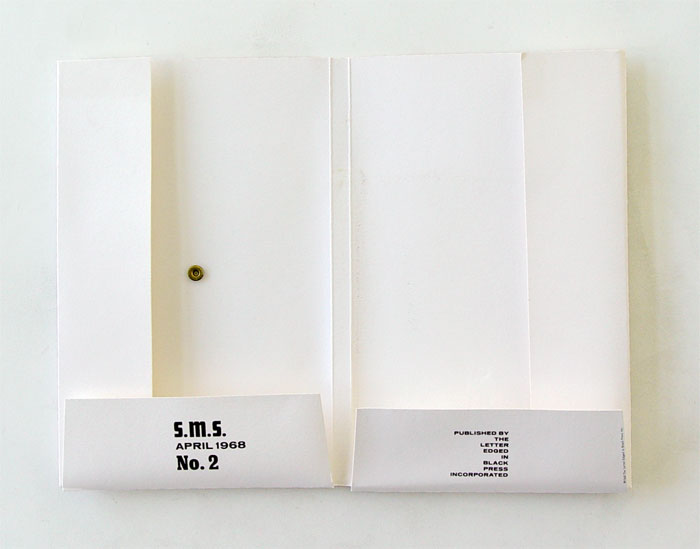
MARCEL DUCHAMP, Contrepetrie, 1968 [vinyl record on empty portfolio]
ca 28 x 18 x 2 cm / ca 11 x 7 x 0.8 inches
relief letters Esquivons les ecchymoses des esquimaux aux mots exquis
vinyl record 7’0”, glued on relief print, stiff paper portfolio
edition ca 2000
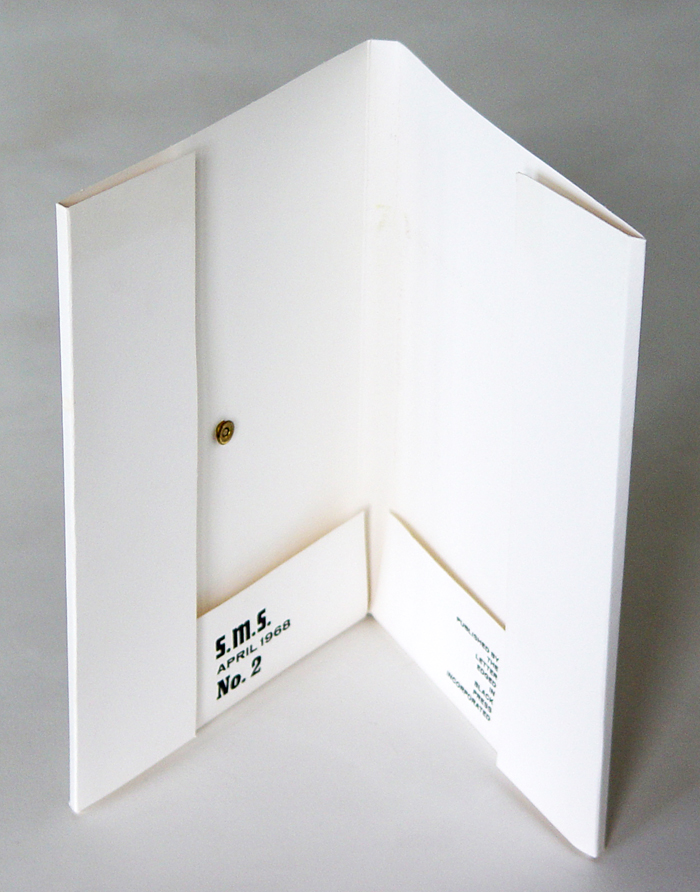
published by The Letter Edged in Black Press Inc. / S.M.S. – William Copley, New York 1968
condition: pristine, although with a very light brownish horizontal line on cover rare in this condition
€ 1.450,- plus € 18,- Track & Trace registered mail
inv.MDuc 000-pr
Sound record: 7′ recording of contrepetrie
This is one of the very last works that French artist Marcel Duchamp (1887–1968) created during his lifetime. It is a recording of his voice reciting French word games, known as contrepètries, which play with the sounds of words. The phonograph record presents an absurd alliterative sentence written in a spiral, that could translate to “We dodge the bruises of the Eskimos in exquisite words.”
S.M.S., short for “Shit Must Stop,” endeavoured to do just that. Founded in New York City by artist, collector and dealer William Copley. S.M.S. was an art collection in a folio, filled with contributions of the artists invited by Copley. Regardless of stature, each was paid US$ 100,- for their contribution.
‘In 1967, in response to William Copley’s request to contribute to S.M.S., Duchamp gave him a sound recording (present location, unknown) he had made at an amusement booth around 1950. For the label of the record, they conceived of using a facsimile of one of the Disks Inscribed With Puns, 1926 (cat. no. 415-23), that Duchamp used in his film Anemic Cinema, 1926-26 (cat. no. 424).’ Arturo Schwarz
The SMS portfolios were a collaboration between William Copley & Dmitri Petrov which they published through their Letter Edged in Black Press Inc., working with some of the most important artists of the twentieth century. Exemplifying the community ethos of the ’60s, Copley sought to produce a new form of art journal that would bypass traditional institutions to distribute the artist’s work directly to its audience instead. Copley accepted contributions in almost any medium, carefully reproducing each artwork in his Upper West Side studio. All contributors, from the world-renowned to the obscure, received the same sum of $100 for their work. Presented without comment, each portfolio was mailed directly to subscribers every two months. Only six portfolios were produced, in an edition of 2000. Each portfolio contained from eleven to thirteen artist objects.
This SMS #2 edition is a seven-minute recording by Duchamp of “contrepetrie,” a word play involving transposing words, letters, and syllables and their sounds to make puns and effect new meanings. Record is part of S.M.S. magazine No.2 – April 1968.
History of prices:
1stDibs, New York, USA € 5.346,- September 2023 (make offer)
eBay-feltown2015, Madrid, Spain € 1.400,- September 2023
Akim Monet Fine Arts, Dallas/Los Angeles, USA US$ 1,000.- September 2022
Gerrish Fine Art, England GBP 1,250.- March 2020
Akim Monet Fine Arts, Los Angeles, USA, April 2020, US$ 2,000.-
Stubbs Fine Art, UK, March 2020, GBP 950.-
Wright Auction, Chicago, USA, 18 January 2018, US$ 500.- incl. premium
_________________________________________________
Extra information:
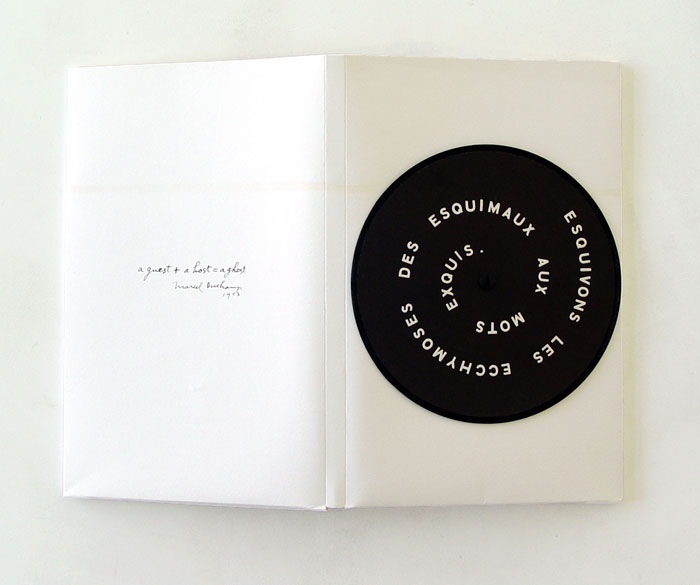
Original content of the empty portfolio S.M.S. issue # 2 as shown above:
The magazine came in the shape of a white folder which contained art multiples – here not for sale – by the following artists:
1. Nicolas Calas 2. Bruce Connor 3. Marcia Herscovitz 4. Alain Jacquet 5. Ray Johnson 6. Lee Lozano 7. Meret Oppenheim 8. Bernard Pfreim 9. George Reavey 10. Clovis Trouille 11. Marcel Duchamp (the record).
Magazine cover reads “A guest + a host = a ghost, Marcel Duchamp 1953”.
Record is fixed with nut and bolt to the magazine.
Part of a folio of artist multiples, Marcel Duchamp’s piece works on at least two levels. One side of this disc features a short word game printed on black paper which covers the area of any grooves. The text “esquivons les ecchymoses esquimeaux aux mots exquis” (trans. ‘Let us dodge the bruises of the Eskimoes in exquisite words’). It is based on an element in Duchamp’s anagrammatically named filmplays on the similarity of the sound of words with quite different meaning and is one of the many circular texts seen rotating on similar discs in Duchamp’s film “Anemic Cinema”. The whole series of text is read by Duchamp on the opposite side of the disc in a 7 minute recording. While almost all are in French, Duchamp does include a single example in English: “my niece is cold because my knees are cold” which helps convey the sense of word play inherent in these pieces, and in fact in much of Duchamp’s work. The reading and circular representation of one of the texts display the circular aspects of these pieces which draw their sly humor from internal references within each stanza. While published in 1968, the recording sounds much older due to its thin quality, and may in fact have necessarily drawn from an archival source as Duchamp passed away that year. Adding to this, the record is haunted by a large amount of surface noise as the playing side was mounted directly to the folder cover enclosing SMS No. 2 leaving the surface exposed to more abuse. The combination of the fidelity and surface noise leaves the record sounding like an older 78 shellac disc even after extensively cleaning. Nonetheless, it is still an important document given the scant number of recordings of Duchamp’s calm speaking voice.
The work ‘Contrepetrie’ is mounted on a portfolio in which SMS # 2 was issued, being a part of the contribution to the magazine. Signed and dated in print verso on portfolio.
BRUCE NAUMAN
Footsteps, 1968
6,6 x 27,5 x 6,6 cm / 7.25 w x 11.75 h inches
offset, tape
edition 2000, of which 1500 have been in fact printed, including one hundred signed, portfolio #5
published by The Letter Edged in Black Press Incorporated, London, 1968
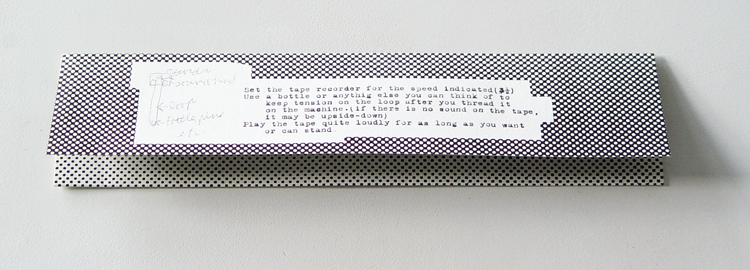
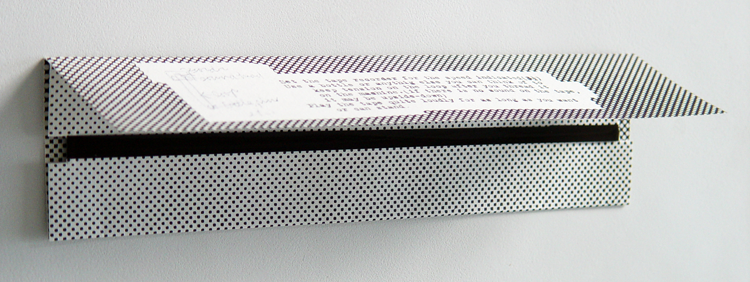
A loose piece of magnetic tape featuring sounds of walking wrapped around a triptych folded card with the following instructions: Set the tape recorder for the speed indicated (3½)
Use a bottle or anything else you can think of to keep tension on the loop after you thread it on the machine (if there is no sound on the tape, it may be upside down)
Play the tape quite loudly for as long as you want or can stand
William Copley, American surrealist painter and art dealer, invited artists in 1968 to contribute to his periodical entitled S.M.S., which stood for “Shit Must Stop.” Copley was inspired by the Fluxus movement.
Decades later the factual printed edition of 1500 got water damaged which left most of the items of portfolio #5 to a total of ca 800 copies.
The Letter Edged In Black Press Inc.
American William Copley founded the publishing house The Letter Edged in Black Press Inc. that produced 6 SMS (abbreviation for “Shit Must Stop”) portfolios released in 1968. In addition to providing a place for artists to work, Copley published a series of artists’ multiples sold by subscription. The artists represented ranged from the very well known to less known artists, including Christian Henning, Ben Patterson, Dick Higgins, Christo, Walter de Maria, Julian Levy, La Monte Young, Marian Zazeela, James Lee Byars, Marcel Duchamp, Bruce Conner, Meret Oppenheim, Ray Johnson, Nicolas Calas, José Cortes, H.C. Westermann, Hannah Weiner, Allan Kaprow, Joseph Kosuth, Roland Penrose, Man Ray, Terry Riley, Dick Higgins, Enrico Baj, Roy Lichtenstein, Arman, John Cage, On Kawara, Robert Watts, Hollis Frampton, Yoko Ono, Mel Ramos, Lawrence Weiner, Angus MacLise, Bruce Nauman, Walter Marchetti, Dian Wakoski, Richard Artschwager, John Giorno, Diter Rot, Claes Oldenburg, and many other with an open mind, covering many areas of art. Among the 73 individual works, 6 involved sound, while the majority were visual or written works. Meticulously reproduced, each item was a distinctive artistic work giving each issue a widely varying character.
BEN PATTERSON, Solo, 1965
each 28 x 21 cm and 21 x 21 cm
6 parts
offset on various kinds of paper, board
texts in German and English
signed, numbered
edition ca 500
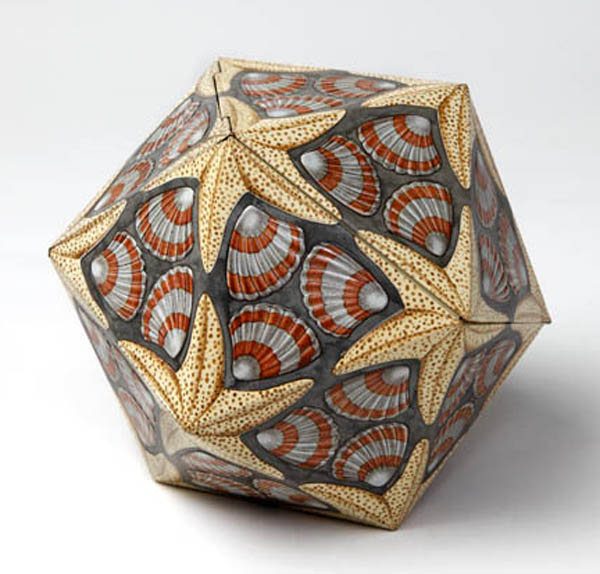
M.C. ESCHER, Icosaëder [Icosahedron], 1963
12,5 x 12,5 x 12,5 cm
printed tin box with embossed relief
edition 7100
published by Verblifa / Vereenigde Blikfabrieken, Krommenie; on behalf of its 75th anniversary
not available
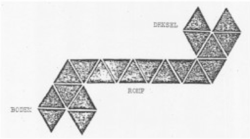
Originally M.C. Escher was not interested in a commission to make a tin box. Nevertheless a delegation of Verblifa convinced the artist eventually by showing a box called Koh-I-Noor once designed in 1955 for the Verkade chocolate factory, i.e. a Icosahedron, a geometrical shape with twenty sides. He got fascinated by this object and invented a way for having the box industrially produced by Verblifa.
The tin was produced in an edition of 6.800 and an additional 300 tins were produced to replace any defects.
Drawing of the invention for the production of the box by M.C. Escher displaying lid, hull and bottom.
Employees during the production of the icosahedron shaped tin boxes in Krommenie 1963.
History of prices.
Venduehuis, The Hague, Netherlands € 2.800,- 29 April 2021 (hammer price)
Auction house Christie’s, Amsterdam € 395,- / US$ 456.- / Dfl. 865,- December 1998
Auction house Vendue Huis, Den Haag € 800,- / US$ 1,060.- August 2013
New Art Editions US$ 1,425.- / € 1.075,- September 2014
KEN FRIEDMAN, This is really it! This is really it! This is?, ca 1962-1968
27,9 x 21,6 cm / 19,7 x 15,3 cm
prints on paper, folded as issued, petrified rubber band
3 parts from unknown source
inv.KFrie 1012
This is an unknown publication, probably connected to one of the “Fourre-Tout” publications produced by Ben Vautier in the sixties. An edition of 101 copies composed of two parts, i.e. a bocal and an envelope with artist’s contributions. For sale at Ben Vautier’s Fluxus shop ‘La Çedille qui rit’ in Nice, France. The theme of this issue “Fourre-Tout” (tr. mishmash) was apparently about “Realism”, although this is not explicitly outspoken in the accompanying text by ben Vautier.
BART VAN DER LECK, Metz & Co Amsterdam – Den Haag, 1952
31 x 13,2 cm
flex print on paper bag, chord
design for and published by Metz & Co, Amsterdam / The Hague
condition: good
€ 225,- plus € 15,- Track & Trace EU registered mail
inv.BvdL 000-pr
Since 1900 Metz & Co. had been under the far-sighted management of J. de Leeuw, who imported the internationally renown Liberty fabrics from London. In the 1920s he introduced stylish, deluxe furniture from Paris and Vienna while gradually taking on more Dutch industrial artists. De Leeuw’s introduction to Rietveld and the painter Bart van der Leck around 1930 brought renewed vigour to the store. Van der Leck designed the firm’s logo as well as an assortment of bags and boxes in his inimitable style of fragmented letterforms with primary colours, all properly reflecting Metz & Co.’s combination of exclusivity and the avant-garde.
The bag’s restraint and air of modernity look is still striking and fresh. On the one hand, the design is applied with a sleek and understated elegance at the bottom of the paper bag, like a sort of stamp. On the other hand, the lettering within the two rectangles is applied decoratively in a refined manner, using lines and blocks.
Metz & Co was a firm specialized in furniture, textiles, and arts and crafts.
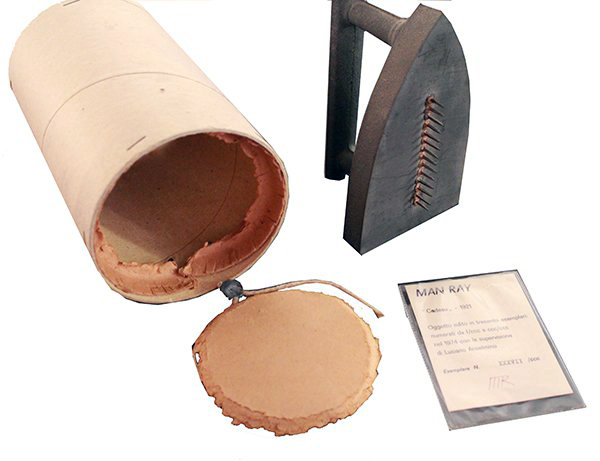
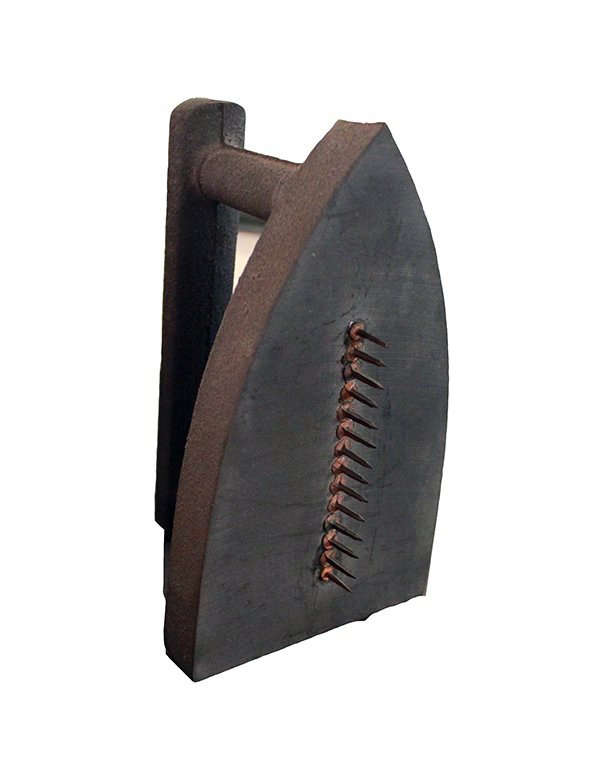
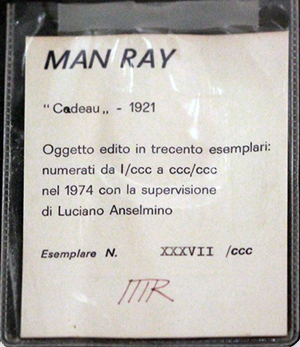
MAN RAY, Cadeau, 1921
16,5 x 10,2 x 9,5 cm
Cast iron, copper spikes, cilinder shaped cardboard box, certificate
signed with initials in ink, numbered
edition 300
The work ‘Cadeau’ was published in 1921 under the supervision of founder Luciano Anselmino, Turin. Here with original box. Again it was executed in 1974 by the same founder and publisher Luciano Anselmino in an edition of 5000, accompanied by a signed and numbered plastic card and a numbered certificate by Arturo Schwarz with information about the object.
“Man Ray never destroys, he always modifies and enriches. In this case, he provides the flat iron with a new role, a role that we dimly guess, and the probably accounts for the object’s strange fascination.”
Arturo Schwarz (dealer and author)