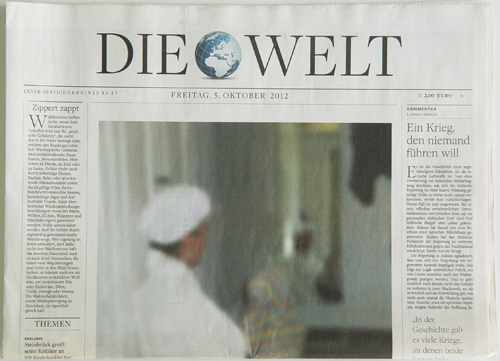
GERHARD RICHTER, Die Welt, 2012
57,3 x 40 cm
digital pigment print on heavy quality paper
signed, numbered
edition 100
published by Die Welt, Berlin, Germany
mint condition
€ 7.800,- plus € 32,- Track & Trace registered mail
inv.GRich 401-pr
The own family is a recurring motive in the work of Gerhard Richter, opposite to newspaper clippings of people he doesn’t know and that he integrates in his paintings. He painted his first wife, Ema, he portrayed his daughter “Betty” as well as his “Uncle Rudi” and “Aunt Marianne”. The latter two family members were painted in relation to Nazi Germany.
The front page of the edition of the daily newspaper “Die Welt” depicts Richter’s second wife Sabine in a white bathrobe and his son Theo in a striped towel, although not recognizable. Painted in his renowned style of blurring a realistic image. Gerhard Richter remarked that it reminded him of Ingres’ painting ‘The Turkish Bath’ (the picture was taken in hotel “Waldhaus” in Sils-Maria).
History of prices:
ArtPrintX.com, Ravensburg, Germany € 8.714,- February 2024
Artsation GmbH, Munich, Germany € 10.400,- June 2016
Lempertz, Cologne, Germany € 5.208,- November 2015 (hammer price)
Artsation GmbH, Munich, Germany € 10.400,- December 2014
Artsation GmbH, Munich, Germany € 7.350,- September 2013
Artsation GmbH, Munich, Germany € 5.350,- August 2013
Die Welt, Berlin, Germany September (year of issue) € 2.000,-
Extra information:
GERHARD RICHTER, Die Welt of 5 October 2012
offset newspaper
29,5 x 40 cm
edition ca 251.500
splendid condition, folded to tabloid size as shown
published by Die Welt, Berlin, Germany
inv.GRich 000-pr
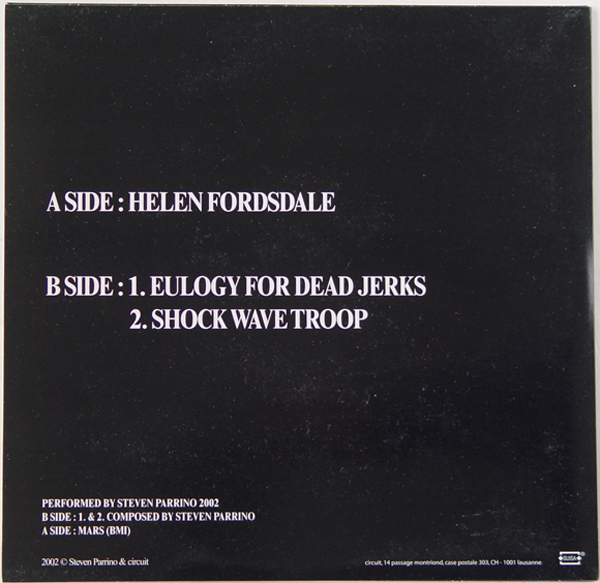
STEVEN PARRINO, Electrophilia, Shock Wave Troop, 2002
live performance with Steven Parrino
10 inch LP, 45 rpm
edition of 400
published by Circuit, Lausanne, Switzerland
p.o.r.
UGO RONDINONE, Cigarettesandwich, 2011 DVD 52′, jewel case
edition 300
published by Galerie Eva Presenhuber, Switzerland not available
Swiss artist Ugo Rondinone examinins the psychic and emotional nature of even the most banal events that occur in real life. Since 1997, Rondinone has been making neon-lit, rainbow-colored signs from phrases he appropriates from pop songs and everyday exclamations that are joyous affirmations of love and life, including the sculpture “Hell, Yes” which spells out the title in gigantic rainbow letters on the facade of the New Museum of Contemporary Art in Manhattan’s Bowery district in New York City.
History of prices:
Galerie Eva Presenhuber, Switzerland € 300,- / US$ 400.- August 2012
UGO RONDINONE, still.life. (apple), 2008 2.25 x 2.5 x 2.25 inches
painted bronze, lead
edition 20 not available
Ugo Rondinone’s “still.life (apple)” is a highly realistic, lead-filled, painted bronze sculpture. A promotion text explains: ‘As the title still.life suggests, Rondinone’s multiple represents a self-contained, frozen moment; weighted and isolated with lead. This apple is an object of desire: it is a sublime example of trompe l’oeil, which reflects a long tradition of still life in paintings’.
History of prices:
Sculpture Center, New York, USA US$ 6,500.- February 2012
SIGURDUR GUDMUNDSSON, Fragment, 1969-2010
32,3 x 23,9 cm (image 9,9 cm x 10,7 cm) / 12.7 x 9.4 inches (image size is 3.9″ x 4.2″)
black and white photograph
signed, numbered
edition 70
Depicting circumstances with absurdist tweaks, his Situations as he calls them read as visual poems that explore the idiosyncrasies of human existence and tend toward the comical while retaining philosophical gravity. Gudmundsson uses himself as the subject of the Situations, but does not consider the works to be self-portraits but, rather, open-ended reflections on a more universal level.
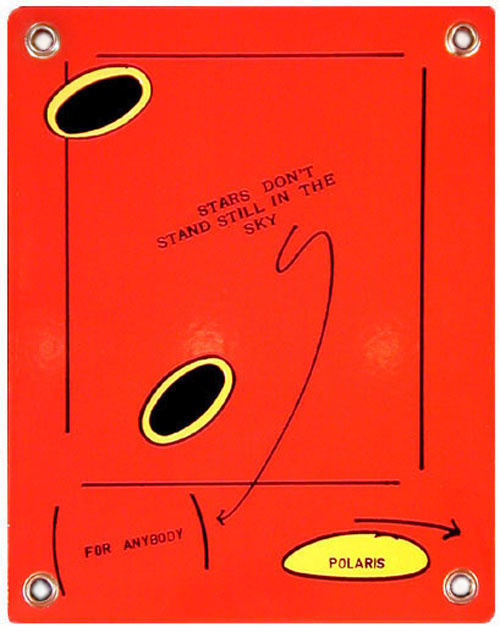
LAWRENCE WEINER, Stars don’t stand still in the sky, 2011
12,7 x 20,3 x 0,6 cm / 5 x 8.25 inches
enamel, raised metal plaque
signed on certificate, edition 100
published by ArtSpace Edition not available
This sculpture employs Weiner’s signature use of language and instructions. The blue arrow, red star, and yellow tags depict a kind of navigational sign based on an empirical fact. “Stars dont stand still in the sky” and yet where they’re going there are three possibilties as indicated: “wheresoever,” “whensoever,” or “howsoever.”
History of price:
€ 715,- / US$ 900.- August 2012
Additional information
There is also another edition with the same titled.
LAWRENCE WEINER, Stars don’t stand still in the sky, 1990
27,7 x 22 x 2 cm / 10 6/8 x 8 5/8 x 1/16 inches
enamel on metal
edition 60
published by Brooke Alexander Gallery, New York, USA
not available
MIKE KELLEY, Street Sign, 2004
39,5 x 61 cm / 15.5″ x 24″
silkscreen on metal plate
edition of 100
LACE Edition, Los Angeles, USA
not available
“When Mike Kelley moved to Los Angeles in the mid 1970’s to attend the California Institute of the Arts in Valencia, several of his first public performances and exhibitions occurred at LACE including “The Little Girls Room” where Kelley exhibited props, drawings, photographs, writings and an environmental audio work. Building his reputation as a provocateur, many of his pieces critique American culture and consumerism and are intended to make the viewer uncomfortable.”
History of prices:
LACE Edition, Los Angeles, USA $1,500 December 2004
MAI-THU PERRET, 2010
set of 4 glasses, edition 100
Swiss Institute, New York US$ 100.- January 2011
Mai-Thu Perret’s works, in a variety of media, from ceramics and textiles to paintings, sculptures or film, have all in common a hand-made aesthetic and use the formal vocabulary of modernism. References to Russian constructivism, 19th-century Arts & Crafts Movement, early-20th-century mysticism, Minimalism, and various other modern art movements can be found all over her work. By interweaving historical movement and her own fiction, Mai-Thu Perret questions utopias and how they could be a context for the production of objects and especially works of art. Within the production of both utilitarian and decorative objects, she’s interested in the status of artworks.