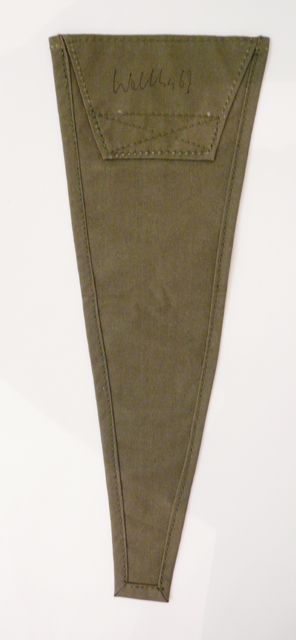
FRANZ ERHARD WALTHER, Find a purpose for the pocket, 1969
ca 37 x 13,5 cm
canvas shaped pocket
unlimited edition stamp signed, dated
condition: good, slightly discoloured
published by Vice-Versand, Remscheid, Germany
€ 1.450,- + € 18,- Track & Trace registered mail
inv. FEWal 27
Here the older and smaller version with stamped signature and date is shown. Franz Erhard Walther began making objects (…the work as a tool…) of fabric that invite the viewer to become active. Here a loop sewn onto the verso enables one to wear this triangle shaped pocket on a belt.
There are two versions: one with stamped signature and dated ’69 and one without. Apparently at some point not all editions were stamp signed and dated.
This work may be found with various titles like ‘Find a reason for this pocket’ or ‘Find a purpose for the bag’. In 1969 Wolfgang Feelisch advertised the multiple as “Find a purpose for the pocket”.
‘Multiple: Segeltuch in Dunkelgrün, genäht zu einer trapezförmigen Tasche mit Lasche, unlimitierte Edition; ca. 37 x 14 cm. Edition des Vice-Versandes. Schneider V 43; dort fälschlicherweise als “stempelsigniert” angegeben.’
From website dd 26 march 2024 of Artax Kunsthandel, Düsseldorf, Germany
History of prices:
Alternateprojects.com, US$ 1,800.- 19 August 2021 (stamp signed)
Alternateprojects.com, US$ 1,800.- 16 April 2020 (stamp signed)
Van Ham Kunstauktionen, Cologne, Germany € 400,- (hammer price) 24 October 2019 (stamp signed)
Karl & Faber, Munich, Germany € 500,- (excl. VAT) 6 December 2018 (stamp signed)
Grisebach, Berlin, Germany € 400,- (hammer price) 29 November 2014 (stamp signed)
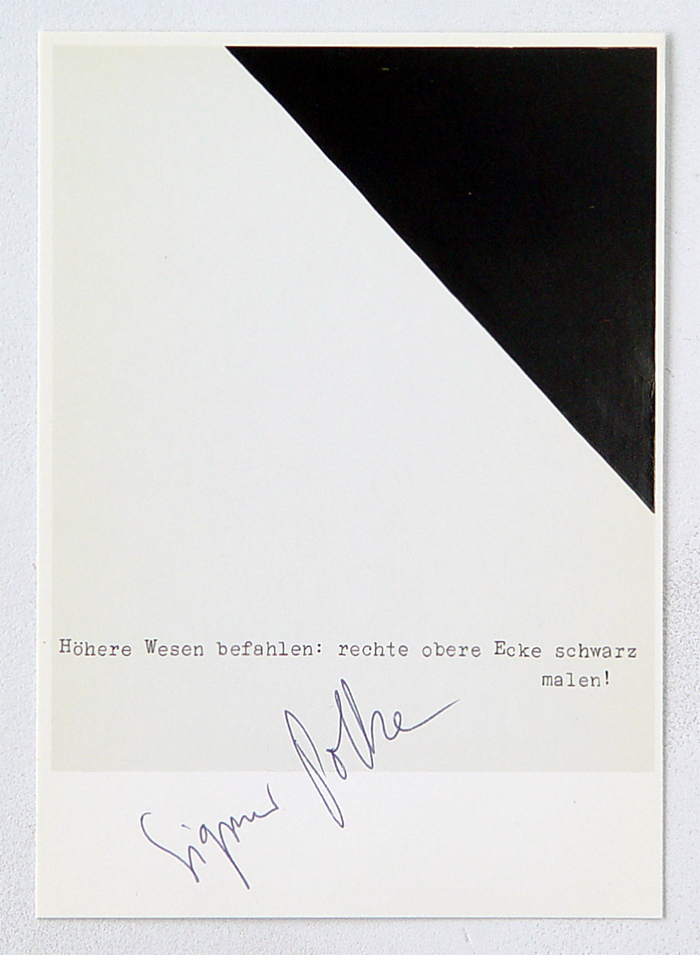
SIGMAR POLKE, Höhere Wesen befahlen: rechte obere Ecke schwarz malen! [1969]
14,8 x 10,5 cm
offset postcard, here signed rare
published by Gebr. König Postkartenverlag, Cologne, Germany
€ 590,- plus € 12,- Track & Trace registered EU mail
inv.SPol 000
This card has been published as part of a set of 10 and was not as such signed. Nevertheless in combination with the René Block poster ‘Höhere Wesen befahlen: rechte obere Ecke schwarz malen!’ this signed postcard may be looked at as an authorization of both this card and the René Block poster from 1969.
OLIVIER MOSSET, Flux Dots by Mosset Total Art Nice, n.d. [1969]
10 x 12 x 1,6 cm
confetti – produced by George Maciunas – in red or black plastic box with label
very small edition: estimation ca 13 – 15
published by George Maciunas / Total Art, Nice, France
Private collection, Amsterdam extremely rare
p.o.r.
inv.OM 000-pr
In 1990 Olivier Mosset had his first solo show in Galerie van Gelder. A few days before the opening I presented him a red box ‘Flux Dots by Mosset’. “Well… looks good!” Olivier commented, “I have heard about it, but this is the first time I see this. I remember that Maciunas once phoned me. He asked whether I was the man of the circle paintings and I said yes, why…?” “Listen he said, you are a Fluxus artist, with all these circles on canvases, you really are!” “No, I answered, I don’t consider myself a Fluxus artist.” Maciunas: “Certainly you are and I have an idea. What about making a Fluxus box with punched dots, you know, like confetti?”
Related information
In 2008 Olivier Mosset had another solo exhibition in Galerie van Gelder. He arrived with huge white monochrome paintings of 8 meters long flown in from his studio in Tucson, Arizona. Still having his rain coat on he gave me a small thick envelope. “I got this from the heirs of Maciunas”, he said. “I don’t know what to do with it, so I thought I hand it over to you. You may do with it whatever you like.” I looked into the half opened cream colored envelope and saw a heap of hundreds of red confetti, unmistakably the ones Maciunas punched for his Flux Dots box edition.
Ref. Kees van Gelder talking to Olivier Mosset in Galerie van Gelder on 20 March 2008.
Ben Vautier opened a gallery shop BDDT / Ben Doute de Tout in Nice in 1958, which later became well-known as the Around 1960. He started to know the artists of Nouveau Réalisme: Yves Klein, Daniel Spoerri and others. In the autumn 1962, he travelled to London for visiting the Festival of Misfits, where he encountered many Fluxus artists, with whom he subsequently collaborated in various ways. A year later, Vautier organised the Fluxus Festival of Total Art in Nice.
OLIVIER MOSSET, Flux dots [1969]
10 x 12 x 1,6 cm / 3.5 x 4.75 x 0.75 inches
edition ca 13 – 15, here box 13 (in black)
published by George Maciunas, New York, USA
OLIVIER MOSSET: Flux Dots [1969] – black box version
Collection University of Iowa Special Collections, Iowa City, USA
OLIVIER MOSSET: Flux Dots [1969] – black box version/verso
Ref. the Fluxus Digital Collection of the University of Iowa were donated by artist Ken Friedman.
FRANZ ERHARD WALTHER, ‘Sockel: Hand und Arm unten’, 1969
59,3 x 19 x 2 cm / 23 3/8 x 7 ½ x 0 6/8 inches
hand sewn fabric
edition 20
signed, dated, numbered on technical drawing as work certificate (A4 size)
not available
The pedestal or ‘Sockel’ to be actively used by the viewer is a central concept in Franz Erhard Walther’s work. During the 1960s Franz Erhard Walther produced a series of 58 sculptural objects that were collectively titled ‘1. Werksatz’ (trans. “First Set of Works”). The earliest of these, ‘Stirnstück’ (trans. “Forehead Piece”), 1963, involved using the front of the head to slide a strip of maroon velvet down a wall. The works in the 1. Werksatz series explicitly tackle the relationship body versus sculpture, also dragging in the problem of the pedestal. Here ‘Sockel, Arm und Hand unten’ (1969) is next to being a title basically an instruction for using the piece as a pedestal. Not only meant physically as Piero Manzoni anticipated his ideas with his ‘Magic Bases’ (1962), namely conceived as a means of turning anyone who climbed onto them into a statue, but also as “a condition that produce a mental image”. The pedestal is a metaphor for everything that supports the human individual and upon which our own images come into being.
JÖRG IMMENDORFF
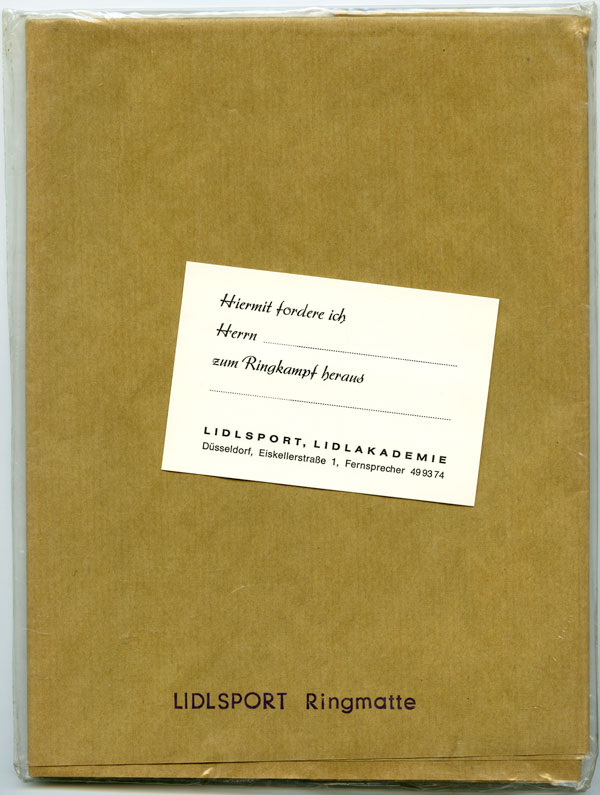
Lidlsport Ringmatte, 1969
ca 19 x 26 cm / unfolded 75 x 100 cm
hand stamped on kraft paper, with text on loose label, in original plastic bag
unlimited and unsigned edition
published by Vice-Versand / Wolfgang Feelisch, Remscheid, Germany
condition: mint – uncommon in this pristine condition
€ 225,- plus € 18,- Track & Trace registered EU mail
inv.JImm 000-pr
Jörg Immendorff’s LIDLSPORT–Ringmatte is a folded sheet of paper, that is meant to be laid out in public and wrestled upon. The loose label is essential. It explains the concept, at least indirectly that a fight on the mat of paper can take place.
In 1968 together with Chris Reinecke Jörg Immendorff founded the „LIDL-Aktionen“. His first „LIDL“-Kunstaktion with a black-red-golden log around his leg put the cat among the pigeons. On the log one could read the title of their new Kunstaktion “Lidl”, being a nonsense word taken from baby language. He walked up and down in front of the Bundestag in Bonn which brought the police eventually to intervene. His provocative attitude of neo-dada events later on triggered the German gouverment to expell him from the Akademie Düsseldorf, based on “Verunglimpfung der Bundesrepublik Deutschland”. Jörg Immendorff founded an office against the commercializing of the Olympiade 1972 and took the initiative to the Aktion “Selbsthilfe Wohnen”. He is also known for a painting called „Hört auf zu malen!“ quickly smeared on the canvas and crossed again with his paint brush. In short artistic concepts were connected to playful events addressing politicians and the society in general.
History of prices:
AaG Auktionshaus am Grünewald GmbH, Berlin, Germany 6 December 2025 € 120 (without label, hammer price)
Zwiggelaar Auktions, Amsterdam 22 July 2021 € 190 (hammer price)
Grisebach Auction, Berlin, Germany 29 November 2014 € 125 (incl. premium)
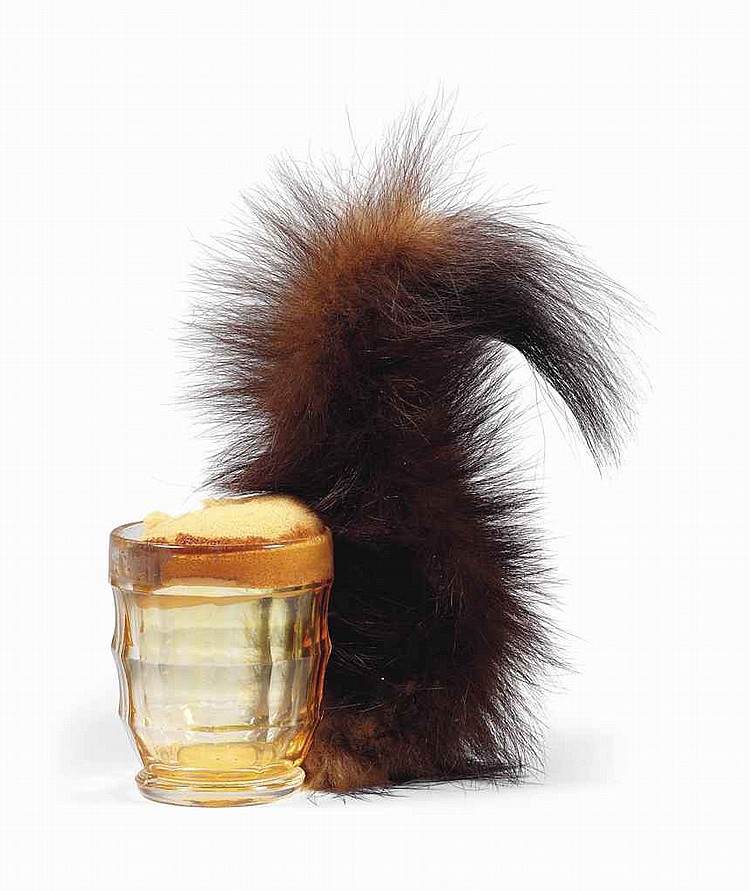
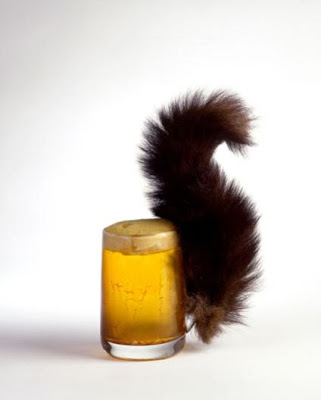
MERET OPPENHEIM, L’écureuil / squirrel, 1969
23 x 21 x 10 cm
beer glass, foam plastic, fur
edition 100
published by La Medusa Grafica
not available
Added information:
The condition of each individual multiple may differ, especially the foam and content of the beer glass is most of the time deteriorated, dried out or petrified.
History of prices:
Galerie Levy, Hamburg, Germany DM 3.000,- February 1985
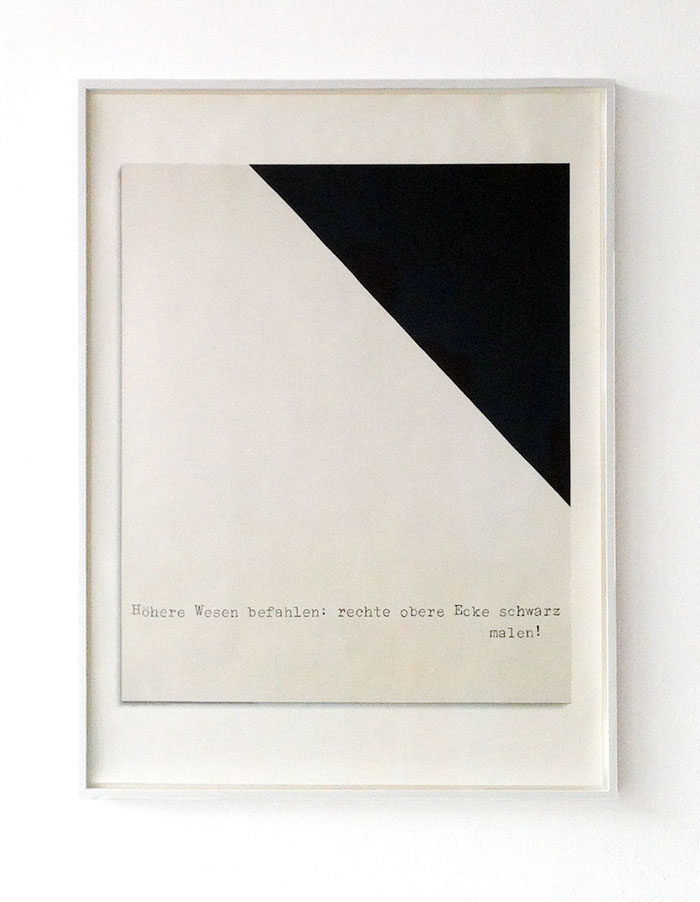
SIGMAR POLKE, Höhere Wesen befahlen: rechte obere Ecke schwarz malen!, 1969
96 x 72 cm (93 x 68,5)
offset print on very thin paper, framed behind anti UV-light glass
edition unknown
published by Edition René Block, Berlin, Germany
not available nymore
Sigmar Polke favoured a plan to have a cheap version in print of his painting Höhere Wesen befahlen: rechte obere Ecke schwarz malen! that is part of the collection of Van Abbemuseum in Eindhoven, Netherlands. Both painting and print caused irritation of the public.
This is printed matter on remarkable thin paper with a printed shadow and therefore may be considered as a work on its own. The painting has been photographically reproduced with several additions to its original. In the lower part of the reproduced painting a hue-like horizontal shadow (i.e. in the text part) causes a kind of snapshot-like liveliness. With the shadow lines on the left and bottom around the work depth is created; as if the light comes from the top right corner. Hence more than just a mere reproduction.
It is remarkable that until today TAIL never detected this edition on internet, sites of antiquarians or even auctions. This is definitely a priceless work.
ERIC ANDERSEN, Tape Piece, [1968]
three printed cards each 3 x 10,6 cm + piece from audio cassette tap in cellophane bag as published
this object is part of Ben Vautier’s magazine Fourre-Tout No. 3
edition 100 + 1 glass bottle with original manuscripts
published by Ben Vautier, Nice, France
Ref. Ben Vautier: Fourre-Tout No. 3, 1968
inv. BVau 220
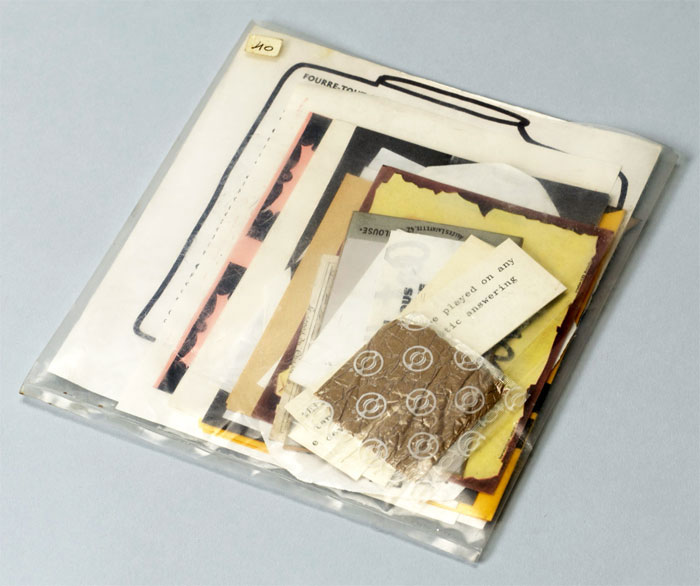
BEN VAUTIER, Fourre-Tout No. 3, 1968
CONTENU DE L’ENVELOPPE
18,9 x 17,4 cm includes all objects, as issued
printed matter and objects in plastic envelope with hand numbered sticker
stamp numbered, here number 00016
6 parts and 1 printed list of contents with felt pen hand drawing of a bocal
edition 100
not available anymore
In an accompanying text of this issue it is announced by Ben and Annie (Noël) that “Fourre-tout” number 3 will be the last one. It is explained that ‘The content of this jar is learning us to admit everything. It reads the idea through the object.’
Issues number 1 and 2 were published in 1967 in an edition 250 each. A copy of issue number 3 is in the collection of the MoMA in New York, USA. The museum has one of the 100 glass jars in its collection that accompanies this periodical with an edition of 100 (+ 1 larger ‘jar’ with original manuscripts), although archived separately from its publication.
Complete content of original plastic envelope “Contenu de l’enveloppe”:
KEN FRIEDMAN – print with ink stamped text: Friedman’zart
HENRY FLYNT – print: Overthrow the Human Race!!
BEN VAUTIER – cut page with pencil drawn circles (recto verso) from paperback book
BEN VAUTIER – punched postcard called There might be an aeroplane in the sky of this tiny postcard
ERIC ANDERSSON [sic] – Tape piece, 3 tiny cards with texts/instruction + loose piece of tape
BEN VAUTIER/GEORGE MACIUNAS ? – small Fluxus bag with paste called A medicine for the asthma of Maciunas
Nota bene: This issue No. 3 is complete, although a glass jar the index is referring to as CONTENU DU BOCAL is lacking.
Extra information
Copy edition number 40/100 in the collection of the MoMa, New York. The glass jar with cork that is part of the publication has been archived by the museum separately.
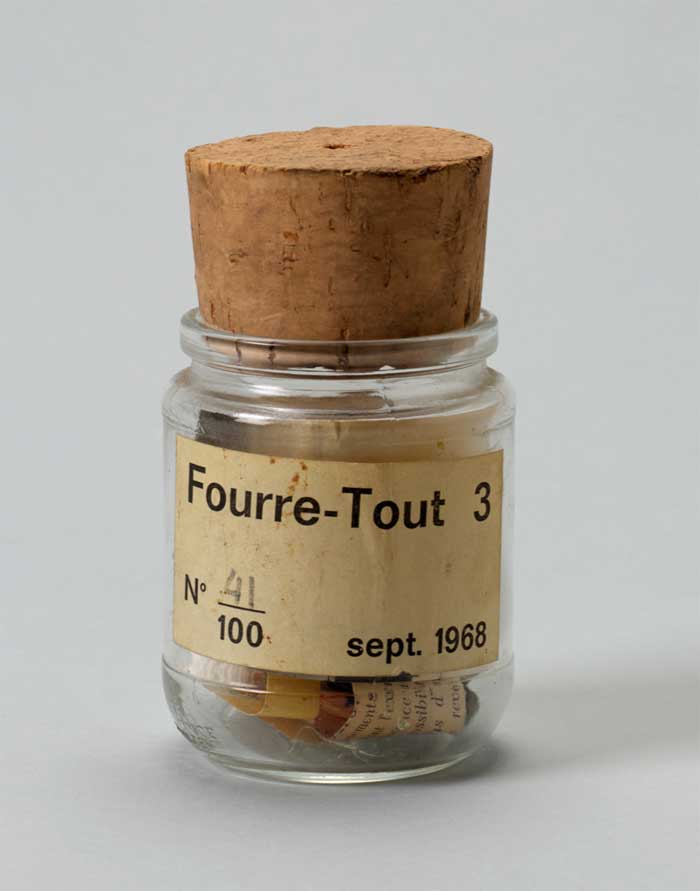
BEN VAUTIER, Fourre-Tout, No. 3, 1968
glass jar, label, felt-tip pen ink, cork, various objects
10,2 x 5,1 cm
being part of periodical
published by Ben and Anne Vautier
Collection MoMA, New York, USA
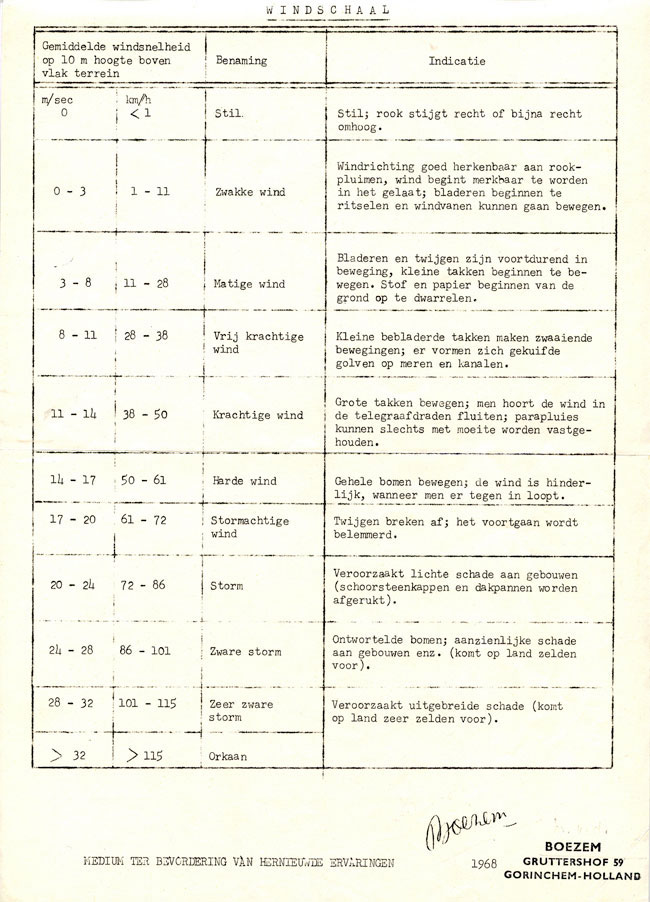
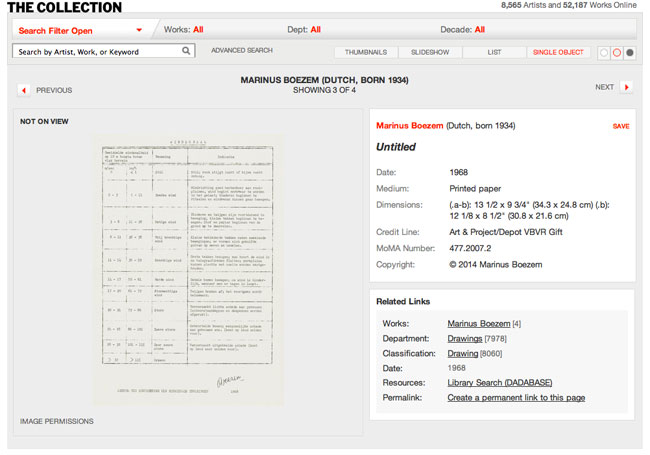
MARINUS BOEZEM, Windschaal, 1968
31 x 21,5 cm
stencil print, hand stamped address signed in print
edition unknown
published by the artist
€ 1000,-
inv. MBoe 500
The subtitle of ‘Windschaal’ shown at the bottom of the stencil print is ‘Medium for stimulating renewed experiences’ (in Dutch: ‘Medium ter bevordering van hernieuwde ervaringen’). The print depicted below is in the collection of the MoMa in New York, acquired through Art & Project in Amsterdam.