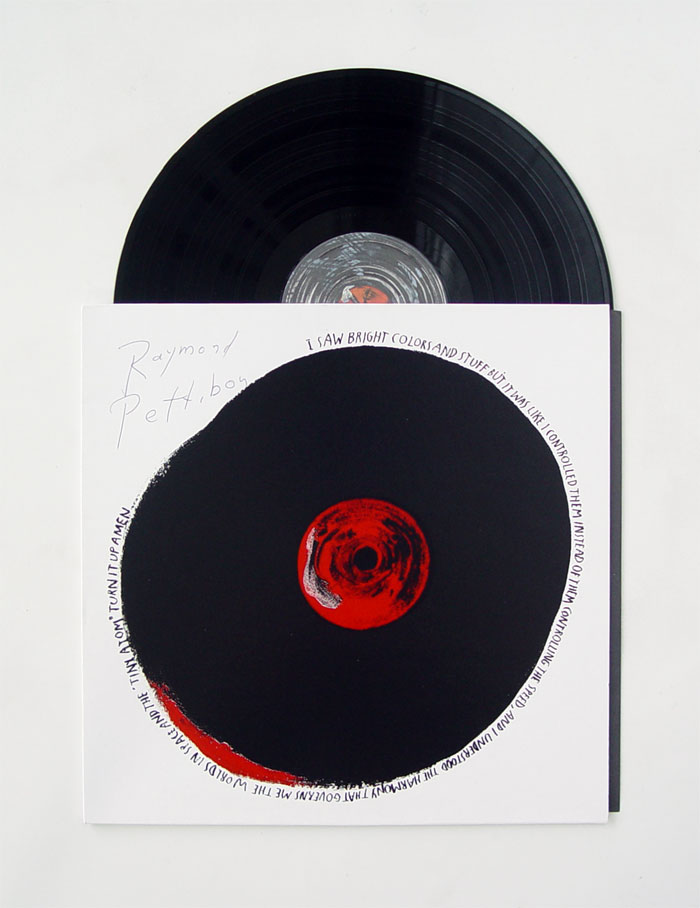
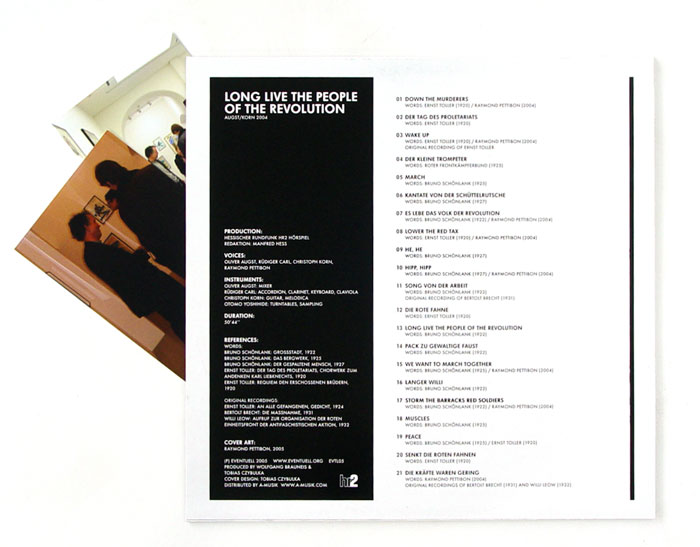
RAYMOND PETTIBON, Blank / “Long Live the People of the Revolution”, 2005
31,1 x 31,5 cm
LP, 12″
signed on cover
comes with 2 private photos of sign event
edition 400, of which unknown signed copies rare
published by Eventuell, Cologne, Germany
€ 450,- plus € 32,- Track & Trace registered EU mail
inv.RPett 698
The cover is a reproduction of a drawing with the following text: ‘I saw bright colors and stuff but it was like I controlled them instead of them controlling the speed, and I understood the harmony that governs me the worlds in space and the ‘tiny atom’ turn it up amen….’ This record is in the collection of MoMA, New York, USA.
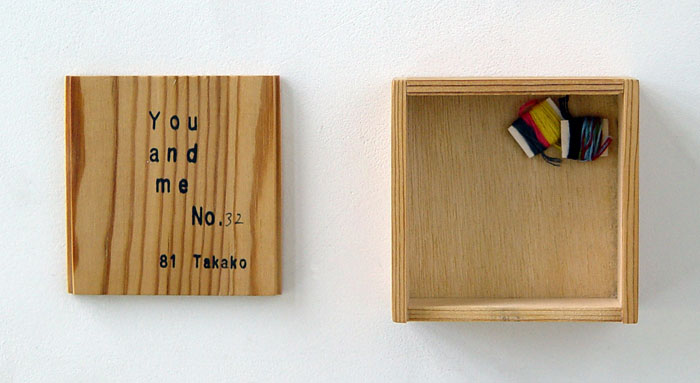
TAKAKO SAITO, You and Me, 1981
3,6 x 8 x 8 cm
yarn spools, coloured threads, wooden box, ink stamps
signed, dated, numbered, here No. 32
€ 960,- plus € 18,- registered mail Track & Trace
inv.TSait 691
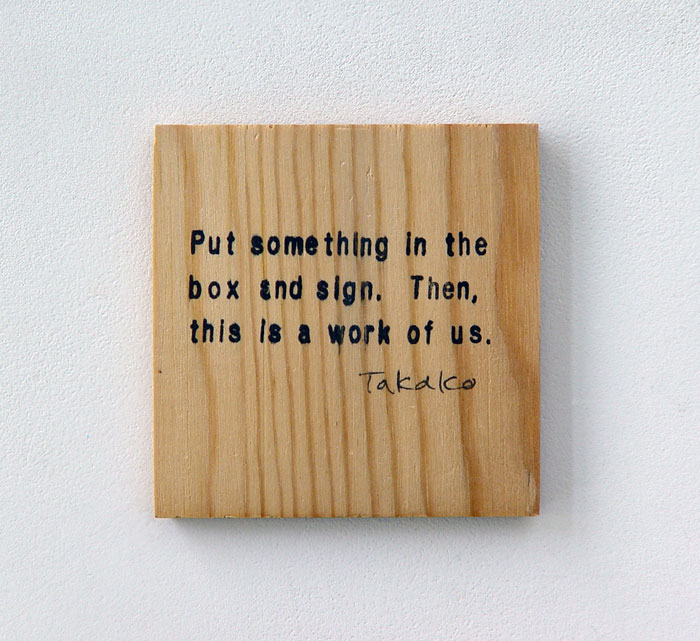
Ink stamped instructions on the reverse of the lid read ‘Put something in the box and sign. Then, this is a work of us.’.
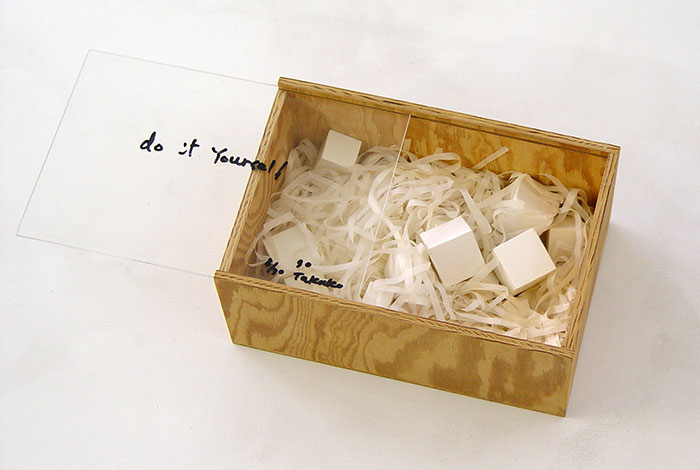
TAKAKO SAITO, Do it Yourself, 1990
10 x 23 x 15.3 cm
17 hand made paper cubes, shredded paper, wooden box, felt pen ink on perspex lid
video tape that accompanied this edition is lacking
signed, dated, numbered
edition 30, here number 8/30
published by Bonner Kunstverein, Bonn, Germany
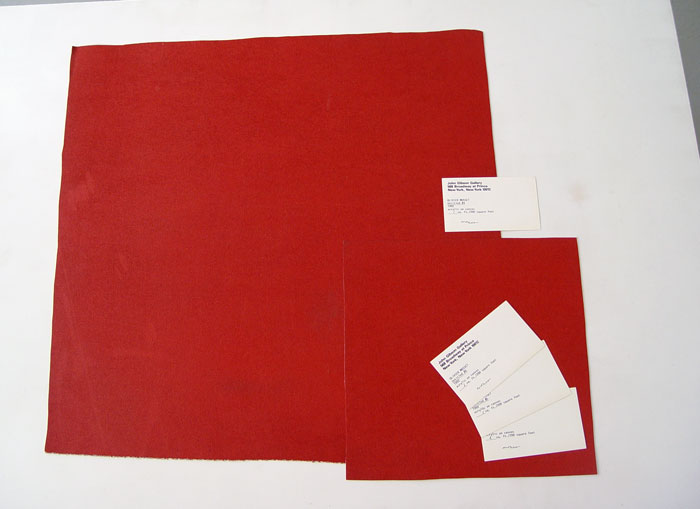
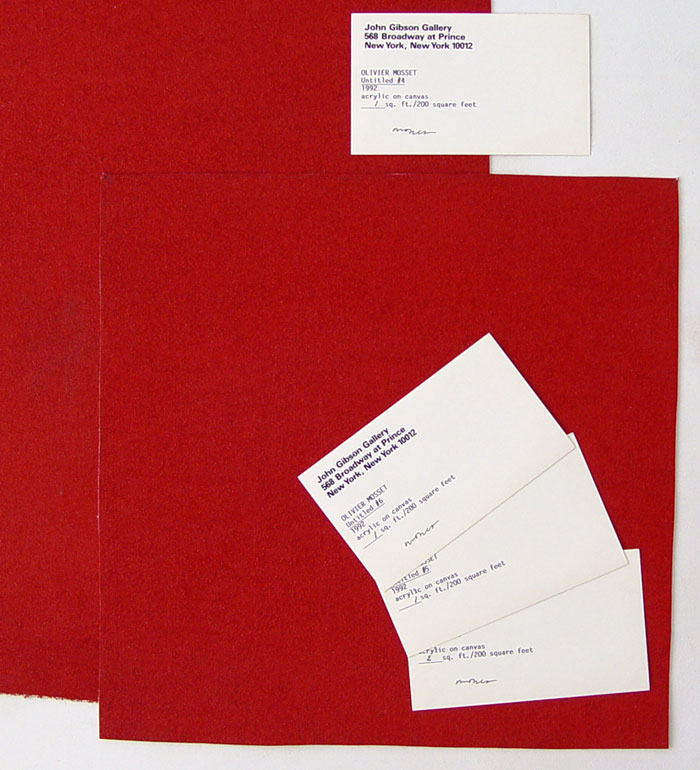
OLIVIER MOSSET, Untitled # 3, #4, #5 and #6, 1992
ca 60 x 60 cm (4 sq. feet) / 31 x 30.5 cm (1 sq. foot)
two pieces of acrylic paint on canvas, 4 labels; 6 parts
signed on 3 labels
numbered and dated in print only sold as unique piece of work
p.o.r.
inv.OM 696-697-pr
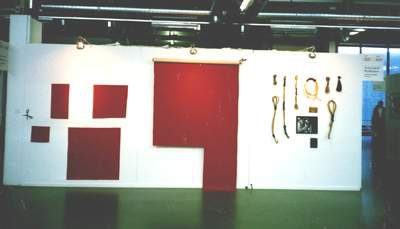
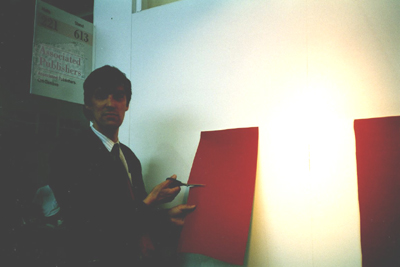
In 1992 John M Armleder proposed several gallerists to show together multiples at the Basel Art Fair under the name Associated Publishers. Participating publishers were Daniel Buchholz, Cologne / Ecart, Geneva / Gallery John Gibson, New York / Galerie van Gelder, Amsterdam / Daniel Newburg, New York and Caroline Nitsch Editions, New York. Gallery John Gibson showed a 10 meters long rolled up canvas originally rejected by Olivier Mosset and kept in his studio. For the Art Basel Editions 1992 he proposed to revive this painting by adding a pair of scissors to the red roll, including pre-signed labels for each sale. This was meant for buyers to cut out a piece of one square foot or more.
During the Art Basel art fair no visitor bought a piece of the edition and at the end of the art fair Kees van Gelder and John Gibson swapped an edition with each other. After the fair the roll of canvas and samples got lost and until today Olivier Mosset has never seen it again. This makes the set pictured above into an unique piece that originally was meant as a kind of DIY edition until the canvas was finished.
Since the roll of red painted canvas is lost for over a period of thirty years, let alone the signed labels, this work should be considered as more than unique. It is a set of three signed editions cut out from the vintage rol for the very first time on the Basel Art Fair. This is all that is left over and therefore this group of works ought to stay together in order to preserve a lucid idea of Olivier Mosset to give a twist to his originally disapproved very large painting. KvG
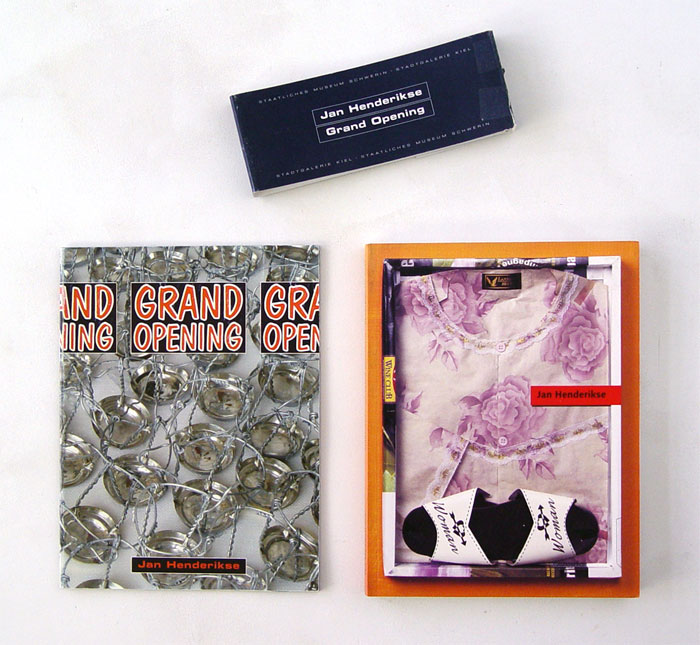
JAN HENDERIKSE, Grand Opening, 2007
21 x 16 x 1,7 cm
2 catalogues, wrapper (tape repaired)
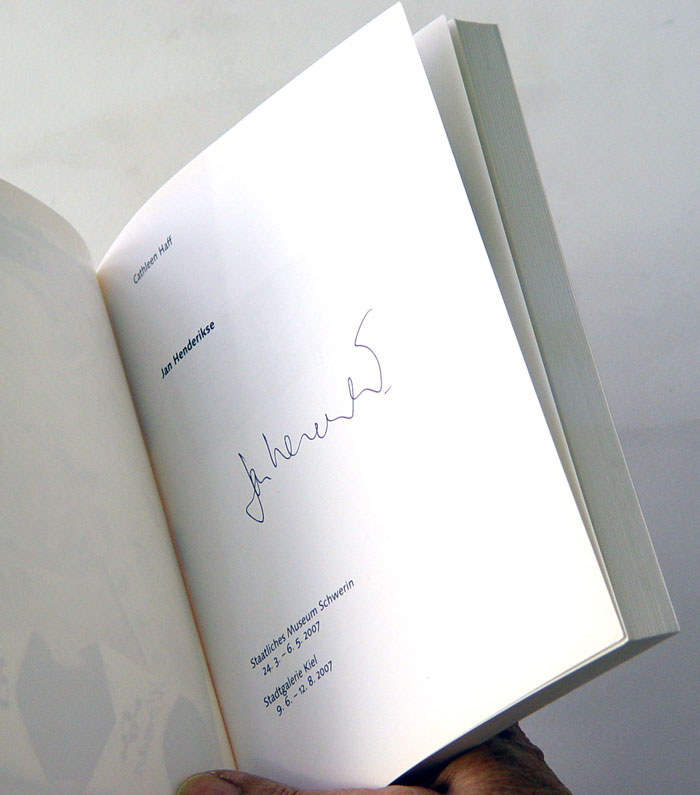
signed in both catalogues
excellent condition, apart from wrapper
inv.JHend 694
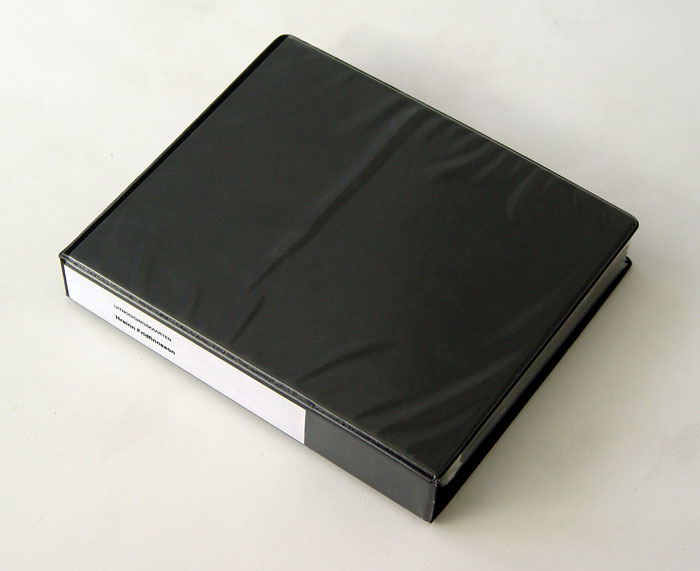
HREINN FRIDFINNSSON, invitation cards of exhibitions 1972-2010
32 x 26 x 5 cm
ring binder with most probably a complete set of exhibition invites in plastic sleeves
€ 1.200,- plus € 24,- Track & Trace registered EU mail
inv.HF 000-pr
The invites in this binder have been collected during a period of 28 years and as such a rarety. It includes a hand written hand-out invite for an exhibition at In-Out Center in Amsterdam in 1972. The card could be considered a self made multiple in tiny envelope, both hand written in pencil. It is unknown if there are any left apart from this one.
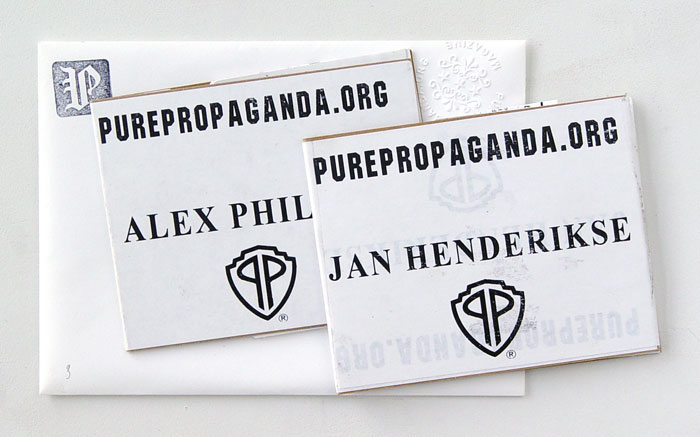
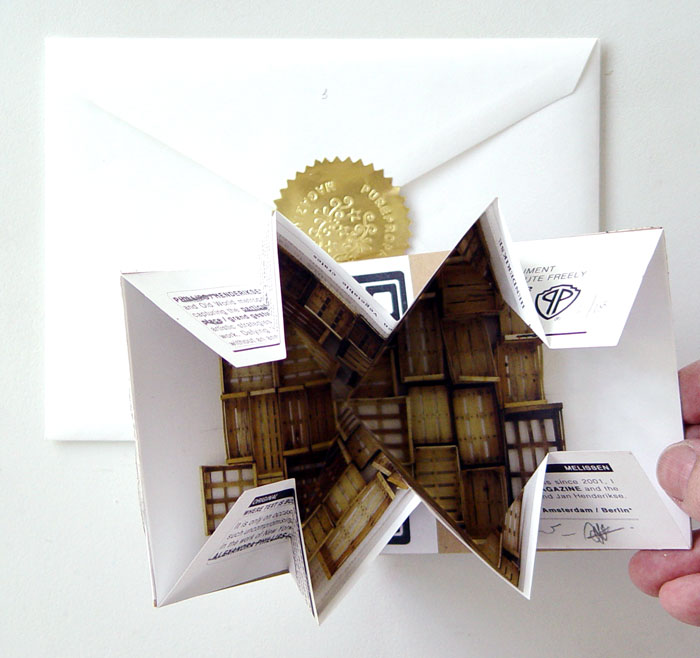
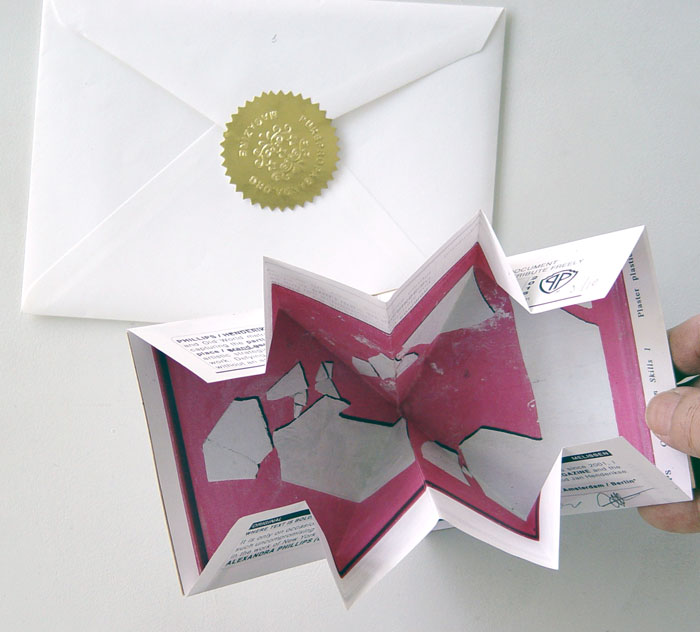
JAN HENDERIKSE / ALEXANDRA PHILLIPS, Pure Propaganda Magazine, 2015
each ca 11 x 14 cm, unfolded 27.7 x 21.5 cm, 2 parts
pop-up card mounted on cardboard, blind and ink stamped envelope with gold seal, colour illustration, text
signed, numbered, here number 3/10
edition 10
published by Antoon Melissen, Amsterdam
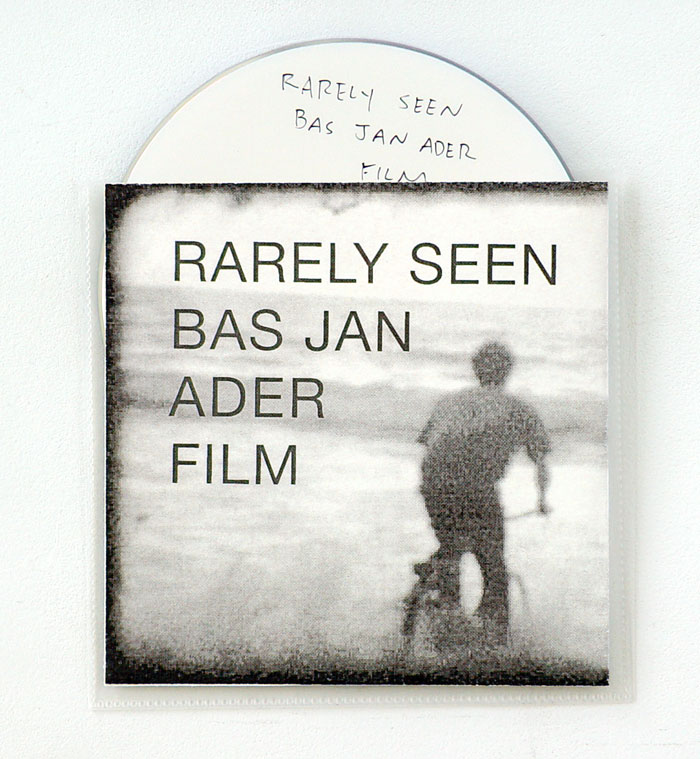
DAVID HORVITZ, Rarely Seen Bas Jan Ader Film, 2009
13 x 13 cm
DVD, plastic sleeve, photo copied cover hand written title by the artist on disc, as issued
edition 30
published by Art Metropole, Toronto, Canada
mint condition extremely rare
inv.DHor 690
‘In 2006 the clip Newly Found Bas Jan Ader Film appeared on YouTube. The six second clip features a man bicycling into the sea. It is announced as a work by Bas Jan Ader found at UC Irvine, where Ader was teaching in the 1970s. The story is not unlikely. Bas Jan Ader, who was lost at sea in 1975 while undertaking an Atlantic crossing that was to be the second work in a series he entitled In Search of the Miraculous, left a small body of highly noticeable works, mostly short films and photographs. One of these works, Fall II, Amsterdam from 1970, is a short sequence showing Ader biking along and then into a canal. The newly found work could be a related iteration. As many of Bas Jan Ader’s works show, he was interested in inserting his own body into a relationship with gravity, investigating phases of transition, the time and space between two locatable states, from standing up to falling down, from hanging from a tree to hitting the surface of the pond below.
It was revealed that Horvitz was in fact the author of this newly found work. Assumingly on request from the gallery Patrick Painter who represents Bas Jan Ader’s estate, Youtube removed the clip for ‘copyright infringement,’ only for it to reappear soon again posted on an account carrying the name of PatrickPainterGaller – most likely Horvitz’s work. Currently you can find the clip as the first video appearing when googling ‘Bas Jan Ader,’ and also on the official Bas Jan Ader website under the section Homages. However tricksterish Horvitz’s effort may appear, it does also expose a great admiration of Ader’s work and kinship to the ideas he brought forth. Newly Found Bas Jan Ader Film was not produced to be shown in a gallery space. It was rather a device that, circulating on the internet, triggered certain mechanisms and revealed how a number of parties reacted to the potential existence of a never before seen Bas Jan Ader work. Horvitz reveals how it is possible to insert new information into already existing narratives and shift their immediate appearance. A work by David Horvitz is today a very visible part of a Google search for ‘Bas Jan Ader’. It is fair to say that he faked his way into this hierarchy of information, but the fact that he succeeded so well is worth our attention. It points to our unfounded reliance on whatever a Google search brings us, and comments on the potentialities of the fake as well as questions our relationship to the real.’ From “But Mr. Horvitz, Where Is The Work?”.
Helga Christoffersen, 2010
Additional information
In 2009 the 2nd Cannons Gallery published a flip book called “Rarely Seen Bas Jan Ader Film” which comprises stills from the film. The book is accompanied with a free 2-sided newsprint David Horvitz produced for his exhibition at the gallery.
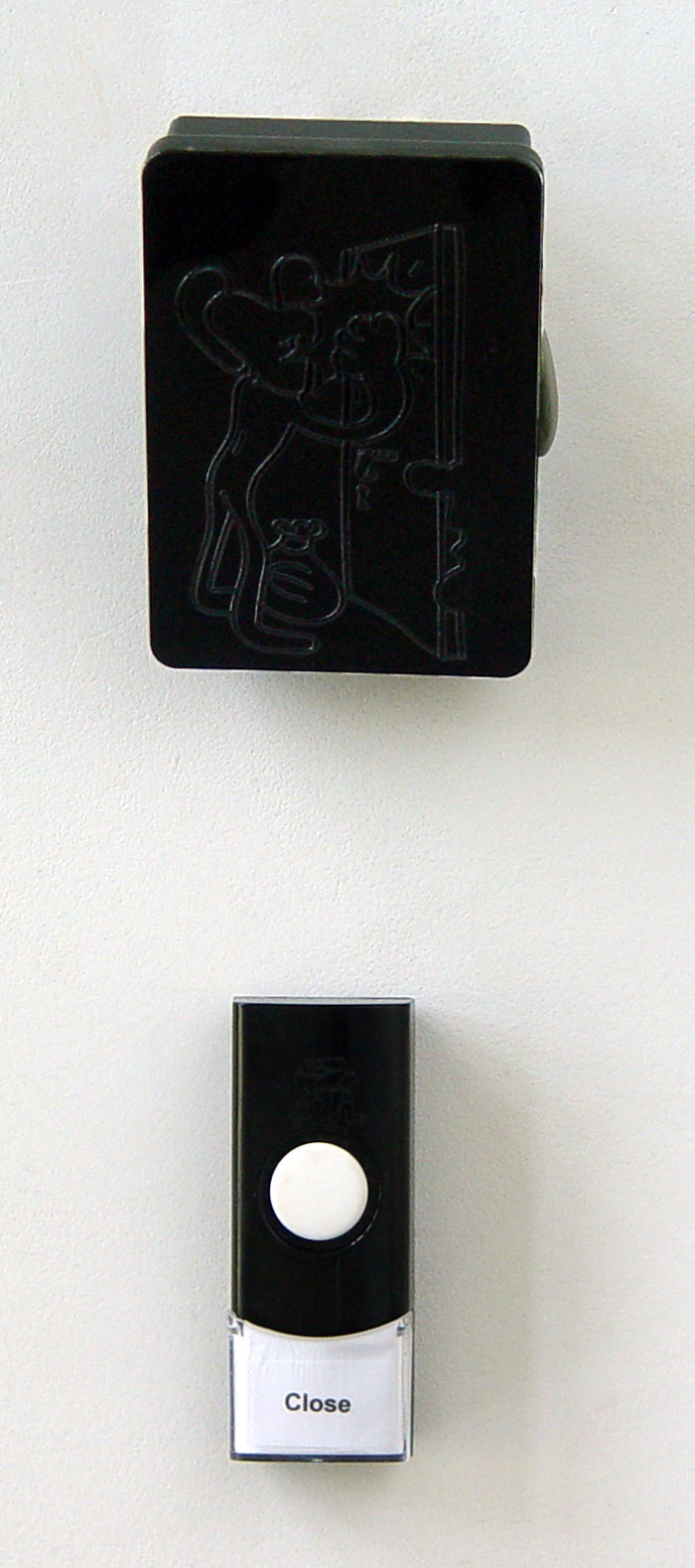
SALIM BAYRI, Close, 2018
9.5 x 6.5 x 4 cm / 8 x 3 x 2 cm
plastic plug-in door bell, laser engraving, remote device
edition 10 + 2 AP
signed, numbered, dated
€ 260,-
Basically the work of Salim Bayri is about letting the eye jump over from one pictorial stone to another. In case an attraction occurs it is a matter of ‘scanning, holding and making’, as he states. In that sense his art is a compilation of objects and narratives that in several titles is described as ‘storage’. His work named “Close” originates from his home country where it is common practice to pass by unannounced at one’s door. Speaking through the intercom one says: ‘Close’, a shortening for ‘I am a close friend’ (or relative) and the door would be opened. Here in Europe the opposite result is easily created if one would ring the door bell introducing himself by saying “Close”. Most likely the door would stay closed.
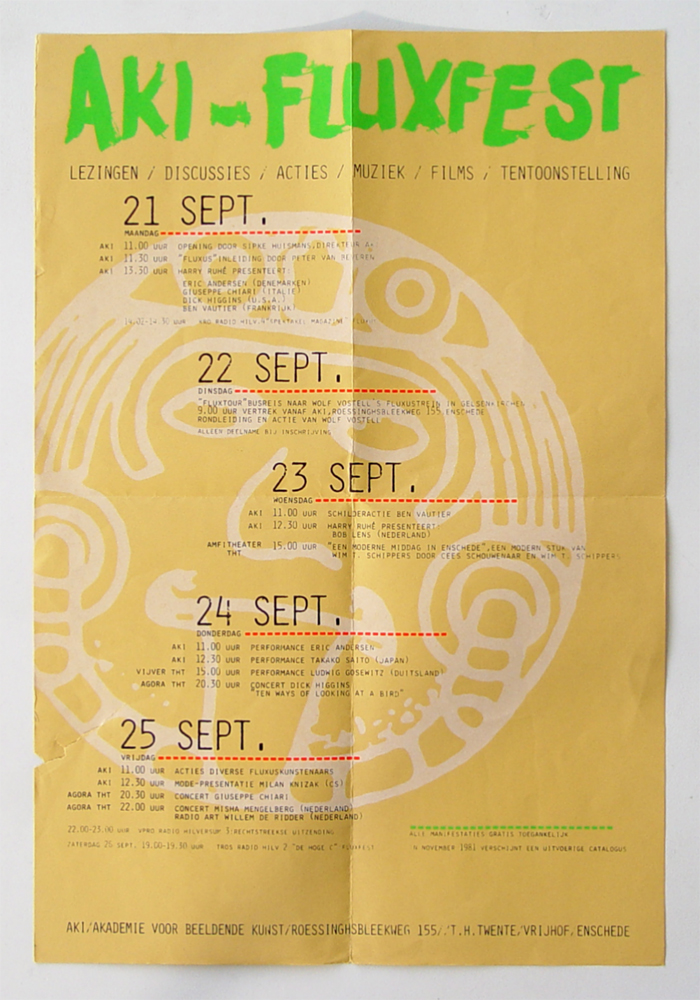
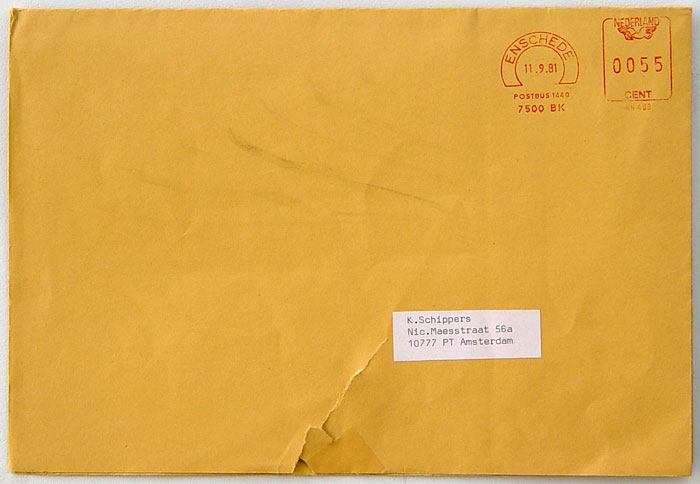
AKI-Fluxfest, 1981
49.4 x 33.5 cm
screen print on paper, poster folded as mailed (17 x 24.8 cm)
condition: reasonable, tear lower left, missing chip of paper
rare
inv.Fluxus 687
Peter van Beveren and Harry Ruhé invited Fluxus artists to participate in a Fluxus Festival at the AKI Art Academy in Enschede in The Netherlands. Participating artists were Eric Andersen, Giuseppe Chiari, Dick Higgins, Ben Vautier, Wolf Vostell, Bob Lens, Wim T. Schippers, Takako Saito, Ludwig Gosewitz, Milan Knizak and Mischa Mengelberg. The director Sipke Huismans of the AKI gave carte blanche to the two curators. Van Beveren and Ruhé managed nine artists to come over for five days to this Fluxus event, namely Eric Andersen, Ben Vautier, Wolf Vostell, Bob Lens, Wim T. Schippers, Takako Saito, Ludwig Gosewitz, Milan Knizak and Mischa Mengelberg. Every artist got a fee of Dfl. 3.000,- (“It is about time that artists should be properly paid…’). In the end the AKI almost went bankrupt caused by the high bills of hotel, dinner and free booze, trip and traveling costs.