GERHARD RICHTER, Editionen 1965-1993, 1993 [poster edition]
84,5 x 59 cm
offset on paper signed in pencil
edition unknown
mint
published by Kunsthalle Bremen, Germany
p.o.r.
Apart from a signature in print this poster is also hand signed in the middle below the image.
GERHARD RICHTER, Eis, 2016
19,5 x 11,5 cm
artist’s book, offset, 144 pp., ca 320 grams
46 by hand tipped-in black and white images
limited edition 350
published by Salon Verlag, Cologne, Germany mint
inv. GRich 309
€ 260,- plus € 12,- Track & Trace registered EU mail
This book is a facsimile of Gerhard Richter’s original design for ‘Eis’, an artist’s book first published by Galeria Pieroni in 1981. The brown yellowish glue stains shining through the pages of that dummy are reproduced here, as an extra factual layer. The 46 pictures – glued in the middle of the book – are reproductions of photos Richter took in Greenland.
The most interesting contribution Gerhard Richter has managed to deliver in the comtemporary visual arts is the uninterpreted image, i.e. an image without interpretation, morality or emotion. A picture made with the objectifying camera leads to a matter of pictorial fact. Since we are used to read images within a fraction of a second Richter manipulates his images by blurring them, and so creating a cooler distance from the viewer looking at an image. Due to this added misty curtain it is more difficult to detect what is going on. Also it blocks a first fast reading. What Emmanuel Kant analysed for the theory of knowledge is what Gerhard Richter analysed for the pictorial phenomenology, i.e. knowledge a priori (knowledge one is born with) or a posteriori (knowledge achieved by experience) is comparable to Richter’s observation that a photo is empty (no thoughts, no ideology, no theme, no order) or loaded (with ethics, aesthetics, etc.).
Since Gerhard Richter is convinced that the objectivity of the (snapshot) photo has to be helped by providing it with manipulations of distance, he states that painting a photo is the best way to bring its emptiness of no position to perfection.
Reading ‘Eis’ against the background of the above one may say that Richter’s idea to make this artist’s book with no beginning and no ending is expressing his will to neutralise a fixed direction of reading (in fact, there are no texts to read). Black and white images are glued in and some are shown upside down towards each other, depending from where you start reading the book. After some confusion one may accept its awkwardness of how to read on and a kind of reader’s ‘floating’ is created. This awareness of being in a cloud is the detached situation Richter is looking for. In German one would say: “Richter’s richtige Richtung” leading to a void in which there is no urge anymore to judge. The reader finds himself in a pictoriality of no beginning and no ending.
The tipped-in images in the middle seen from the book edge:
History of prices:
Stefan Schuelke Fine Books, Cologne, Germant January 2025 € 280,-
eBay-carolinanitsch, New York, USA US$ 1,500.- September 2023
Studio Bibliografico Marini, Valenzano, Italy € 439,- September 2023
Galerie Buchholz, Cologne, Germany € 680,- September 2023
eBay-carolinanitsch, New York, USA US$ 900.- December 2022
Galerie Buchholz, Cologne, Germany US$ 351.- December 2022
eBay Kleinanzeigen-Christian, Nordrhein-Westfalen, Sankt-Augustin, Germany € 550,-
July 2022
Studio Bibliografica Marini, Rome, Italy € 350,- July 2022
eBay-carolinanitsch, New York, USA US$ 900.- December 2021
Antiquariat Querido-Frank Hermann, Düsseldorf, Germany US$ 255.- December 2021
Buchhandlung Walther König, Cologne, Germany € 240,- July 2021
Antiquariat Querido-Frank Hermann, Düsseldorf, Germany € 220,- April 2020
GERHARD RICHTER, Wald, 2008 [artist’s book]
24,6 x 17 x 3,4 cm
offset, German language, 396 pp., ill., 1.3 kilograms
HC with dust jacket
edition 2000
published by Walter Koenig Buchhandlung, Cologne, Germany mint
€ 520,- plus € 18,- Track & Trace registered mail
inv.GRich 714_979
Gerhard Richter’s artist’s book Wald assembles 286 photographs that he has taken since 2005 in a forest Hahnwald close to Cologne. These photographs focus on fallen trees and branches lying on the woodland’s ground, i.e. photos on vertical tree trunks and horizontally piled logs or diagonally broken branches.
Opposite to the typology of the photographs, Gerhard Richter used a text taken from Waldung – Magazin für Wald, Wandern, Wissen, No. 1/2006, a German magazine about forestry. The text is composed of computer generated ad randomness, without syntax or linguistic logic.
Gerhard Richter removed proper nouns and passages. The resulting and abstracted text is still recognizable as a text about forests in terms of vocabulary. He divided the type area into seven horizontal strips, which he arranged according to a strict concept, but subverted it through individual interventions. The 106 differently composed pages continuously filled with text, only to shrink again after the only fully occupied page in the middle.
It is a fading in and out of type images. Richter roughly sorted the photographs into groups:
– delicate branches
– horizontally lying trunks
– diagonally or vertically growing trees.
History of prices:
LLU Buch Service/Lars Lutzer Antiquariat, Wahlstedt, Germany April 2025 € 1.190,-
Antiquariat im Baldreit, Baden-Baden, Germany April € 785,-
Booklooker, Greiz, Germany April 2025 € 340,- (website: ‘slight signs of wear’)
London Lane Company, London UK October 2024 € 787,-
Dividing Line Books, Ridgewood NY, USA October 2024 € 282,-
Amazon, December 2020 US$ 450.-
www.store.bookdummypress.com, May 2019 US$ 300.-
Amazon, May 2019 US$ 450.-
Amazon, July 2016 between US$ 430.- and US$ 605.-
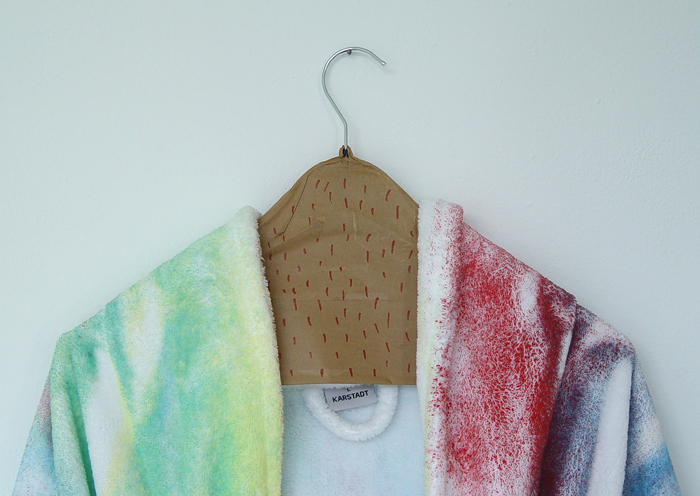
Gerhard Richter Style Tote Bags, 2015
each ca 65 x 25 x 8 cm
print on polyester bags: “Abstract Painting” I, V and IV
produced by RedBubble, San Francisco, USA
mint
inv.GRich 000-pr
RedBubble Pty Ltd (a proprietary limited company abbreviated as ‘Pty Ltd’ is an Australian business structure) advertises in 2015 as follows: ‘Gerhard Richter Style is also available as Throw Pillows, Drawstring Bags, Art Prints, Canvas Prints, and Posters’. Here three tote bags inspired by abstract paintings of Gerhard Richter directly referring to subsequently “Abstracts Bild I”, “Abstracts Bild V” and “Abstracts Bild IV” [sic].
For some reason in 2018 these Style Tote Bags 2015 are not offered anymore by RedBubble Pty Ltd. In stead a company called Society6.com and FineArtAmerica.com have started to sell similar products.
In 2019 FineArtAmerica.com offers on its side only four products that are made with the consent of Gerhard Richter. Shown are two ‘Throw Pillows’ and two ‘Tote bags’ with reproduced details of two paintings.
RedBuble Pty Ltd sells not only in-the-style-of, but also merchandised Gerhard Richter products. See more at RedBubble Gerhard Richter products.
GERHARD RICHTER, 1024 Colours, 2015
ca 11 x 13 x 3 cm / 70 x 50 cm
pouch with polyester Tote bag, two attached labels
edition unknown
published by Loqi LLC, Saint Helena, USA
condition: mint
inv.GRich 874_876
Descriptions of the term tote or tate for bags, meaning bags “to carry”, can be traced back to 1900. During the 1950s, tote bags began to enter into the main culture. Women primarily utilized them as practical handheld bags because they didn’t require much care.
Merchandising art can be considered as a form of commercial appropriation. Previously merchandise products like that were usually put on the market after the death of famous artists like Vincent van Gogh or Piet Mondriaan. Since Appropriation art came into fashion, nowadays living artists accept this spin-off income as almost part of the art they are making, I guess. It is striking that commodities like tote bags or mugs are offered for just a few years at venues like museums and then they disappear completely and become part of history.
Here a detail of a painting of Gerhard Richter called “1024 Farben” has been reproduced on a synthetic shopping bag apparently authorized or sanctioned by the artist as a product design by Loqi, a Limited Liability Company.
GERHARD RICHTER, Die Welt, 2012
57,3 x 40 cm
digital pigment print on heavy quality paper
signed, numbered
edition 100
published by Die Welt, Berlin, Germany
mint condition
€ 7.800,- plus € 32,- Track & Trace registered mail
inv.GRich 401-pr
The own family is a recurring motive in the work of Gerhard Richter, opposite to newspaper clippings of people he doesn’t know and that he integrates in his paintings. He painted his first wife, Ema, he portrayed his daughter “Betty” as well as his “Uncle Rudi” and “Aunt Marianne”. The latter two family members were painted in relation to Nazi Germany.
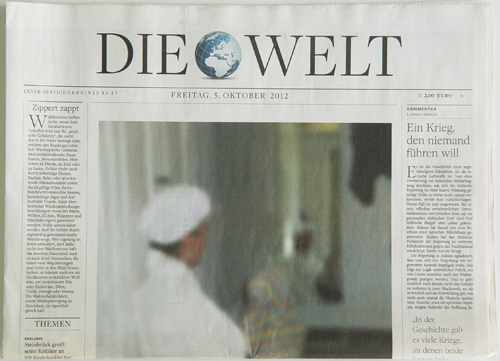
The front page of the edition of the daily newspaper “Die Welt” depicts Richter’s second wife Sabine in a white bathrobe and his son Theo in a striped towel, although not recognizable. Painted in his renowned style of blurring a realistic image. Gerhard Richter remarked that it reminded him of Ingres’ painting ‘The Turkish Bath’ (the picture was taken in hotel “Waldhaus” in Sils-Maria).
History of prices:
ArtPrintX.com, Ravensburg, Germany € 8.714,- February 2024
Artsation GmbH, Munich, Germany € 10.400,- June 2016
Lempertz, Cologne, Germany € 5.208,- November 2015 (hammer price)
Artsation GmbH, Munich, Germany € 10.400,- December 2014
Artsation GmbH, Munich, Germany € 7.350,- September 2013
Artsation GmbH, Munich, Germany € 5.350,- August 2013
Die Welt, Berlin, Germany September (year of issue) € 2.000,-
Extra information:
GERHARD RICHTER, Die Welt of 5 October 2012
offset newspaper
29,5 x 40 cm
edition ca 251.500
splendid condition, folded to tabloid size as shown
published by Die Welt, Berlin, Germany
inv.GRich 000-pr
Untitled, n.d. [ca 1980-1990]
27 x 21 cm
offset, book page, signed in black ink
Collection Kees van Gelder, Amsterdam
€ 1.200,- + € 12,- Track & Trace registered mail
In 1980-1990’s an Autographengruppe in Bonn started to collect signatures of people well-known in sports, literature and the arts. Not only postcards but also pages of books were cut out of art catalogues that were signed on the spot during openings or more often requested by the club members through mail. In the early beginning of this century the collector’s group decided to sell little by little a part of their collection on Internet through eArt.de and eBay.
“This work is part of an extensive unique collection of catalogue pages and various printed matter signed by Gerhard Richter. The way the signatures are placed on the reproductions create a distance and deconstruction of the illusion of the image. A phenomenon that is very similar to the signed Goslar Kerze poster of 1988. His signature positioned straight on top of the image as an ultra short painter’s gesture – opposite to the hard labour of his elaborate swept paintings – high lightens the gap between the reproduced and the uniqueness of each handwriting apparently integrated in the image.
One of the most important characteristics is the way the artist creates a distance between emotions possibly aroused by an image and the way a painting is blurr painted. Or in this case is reproduced and then disturbed by the gesture of a hand writing. The question about what the reproduced represents is put aside or at least put on hold by showing us two separate moments of two different ‘images’. This is opposite to what Roland Barthes called “punktum”. The depicted arouses direct emotions of recognition or disgust, caused by a meaning that pops up before we realize this. Nothing is in the way and these meanings suddenly appear to come out of the photo, id est here out of the abstract picture. This is in contrast to what Barthes calls the ‘studium’, which refers to the longing of a search of meanings in a picture. In fact it is ajourning the pass of a judgement on what is seen until the addition sum is made. In his catalogue pages, each signed on loose prints, the two never seem to come together due to the different levels and meaning of each ‘image’. The abstract painting here reproduced in print never reconciles with the image of authorization a signiture stands for. The viewer has to look to the dimension of the reproduced being confronted again and again with the un-pictorial “standard sweep curtain” of Richter’s signature.”
Kees van Gelder, October 2006
GERHARD RICHTER, Sindbad, 2010
32 x 26,4 x 1,8 cm
artist’s book, 116 pp.: silkscreen, lacquered pages, incl. banderole 1,4 kilograms
limited edition 800
published by Buchhandlung Walther Koenig, Cologne, Germany mint condition, cellophane seal as issued
€ 1.985,- plus € 18,- Track & Trace registered mail
inv.GR 000-pr
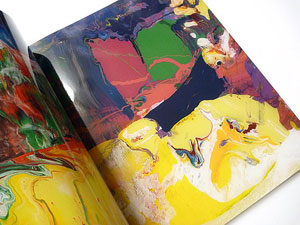
Originally “Sindbad” is the title of a series of 98 pictures, painted on the back of panes of glass in 30 x 24 cm format, from 2008. In their first exhibition, Richter paired them as diptychs, like 49 double pages.
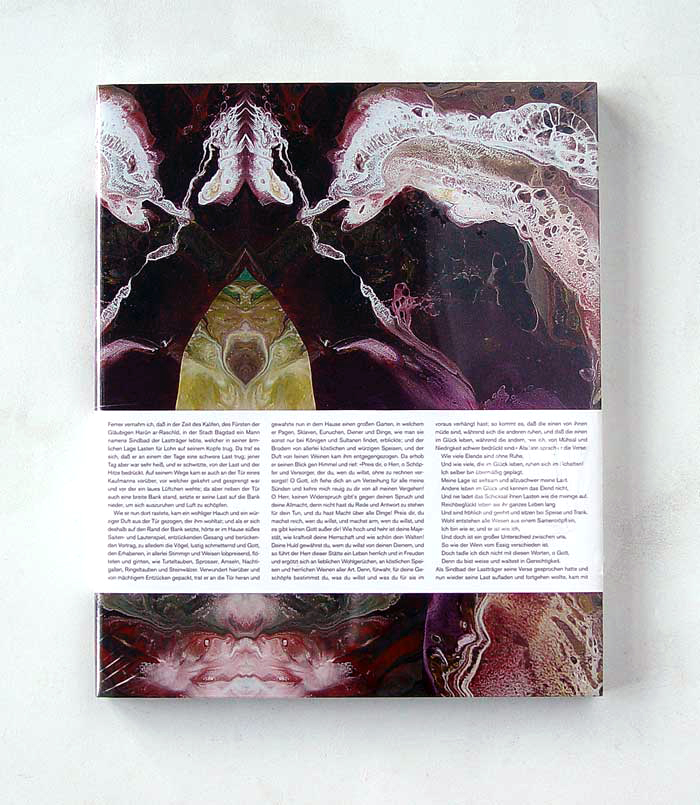
The concept of this book was already clear at the time of their painting. Richter decided to reproduce all of the pictures in original format, cut over three pages, leaving a bar of two centimetres blank at the binding. This gives the book its form. The seven texts about ‘Sinbad the Sailor’, each set in three columns over double pages, give structure to the extensive, “fairytale” series. The banderole around the book contains an introduction to the journey. Every detail – paper, typography, layout and flow of the book – was decided by the artist. “Sinbad” (in German “Sindbad”) is without doubt a further highlight in Gerhard Richter’s series of artist’s books.
Sindbad is the title of a series of 98 lacquer pictures made in 2008, painted on the back of 12 x 10-inch panes of glass. For their first public exhibition, Richter paired them as 49 diptychs, which resembled 49 book-page spreads, pointing towards the possible ideal incarnation of these works as a large-format artist’s book. Using silkscreen printing, this volume reproduces all 98 of the pictures at their original dimensions. Seven texts, on the theme of Sinbad the Sailor (in German only), are interleaved with these magnificent images, and a bellyband around the book offers a concise introduction to the work.
History of prices:
Café Lehmitz, Cologne, Germany € 1.780,- January 2023
Buchhandlung Walter Koenig, Cologne € 1.800,- December 2022
Antiquariat Heinzelmännchen, Stuttgart, Germany US$ 1,512.- December 2022
eBay-ashbinx74, Bruton, UK € 1.695,- July 2021
Catawiki, Assen, Netherlands € 440,- 14 December 2020 (hammer price)
Buchhandlung Walter Koenig, Cologne € 1.800,- March 2020
eBay-ashbinx74, Bruton, UK € 1.588,- July 2020
Buchhandlung Walter Koenig, Cologne € 1.800,- October 2019
Buchhandlung Walter Koenig, Cologne € 680,- March 2017
Antiquariat Heuberger, Cologne € 650,- January 2017
Buchhandlung Walter Koenig, Cologne € 680,- November 2014
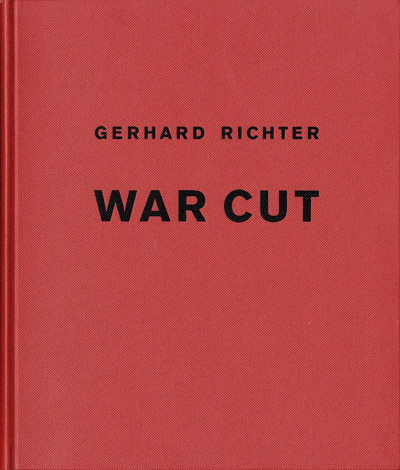
GERHARD RICHTER, War Cut, 2004
25 x 21 cm
hard cover, 340 pp.
edition 2000; nrs 1-200 signed with felt-tip pen on penultimate page, numbered
2,000 copies, numbered with stamp on the penultimate page, of these a few copies are also signed, dated and marked h.c. in felt-tip pen on the penultimate page,
150 copies, signed, dated and numbered in blue ballpoint on penultimate page
published by Walther Koenig, Cologne, 2004 here unsigned
inv.GR 000-pr
In May 2002, Gerhard Richter photographed 216 details of his “Abstraktes Bild Nr 648-2”, 1987. Working over a period of several weeks, Richter combined these 10 x 15 cm details with 165 texts on the Iraq war, published in the German FAZ newspaper on March 20 and 21. ‘War Cut’ follows an ever denser rhythm in which texts and gaps take up the same amount of space as the pictures, creating a strictly composed work of open and closed layouts and their mirror images. A conceptual artist’s book about the war in Iraq and one may say war in general communicated through newspapers.
Extra information:
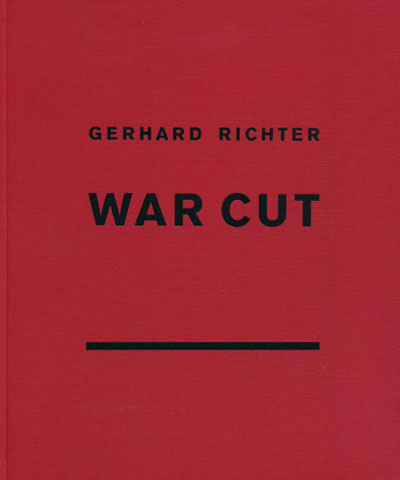
In 2012 a second edition in English was published with a different book cover:
History of prices – signed version edition 200
Bengtsson Fine Arts, Landskrona, Sweden $ 2700.- November 2010
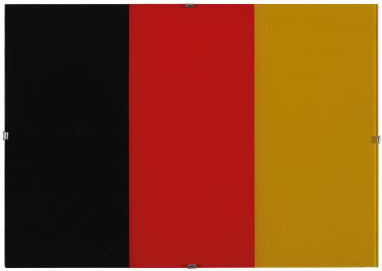
GERHARD RICHTER Schwarz, Rot, Gold II, 1998
21 x 29,7 x 1,3 cm /8.27×11.69 inches
synthetic resin paint behind glass, hard fiberboard mount, metal parts
4 different shades of each colour
edition of a unique series 64 + 3 AP
verso signed, dated on sticker
published by Galerie Fred Jahn, Munich, Germany
out of stock
This edition is marked with a three digit combination in felt-tip pen on reverse and each multiple with inv.id WV-Nr. 855-8 was made in conjunction with ‘Schwarz, Rot, Gold’ from 1999, a commissioned work by the German Bundestag for the Reichstag building in Berlin, Germany.
History of prices:
Auction Ketterer Kunst, Munich, Germany € 5.000,- / $ 6,657.- 24 April 2010
Auction Van Ham, Cologne, Germany € 6.200,- / $ 8,300.- June 2011