ANDY WARHOL, After the Party, 1979
53,3 x 77,5 cm / 21 x 30.5 inches
screen print
signed, numbered
edition 1000
not available
This work was part of Andy Warhol’s “Exposures” series intended to accompany a book of party photographs of both Warhol and Interview’s editor Bob Colacello. They had planned to produce two editions, one gold, one silver, producing them through their new publishing company that was partly owned by Grosset and Dunlap, Andy Warhol Books.
ANDY WARHOL, Exposures
book-golden version, screen print on cover
signed, numbered
edition 1000
not available
VLADAN RADOVANOVIC, Photo Paper Trans Media Tape, 1978 [invitation]
A4
printed invitation
published by Other Books and So / Ulises Carrión, Amsterdam
€ 120,-
Stempelboek / Book of stamps, 1975
30 x 21 x 2 cm
edition 51 + 39 HC
published by Brummense uitgeverij van Luxe Werkjes / Jan Brand, Arnhem – Peter van Beveren, Middelburg
not available
This artists book with hand made stamps has been made in co-operation with the Kunstinformatiecentrum in Middelburg run by Peter van Beveren. Some of the 34 contributions are signed a.o. Tim Ulrichs, Marten Hendriks, Hans Werner Kalkman, Robert Jacks, Ken Friedman, Klaus Groh, Uwe Kreutzfeld, John Armleder, Ben Sleeuwenhoek, Endre Tot and Woody van Amen. A few pages are slightly wrinkled due to the technique of stamping.
TAKAKO SAITO, To my friends, n.d. [1974]
20,3 x 15,2 cm
book in hand-dyed slip case
Japanese bound, handwritten title and name, xerox printing, various color pencils, gouache, collages tipped-in miniature mini-books
series of very small hand made edition
signed
published by Beau Geste Press, Devon, England mint, hand made extremely rare in this condition
€ 1.450,- plus € 12,- Track & Trace EU registered mail
inv.TSai 000-pr
In the mid-seventies Takako Saito commemorates her days in Devon. The main part is called “My friends” (with drawings of cattle and cats) and another part is described as “Days in Devon” that exists of a separate booklet with drawings, pasted in de back, 28 pages, small leporello and tipped-in miniature books.
Although Fondazione Bonotto mentions an edition of 120, it is extremely difficult to find a copy of this elaborated artist’s book.
DIETER ROTH, Karnickelkoettelkarnickel (Rabbit-shit rabbit), 1972
21 x 19 x 10 cm
rabbit droppings, straw
verso signed and numbered on label
edition 200 + 26 AP (numbered I-XXVI)
splendid condition; as new
p.o.r., Margin scheme
Dieter Roth is known for his artist’s books, speedy drawings, sculptures and installations. He was an extreme example of a Fluxus artist using found materials, including rotting food, melt chocolate and, like in this multiple, animal droppings. He once said: ‘Wait, later this will be nothing’. He is known as Dieter Roth and Diter Rot.
This edition is in the collection of the Moma in New York, USA: Dieter Roth, MOMA.
History of prices:
Koller, Zurich, Switzerland € 1.867,- (hammer price) 26 June 2025
Korff Fine Art, Ilmmünster, Germany € 13.500,- January 2025
Nosbüsch & Stucke, Berlin, Germany € 2.200,- (hammer price) 10 November 2023
Van Ham Kunstauktionen, Cologne, Germany, € 2.500 (hammer price) 12 January 2023
Christie’s, Netherlands € 5.000 – € 7.000 estimate 22 November 2022
Karl & Faber, Munich, Germany € 7.500,- (incl. premium) 9 December 2021
Van Ham Kunstauktionen, Cologne € 7.000,- (hammer price) 30 November 2016 – nota bene: same edition number was auctioned on 2 June 2016
Van Ham Kunstauktionen, Cologne € 5.000,- (hammer price) 2 June 2016
Christie’s, Zurich, Switzerland € 10.350,- (hammer price) 5 May 2015
Germann Auktionshaus, Zurich, Switzerland € 11.500,- 11 June 2012
In 1987 Eat Art Galerie in Düsseldorf published “Karnickelköttelkarnickel” in an edition of 250 + 26 AP:
DIETER ROTH, Karnickelkoettelkarnickel (Rabbit-shit rabbit), 1987
21 x 19 x 10 cm
rabbit droppings, straw
edition AP: 26
published by Eat Art Galerie, Düsseldorf, Germany
TAKAKO SAITO, unique performance garment [beetle], 1972
ca 72 x 164 cm
cotton, peasant blouse, buttons, embroidery
two unique garments
signed, dated
inv.TSait 158-pr
TAKAKO SAITO, unique performance garment [pine trees], 1972
ca 68 x 130 cm
cotton, peasant blouse, buttons, embroidery
signed, dated
inv.TSait 158-pr
In the seventies these unique garments have been used by Takako Saito during performances in the US. Both peasant blouses are all-over hand embroidered with flowers, puppets, trees, animals and abstract decorations. Provenance Steven Leiber, New York, USA.
HANNES VAN ES, Confrontated, In Crisis and Portraits, 1971
A4, 5 parts
black & white photos in original frames
signed, dated, number 1/8, unique
planned edition 8 of which only this unique series came into production
published by Galerie van Gelder, Amsterdam
€ 3.400,-
inv.HvE 000-pr
In the early seventies the artists Hannes van Es and Louwrien Wijers lived on a boat. Both artists were only influenced by their time of hippie dom and alternative ways of living together. In their case they were specifically inspired by Ben d’Armagnac and Ger Dekker. The individual titles of this series of photos are “hannes van es confrontated” [sic], “louwrien wijers in crisis”, “louwrien wijers in crisis”, “portrait of louwrien wijers” and “portrait of hannes van es”.
LOUWRIEN WIJERS, untitled sculpture [Woman is the Jewel], 1971
30 x 30 cm
printed in cold lead typesetting, i.e. book printing
8 sheets, cover sheet, cardboard base, vintage rope
edition 44
condition: good, although aged with protection sheet worn at the extremeties
published by De Appel, Amsterdam / the artist very rare
Private collection, Amsterdam
inv.LWije 000-pr
The introduction text starts with a description of a visit to the studio of Hanne Darboven in Hamburg. From the first page on each next loose sheet is printed with a bigger font. During the afternoon of the 9th of December, sitting with Hanne Darboven in her workingroom at the parental Hamburg home where she lives, I experienced a fight within myself which forced me to either deny her work in order to be able to respect her person or deny myself and continue an agreeable feeling towards the work lying between us on the table.….
History of price:
Zwiggelaar Auctions, Amsterdam, 24 June 2022 € 800,- (hammer price)
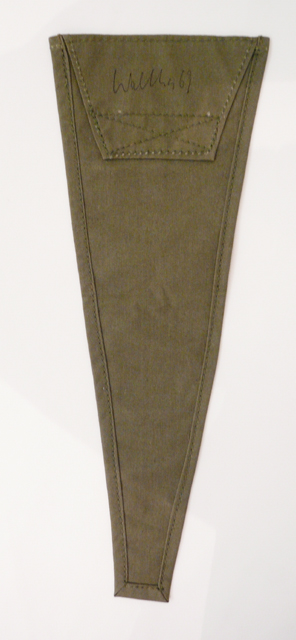
FRANZ ERHARD WALTHER, Find a purpose for the pocket, 1969
ca 37 x 13,5 cm
canvas shaped pocket
unlimited edition stamp signed, dated
condition: good, slightly discoloured
published by Vice-Versand, Remscheid, Germany
€ 1.450,- + € 18,- Track & Trace registered mail
inv. FEWal 27
Here the older and smaller version with stamped signature and date is shown. Franz Erhard Walther began making objects (…the work as a tool…) of fabric that invite the viewer to become active. Here a loop sewn onto the verso enables one to wear this triangle shaped pocket on a belt.
There are two versions: one with stamped signature and dated ’69 and one without. Apparently at some point not all editions were stamp signed and dated.
This work may be found with various titles like ‘Find a reason for this pocket’ or ‘Find a purpose for the bag’. In 1969 Wolfgang Feelisch advertised the multiple as “Find a purpose for the pocket”.
‘Multiple: Segeltuch in Dunkelgrün, genäht zu einer trapezförmigen Tasche mit Lasche, unlimitierte Edition; ca. 37 x 14 cm. Edition des Vice-Versandes. Schneider V 43; dort fälschlicherweise als “stempelsigniert” angegeben.’
From website dd 26 march 2024 of Artax Kunsthandel, Düsseldorf, Germany
History of prices:
Alternateprojects.com, US$ 1,800.- 19 August 2021 (stamp signed)
Alternateprojects.com, US$ 1,800.- 16 April 2020 (stamp signed)
Van Ham Kunstauktionen, Cologne, Germany € 400,- (hammer price) 24 October 2019 (stamp signed)
Karl & Faber, Munich, Germany € 500,- (excl. VAT) 6 December 2018 (stamp signed)
Grisebach, Berlin, Germany € 400,- (hammer price) 29 November 2014 (stamp signed)
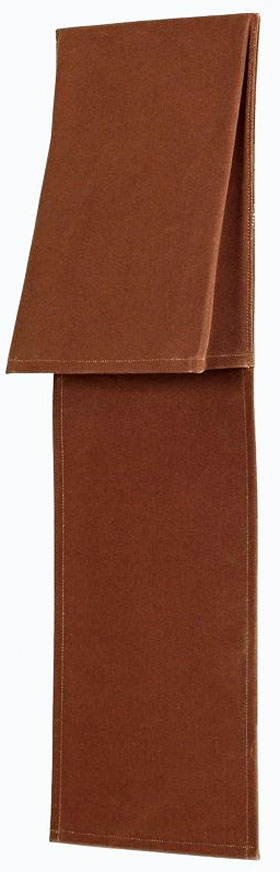
FRANZ ERHARD WALTHER, ‘Sockel: Hand und Arm unten’, 1969
59,3 x 19 x 2 cm / 23 3/8 x 7 ½ x 0 6/8 inches
hand sewn fabric
edition 20
signed, dated, numbered on technical drawing as work certificate (A4 size)
not available
The pedestal or ‘Sockel’ to be actively used by the viewer is a central concept in Franz Erhard Walther’s work. During the 1960s Franz Erhard Walther produced a series of 58 sculptural objects that were collectively titled ‘1. Werksatz’ (trans. “First Set of Works”). The earliest of these, ‘Stirnstück’ (trans. “Forehead Piece”), 1963, involved using the front of the head to slide a strip of maroon velvet down a wall. The works in the 1. Werksatz series explicitly tackle the relationship body versus sculpture, also dragging in the problem of the pedestal. Here ‘Sockel, Arm und Hand unten’ (1969) is next to being a title basically an instruction for using the piece as a pedestal. Not only meant physically as Piero Manzoni anticipated his ideas with his ‘Magic Bases’ (1962), namely conceived as a means of turning anyone who climbed onto them into a statue, but also as “a condition that produce a mental image”. The pedestal is a metaphor for everything that supports the human individual and upon which our own images come into being.