JOSEPH BEUYS
from “Rheinische Bienenzeitung” – Biene in der Kunst, 1975
offset print, folded as issued, Edition Verlag Constatin Post, Cologne, Germany
23,5 x 33 cm / 9 1/4 x 13 inches
edition 34 + several AP’s (here AP)
published by Edition Constatin Post, Cologne, Germany
mint, rare
Ref. Schellmann 152, p. 166
€ 690,- plus € 18,- Track & Trace EU registered mail
inv. JBeuys308
Coll. Harvard Art Museums/Busch-Reisinger Museum, The Willy and Charlotte Reber Collection, Louise Haskell Daly Fund, Cambridge, MA, USA
MAN RAY, Self portrait, 1974
69,7 x 99,5 cm
offset, triptych
folded for mailing as issued
publisher Studio Marconi, Milano, Italy
sculptural poster as self portrait designed by the artist
condition: three tiny wears in center due to folding as sent
uncommon, not mentioned in the Junko and Teruo Ishihara collection
(excluding handmade wooden reader’s desk)
€ 180,- plus € 12,- Track & Trace registered mail
inv.MRay 198-pr
In his fifties Man Ray shaved half his face for the above self-portrait. Francis Naumann has suggested that this act may have referred to Man Ray’s duel identity as an American artist with strong ties in Europe. He was living in Hollywood at the time he took the photograph in 1942, and would return with his wife Juliet to Paris in 1951 to spent the rest of his life.
This large triptych print was published as an announcement for a work called Autoritratto (23 x 18 cm), a signed and numbered photo edition of 23 copies – together with a biographical text and an archivist’s note in pencil with the name of the artist. Not discoloured copy!
History of price:
Studio Bibliografico Marini, Valenzano, Italy January 2026 € 200,-
Mouvements – rue Visconti, Paris, France January 2026 € 100 (verso repaired tear)
L’Arengario – Studio Bibliografico, Cellatica, Italy February 2025 € 250
Mouvements – rue Visconti, Paris, France February 2025 € 100 (verso repaired tear)
Casa d’Aste, Brescia, Italy February 2025 estimate € 200 – € 300
JESSICA STOCKHOLDER, Place mats, 2002
each 35,6 x 26,7 cm / 10 1/2 x 14 inches
pack of 100 double-sided paper place mats
offset
edition 1000
mint condition
published by The Renaissance Society / University of Chicago, Chicago, USA
inv.JStoc 299
History of prices:
Unoriginalsins.co.uk, Midlothian, UK June 2023 GBP 45.-
The Renaissance Society, Chicago, USA June 2022 US$ 30.-
Artware, New York, USA July 2016 US$ 40.-
The Renaissance Society, Chicago, USA January 2012 US$ 30.-
KRIS VAN DESSEL, Approaches, 2015-2016
5,3 x 8,4 cm
USB stick
numbered, monograph signed
certificate card, size:5,5 x 8,5 cm
edition 30
€ 300,- plus Track & Trace registered EU mail
inv.KvDe 000
“Approaches” is an interpretation of 115 art works that are part of the private collection of Kris van Dessel. From each work he took the most dominant colour and turned that into a plain monochrome surface that may be printed by the owner of the USB stick on standardized sheets of paper varying from size A4 to A0. There is no manual for the printing process. The artist gives the owner the freedom to have the prints machine folded into an A4 size, making it possible to store all prints in the cardboard box that comes with the edition.
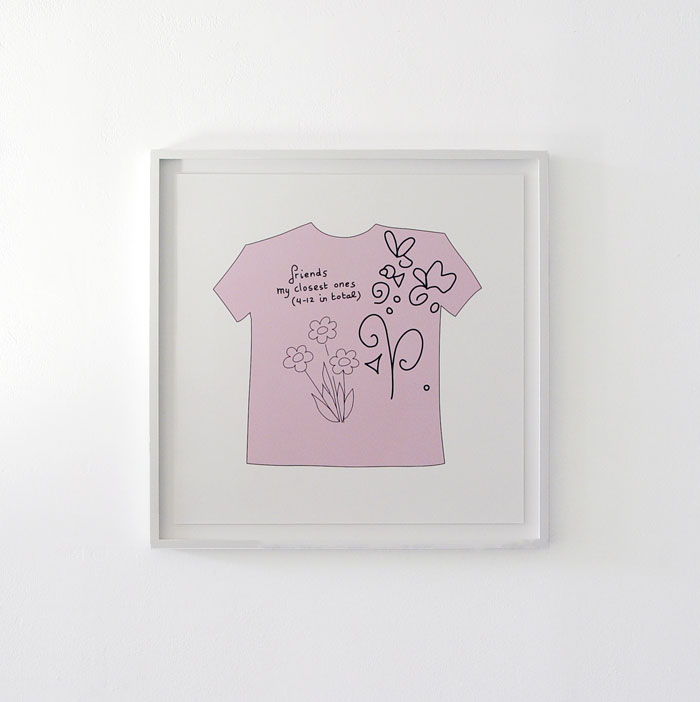
LILY VAN DER STOKKER, Friends my closest ones (4-12 in total), 2016
44 x 44 cm
digital print, unframed
signed, dated, numbered
edition 3 + 1 AP (56 x 56 cm)
€ 950,- ask for details
JONATHAN MONK, The Magnetism of Colour, 2016
94 x 68 cm
silkscreen print on 150 gas C-mat paper, set of 10 magnets on cardboard base
signed on sticker, numbered
edition of 25 + 5 A.P.
(does not include a vitrine)
published by More Publishers, Brussels, Belgium
This print comes with a set of 10 colored magnets to hang the print on. The edition is signed and numbered on a adhesive label, glued on the back of the package of magnets.
This edition is part of a so-called Public Poster Program initiated by the More Publishers in Brussels. The show cases they are presented in are on display in Belgium at MuZee in Ostend, MuhKA in Antwerp and KASK in Ghent. Each month a new poster is launched on the theme time and space. More info at link: http://www.morepublishers.be/series/260
Basically a set of ten colour magnets on a piece of white cardboard is offered, but Jonathan Monk’s edition would not be a (typical) Monk piece if he wouldn’t make a repetition by having it simply reproduced. And that’s what he did using a poster as a vehicle of that drive, so characteristic for his way of working.
OLA VASILJEVA (and Zelda Ivkovic), Counting Steps Edition, 2016
59,4 x 42 cm
silkscreen, pencil drawing, collage on paper
stamped and numbered by the artist
edition 10 + 5 AP (here number 10/10)
inv.OVas 812
In 2008 Ola Vasiljeva founded OAOA / The Oceans Academy of Arts, a magazine and poster format as an experimental platform that plays with ideas of experimental systems of looking and reading. The would-be institution presents itself as real and plays with its own illusive image as a stage for the artist’s reflections. The magazine OAOA aims to de-condition and to un-learn in relation to the critique of reason and common logics. The result is a visual input of no-sense, fragmentation, de-funtion and a-chronology. In this sense Counting Steps Edition may be understood and read.
DORA GARCIA, Performance / Respiración / Eco Oscuro, 2016
each 84 x 59,4 cm
silkscreen on offset print (250 g/m2)
edition 15 + 5 AP
signed, numbered
numbers 1/15 -10/15 are available as complete sets
published by More Publishers, Brussels, Belgium
Order at More Publishers, Quenest, Belgium
The edition was produced on the occasion of Respiración Artificial / Performance / Eco Oscuro in IVAM, Institute for Modern Art in Valencia (March 3 – June 19, 2016), an exhibition in three parts. The three prints derive from the different moments of the exhibition and hung in the rooms of the museum where the exhibition of Dora Garcia was held. The edition numbers 11/15 – 15/15 were individually sold.
History of prices:
More Publishers, Quenest, Belgium February 2025 € 700,-
More Publishers, Quenest, Belgium February 2022 € 800,-
DAVID HORVITZ, Studio Rent Editions, 2015 (rent for September)
10 x 25 cm
hand stamped and black-edged card
signed, dated, numbered
edition 10
published by the artist
inv.DHor 000-pr
GAILLARD & CLAUDE, after “Untitled, Gaillard & Claude 2015, plaster and speaker stand”, 2015
118,8 x 168 cm
digital print on Maco Mat, 150 gr.
large transparent plastic sleeve
signed, numbered
edition 12 + 3 AP
p.o.r.
Vinyl edition
GAILLARD & CLAUDE, Monkey Puzzle, le désespoir du singe, 2015
7 inch single / 45 rpm, 3’12”
hand numbered
edition 300